Author: Eleanor Chilvers

  • Why it’s time to alleviate the burden on HR teams

    Why it’s time to alleviate the burden on HR teams

    Managing employee benefits and insurance schemes can be a troubling issue for HR. Human Resources currently find itself encircled by a perfect storm of challenges some of which have been exacerbated by the pandemic and the cost-of-living crisis.

    In this blog post, we shine a light on three key elements which are impacting HR’s ability to manage employee benefits effectively:

    • The sheer scale of existing HR duties
    • The rising demand from employees
    • The complexity of employee benefits themselves


    Looking for ways to better manage employee benefits and insurance policies for your business? Contact our team at +44 (0)1273 974419 or click on the bottom right chat box for advice and support.


    Challenge #1: The sheer scale of HR duties

    HR duties will vary from company-to-company, but usually encompass a wide range of disciplines and responsibilities.

    • Recruitment and staff training
    • Improving the daily lives of employees
    • Improving the overriding company culture
    • Listening to staff concerns and providing solutions wherever possible
    • Acting as a conduit between the workforce and senior management
    • Establishing and maintaining relationships with staff
    • Ensuring employee records are maintained
    • Overseeing payroll
    • Keeping up to date with workplace legislation
    • Resolving workplace conflicts
    • Setting up, implementing, and maintaining employee benefits and reward schemes

    But if HR becomes overstretched, it stifles their ability to support the wider team – and everyone suffers. Sadly, this happens far too often. According to the 2021 State of People Strategy Report, 42% of HR teams cited emotional exhaustion and burnout as their top challenges.

    Employee benefits won’t receive the required care and attention if those responsible are overwhelmed. A layperson with limited time on their hands will be hamstrung in their ability to make the best choices and allocate budget in the most effective way or effectively review any schemes currently in place.


    Challenge #2: Rising demand from employees

    Today, there seems to be an ever-increasing pressure placed upon individuals’ physical, mental, and financial health.

    We call these the “three pillars of wellbeing”, each closely related and inherently linked to the other.

    When one pillar falls, the others tend to follow. The pandemic and current economic-social state have impacted all three, increasing the pressure on HR to find new and improved ways to provide the support they need.

    Let’s examine each one separately…

    Mental Wellbeing

    An apt summary would be to say that HR exists to ensure the right people are in the right jobs and performing to the best of their ability. No wonder they are widely considered the backbone of any company!

    While mental health was already a major issue pre-pandemic, there’s no doubt that the anxieties created by the presence of Covid, and the sense of isolation created by social restrictions, have exacerbated the problem.

    According to a study by MITSloan, more than three-quarters (78%) of workers said that the pandemic had negatively affected their mental health, with a similar number (76%) indicating that companies should be doing more.

    Meanwhile, meditation app Headspace has reported a 500% increase in interest from businesses trying to grapple with the mental health issue.

    Multiple surveys point towards the same trend – the demand for mental health support is increasing. HR will be the ones tasked with addressing this issue whether via employee benefits schemes or as part of their daily duties.

    Physical Wellbeing

    Nine in 10 employees selected ‘health’ as the top life priority in our survey – encompassing both personal health and family health. Meanwhile, private health insurance was employees’ third most desired workplace benefit (behind flexi and homeworking arrangements).

    In the first eight months of 2021, demand for private health insurance policies jumped by 46% compared with the same period in 2019, according to health insurance comparison site CompareNI.

    With concerns around NHS capacity issues, the employee demand for a safety net in the form of private healthcare is still high.

    Robert Smith, Sales Director at Freedom Health Insurance has observed this trend first-hand:

    “We have seen an increased interest in group health insurance since the pandemic here at Freedom Health Insurance. Due to NHS waiting times, corporate clients are looking for solutions that can help staff access medical treatment quicker.

    “From a business perspective, this could help with absenteeism and presenteeism rates, ultimately impacts the bottom line. But having this access to private healthcare through company policy while the cost-of-living crisis and the continued pressure on public medical services remains – is for many employees and their families a huge weight off their shoulders.”

    Financial Wellbeing

    In this difficult environment, HR is tasked with helping the workforce as best they can – not just via the day-to-day support but also via the employee benefits package they provide for staff.

    The rising cost of living has created financial difficulties for many. According to new research, over half of Britons (52%) are feeling stressed about their financial situation as the economic cost of global lockdown restrictions, the energy crisis and other factors begin to bite.

    Altogether, we are looking at a perfect storm of events which are challenging people’s mental, physical, and financial wellbeing. It’s clear to see how one impacts the other: financial difficulty can cause heightened anxiety and concern, a major downturn in mental wellbeing can itself lead to physical illness – and ill health can lead to loss of income.

    And let’s not forget the needs of HR themselves. At the height of the pandemic, a striking 90% of HR professionals said their stress levels had increased, while almost half (47%) said their stress levels had increased dramatically.

    While some of the anxieties surrounding the pandemic may have alleviated, times remain turbulent. HR is not immune to these forces and yet they are tasked with being the rock upon which colleagues can depend.


    Challenge #3: Complexity of employee benefits

    As readers are likely aware, employee benefits often demand vast amounts of time and attention from HR departments. This stems from the following factors:

    • Planning, sourcing, and implementing an employee benefits scheme
    • Ensuring every employee’s needs are considered and served in the most effective way
    • Managing policy claims with the insurer on behalf of employees
    • Introducing benefits to the workforce and demonstrating how to use them
    • Performing annual reviews to ensure schemes are providing maximum ROI


    Despite its complexity, busy HR teams are expected to manage employee benefits alongside all their other duties.

    The list of available workplace perks is almost endless and includes:


    Are you ready to provide the best support for employees and HR?

    With so many employee benefits available for tackling a broad range of employee needs, it’s no wonder that many workplaces are struggling to meet demand in the most optimal way. The problem for HR teams is that it further entangles them in administrative duties which rob them of the time required to do what they do best – cultivate a happy and productive workforce.

    Instead of shouldering the burden, HR is best advised to offload it to experts in the field of workplace benefit schemes. The Engage team offer expert assistance free of charge, advising on issues surrounding employee benefits and insurance policies. We source FREE quotes, help implement benefit schemes and will be there to advise on the claims process and renewals.

    Contact us at enquiries@engagehealthgroup.co.uk or call +44 (0)1273 974419 for FREE no-obligation advice and support.


  • International Essential Guides: Pre-placement Assessment

    International Essential Guides: Pre-placement Assessment

    Between 20% and 40% of international employee assignments fail each year, due to expatriates and their families suffering from physical, mental, or medical health problems or a lack of preparation and integration training for the host country.

    With such a high rate of failure still surrounding expatriate assignments and relocations, what can be done to prevent employees from feeling unprepared for this type of job opportunity?

    One very important process is pre-placement assessment, helping staff and their families to prepare for the changes they are having to face.

    Check out our need-to-know guide on pre-assignment screening and assessments.


    Need help finding the right international employee benefits and protection policies for expatriate staff? Contact our team of AMII-affiliated experts for FREE quotes and advice. Call +44 (0)1273 974419 or click on the bottom right chat box.


    What does pre-placement assessment mean?

    Pre-placement assessments also referred to as pre-assignment screening, is a thorough risk assessment undertaken by a business ahead of expatriate assignments. They are vital in boosting the expats chances of a successful international placement and ensure both a return on investment and the wellbeing of staff.

    The assessment can include the following:

    • Health Screening
    • Personal evaluation
    • Family support services
    • Measuring mental health e.g., depression, anxiety, post-traumatic stress disorder
    • Measuring current risk factors e.g., childhood trauma, adult trauma exposure, family risk
    • Resilience factors e.g., coping mechanisms, family/social support, healthy lifestyle

    The aim of pre-placement assessments is to inform expats and employers of any current health issues or social/external risk factors that can affect the success of the assignment.


    How does it work?

    Screenings and assessments vary massively depending on the specific nature of expat assignment. We have broken down the services on offer into four sections, each targeting a different aspect of preparing employees before travelling overseas.

    International health screening

    Travelling overseas for an assignment can lead many expats to suffer from health-related issues producing higher failure rates, further expenses on medical evacuation, and having to handle staff absence and replacement.

    Having a pre-assignment medical and health screening protocol will mean any unknown conditions will be flagged up and brought to the attention of both employer and employee. Following this, expats will then understand how to integrate within the local healthcare system in their host country, learning what’s available to them to help with any health conditions and how best to receive help once they have been situated.

    International health screening is usually conducted via an online system which reviews:

    • Employee’s current health
    • Availability and quality of local healthcare in the host country
    • Risks that might come with the type of work
    • Length of assignment

    All in all, these health screenings will predict, prevent, and prepare employees and their families before setting off on assignment and allow them to feel more in control if a health condition was to surface when overseas.

    Pre-departure preparation and evaluation

    This is all about helping businesses select the right candidates for an overseas assignment as not everyone will be suited to thrive in this working climate.

    This is established through a Management Selection tool which identifies personal and business risk factors for each shortlisted candidate. On offer alongside this service, businesses can include coaching and skill building to provide employees with tools and coping strategies to thrive even more when on assignment.

    Pre-departure family preparation

    Focusing more on family members and mental wellbeing is another important element of pre-placement assessments. These assessments are counsellor-led sessions which build awareness and the skills needed to handle difficult situations.

    Questions that are addressed could be:

    • What are the potential strengths and weaknesses the family have for the upcoming experience?
    • What are the potential problems?
    • What are the key skills that are needed to be successful in this venture?

    Family preparation helps employees to identify any vulnerabilities and coping strategies to prepare the whole family for the assignment, addressing re-location and cross-cultural adaptation.

    Destination services programme

    Our final variation on pre-placement assessments is all about getting to know the host location and what this means for the employee and their family. Providing extensive international knowledge allows for expats and their families to feel confident in their move and gives a logistical hands-on approach.

    Destination services programmes look at the following to make the transition as smooth and successful as possible:

    • An area orientation based off-of a preview trip to the host country/city
    • Assistance with lease and sales, and any other accommodation search
    • Assistance with any local necessities e.g., bank accounts, driving licence, local doctors, local dentist etc
    • Searching for and understanding local social systems in place e.g., the school system and registering children


    Why are pre-placement assessments so important?

    The average cost of an expat assignment is around £220,000 per year – this is a huge investment so ensuring assignees and their families are appropriately prepared are vital for business success. Physical and psychological factors must be considered when preparing a staff member for an overseas assignment.

    It’s a huge transition to begin living and working in a new place with different customs. Without the proper preparation and toolkit in place, the potential for a failed assignment is high. Pre-placement assessment is designed specifically to combat this, minimising potential risks, and set to achieve the most successful outcome for everyone involved!

    Below are a few extra reasons why offering a pre-placement assessment is important.

    • Employer duty of care: employers have full responsibility to ensure nothing happens to their assignees/expat employees, no matter the location
    • Visa requirements: for some host countries, specific medical checks are a requirement
    • Management of chronic illnesses:g., high blood pressure, diabetes, and cholesterol can be difficult to manage with no personal knowledge of available treatment
    • Employees voluntarily opting out of assignments: this can happen after discovering a health risk through assessments – will save the employer expensive emergency medical/repatriation costs further down the line


    The best route to seeking out help – the Engage International way

    The international employee benefits and health insurance market is a wide and varied one and can be off-putting when finding which policies or products are best going to help your staff. Pre-placement assessments are no exception! Outsourcing to an international health expert or specialist consultant removes any stress from the equation.

    Check out more international employee benefits here and see how else you can protect your international workforce.

    Engage Health Group has a huge global reach of partnerships across 50+ countries and territories, meaning our 14 expert staff members have the connections and international expertise to assess what it is you and your employees/assignees need for a successful transition overseas.

    Get in touch with one of our teams where we deliver the best advice and most competitive quotes on the market.

    Contact us at +44 (0)1273 974419 or use the contact form on the bottom right. We’ll help plan and deliver the best scheme for your business going forward on your international venture.


  • What’s next for digital healthcare? L&G reveals all…

    What’s next for digital healthcare? L&G reveals all…

    COVER Magazine posed the question ‘What’s next for digital healthcare?’ in a recent webinar hosted with Legal & General.

    The webinar explored the key factors currently impacting the digital healthcare space, including:

    • Personalised health approaches
    • Advancements in data and technology
    • The prevention of health risks
    • Support for long-term/chronic conditions
    • Interventions for mental health


    In this article, we’ve delved into the most interesting insights from this webinar, exploring how digital healthcare is in a constant state of growth and development, and what this means for employers and employees.

    Looking to invest in digital healthcare options and employee benefits? Contact our team of experts for FREE quotes and advice. Call +44 (0)1273 974419 or fill in the contact form on the right.


    5 things you should know about the future of digital healthcare

    “The digital arena is the arena in which we live and exist day-to-day – that is our everyday reality.”


    Digital healthcare has made big strides over the last few years, yet there is still more work to be done to ensure employee needs are effectively addressed.

    A panel of experts from L&G, Teladoc, and HCI tackled current developments in the healthcare and wellbeing arena.


    1. Healthcare must meet the needs of the “Netflix generation”

    There have been major changes within public and private healthcare as it has moved from an exclusively in-person model to one that increasingly utilises remote services. Virtual clinics and GP services are on the increase, and private healthcare packages can now provide multiple services within one digital platform.

    The acceleration of digital health services post-pandemic has moved everything up a step. Healthcare providers and services must be responding to this pace and ensure there are fully integrated approaches, so patients have a choice whether it’s via the NHS or through private routes.

    Even people with chronic and long-term health conditions (HCI) are increasingly able to benefit from digital support.

    A big part of the drive comes from consumer expectations. We now live in a world of smartphones, Spotify, Netflix, and constant access to just about everything you can think of at the touch of a button. Consequently, employees and clients have become more “consumerised” and expect fast-paced results or solutions. They will increasingly expect the same when it comes to health and wellbeing.

    2. Providing easy (and private) access is a must

    Digital healthcare makes a wider range of services more accessible, but it still needs to be signposted. Are they accessing the platform? Do they know how to access it? And do they know how to use it?

    There is still a stigma around many health conditions, so a platform that provides an individually tailored and confidential service is a big step forward. This means employees can gain direct access to the support they need, without needing to go through HR and management.

    But such services still need to be clearly promoted to employees. They need to know what’s available to them and how they can use it. That could mean giving bespoke tutorials on how to use the platform, for example. Also, the simple matter of providing health services under one easy-to-access platform is vital – too many platforms and access points are likely to lower uptake.

    Health and wellbeing can sometimes be an exploratory process. Having a digital portal enables employees to find their most trusted provider and access a range of services. Knowing that access to a healthcare provider is private and direct bypasses a barrier which too often stops people from seeking help.


    Digital healthcare platforms are often provided within Business Health Insurance policies. Find out how it knits together by contacting our expert team of brokers at Engage Health Group. Call +44 (0)1273 974419 or fill in the contact form on the right for FREE guidance.


    3. Technology can support new “health empowered” employees

    A perk of digital healthcare is how it promotes self-management and care when it comes to individual health. It can make clients feel more in control of their health. For example, if they know which service they require, they can quickly access it – all on their own terms. This enables them to engage as informed consumers/patients.

    People-centred healthcare using multi-disciplinary teams gives a truly holistic, individually tailored patient/employee experience and boosts the overall quality of life. The digital arena supports patients in their role as active participants, empowering employees to take an interest in their own health and wellbeing.

    4. Data-driven healthcare will improve outcomes

    Confidentiality and data usage are other major topics covered in the webinar. Quality assurance and confidentiality have always been important in any healthcare service. However, digital healthcare constantly monitors and uses data from its platforms to create successful evidence-based services.

    Interestingly, HCI offers a service where patients can capture and record their own health experiences to track their symptoms or general health and wellbeing. This record is patient-held, meaning it goes no further than the platform and the individual. It enables visibility, better self-management of health, and provides an insightful tool for progressing to the next step.

    5. Personalised experiences are key

    Landing on a fully personalised experience is THE aim of digital healthcare. It’s all about supporting the health journey of every individual employee.

    The expert panel referred to all the factors of a patient’s life as their “individual system”, which includes family and employer-employee dynamics. Recognising the employee’s needs in their individual system means supporting their families and loved ones as well.

    A great analogy that the panellists used to capture this reality was that nobody’s “homepage” is the same. Just as a homepage on Netflix or Spotify would capture the different elements of your life – family members, favourite shows, favourite songs – so must your digital healthcare portal.

    Having easy access, availability, and flexibility to create a personalised experience is vital to getting the best care for your employees.


    Looking for independent advice?

    The future of digital healthcare is a fascinating topic – and it was great to hear the views of industry insiders. It’s also encouraging for those businesses seeking the most effective way of supporting the health and wellbeing of their workforce.

    So, how do businesses make the most of the opportunity it offers?

    There is no one way to get started with digital healthcare, but we would always recommend getting expert advice. Digital health support is often provided within Company Health Insurance policies but can also be purchased separately.

    By speaking to an AMII-affiliated broker like Engage Health Group you can get independent advice on how best to navigate the world of employee benefits – and get FREE quotes in the process.

    Contact us at enquiries@engagehealthgroup.co.uk or call +44 (0)1273 974419 for FREE no-obligation advice and support.
  • What can an international benefits consultant do for your business?

    What can an international benefits consultant do for your business?

    In general terms, an international benefits consultant specialises in helping companies negotiate the international employee benefits and health insurance market.

    Some businesses may require end-to-end assistance, going all the way from developing a benefits strategy to implementing and introducing policies across the business. Other companies may just want assistance on a specific issue, such as help in finding a suitable International Health Insurance scheme at a competitive price.

    The job of any good global consultant is to help clients establish what they need under one manageable scheme – and act as a single point of contact for all their policy questions. The end goal is always to provide the best protection and support to employees in the world, in the simplest and most effective way.

    Need help setting up or reviewing an international employee benefits plan? Contact our team of AMII-affiliated experts for FREE quotes and guidance. Call +44 (0)1273 974419 or click on the bottom right chat box.


    What services does an international benefits consultant provide?


    1.Advises on the full raft of international employee benefits, including:

    International Group Health insurance

    • Gives employees access to private healthcare in multiple countries around the world
    • Provides more comprehensive coverage than available in typical health insurance plans
    • Remember, some countries (for example USA, UAE and Saudi Arabia) require businesses to provide private health insurance for their employees as a condition for visas.

    Learn more about International Group Health Insurance

    International Group Income Protection:

    • Provides financial support to an employee should they fall ill anywhere in the world (exceptions applying).
    • The company decides how large the insurance payout will be (up to 80% of the employee’s wage)
    • Particularly good at providing peace of mind for expat employees and their families

    Learn more about International Group Income Protection

    International Group Life insurance

    • Provides financial support to a team member’s loved ones, situated anywhere in the world, in the event of their death.
    • The policy still applies if they move from one country to another.
    • Immediate family members can also be added to the policy

    Learn more about International Company Life insurance

    International Employee Assistance Programmes

    • These digital platforms provide staff with a toolkit to support their general emotional wellbeing
    • Provides practical health and wellbeing support e.g., counselling services, financial advice, stress support and more.
    • Multi-lingual support ensures your team can get appropriate support, whatever their language

    Learn more about Global Employee Assistance Programmes

    Pre-assignment screening

    • Designed to check whether an employee is suitable for an overseas assignment
    • Includes health screening, personal evaluation and family support services
    • A specific requirement for certain industries, such as Oil & Gas, Aviation and Maritime.

    Learn more about pre-assignment screening

    Other products which an international benefits consultant may be able to advise on include:


    2.Search for and provide the best quotes

    A good international benefits broker, like Engage Health Group, will scour the whole insurance market for the best policy, rather than be tied to any one provider. Indeed, they will usually be able to source better deals than are available publicly. This is because providers can attract repeat business from a broker if the price and terms are right – making the insurer bend that little further backwards to provide a competitive quote!

    But it’s not just about insurance schemes. We also provide quotes on Employee Assistance Programmes, digital benefits platforms, corporate wellness schemes, health screening services and much more.


    3.Implementing the scheme

    International benefits consultants can also assist with the practicalities of implementing the scheme. This might include:

    • Communicating with employees and different business divisions via remote or in-person presentations
    • Providing written guidance and promotional materials
    • Advising on digital platforms to better implement the scheme
    • Answering ongoing queries


    4.Claims and policy management

    A good consultant will help with any disagreements that arise with the insurer. For example, if a claim is turned down, we can help assess whether you have a case and, if so, raise it with them on your behalf. We’ll also provide an annual review to check whether it’s worth switching to a different policy or provider to gain better value for your business.

    “They went out of their way to provide us with the best quote and negotiated with our current provider, they managed to increase our level of cover and drop the cost. They provide support during the change over to the new policy and came to our office to do an all-company presentation explaining how to get the best out of our cover” – Europe/New Zealand/Australia, 60 employees, Global IT company

    Check out more of our client testimonials here.


    How do international benefits brokers help your business?

    Partnering with a global benefits consultant aids businesses in the following ways:

    • Alleviates the burden on HR as they can outsource the workload to an independent expert
    • More cost-efficient as they’ll keep you from paying for separate national policies
    • Provides peace of mind that your benefits are being taken care of in the most efficient way possible – and no paying over the odds
    • Offers on-tap access to insider knowledge – helping you navigate the complexity of international rules and regulations
    • Ensures consistency across your workforce – every global employee receives access to the same level of benefits through a harmonised scheme
    • Provides help with setting up, implementing and communicating the new benefits scheme


    International consultancy in action

    As international benefits specialists, we’re accustomed to working with businesses which have a global footprint. For example, we planned and launched a global benefits scheme for a company which had over 1000 primary policyholders across Europe, the USA, and South America. It was a complex undertaking, but we were able to achieve the best possible outcome for them.

    Our International Director, Ian Abbott, explains the process:

    “For this specific customer, we broke their needs and requirements down into simple steps to see what was needed and where. Having a detailed understanding of the countries their employees are based in, and the health condition of their employees, we could create a plan that best fits with the company’s strategy. We helped the client manage their cover under one policy, making even their far-reaching employees protected under a simple and accessible plan.”

    The key is simplicity. Without a keen understanding of how to piece together an employee benefits scheme tackling the needs of employees working in different parts of the world, it gets very confusing, very quickly.


    How much does a consultant cost to your business?

    There is no extra cost to either to your business if you employ the consultants at Engage. Our team of experts offer advice and quotes for free, so always be wary of brokers that charge for their services.

    So, where do we get our money from? We are remunerated by the insurer partners and providers we work with, meaning you get expert advice, full market reviews, and peace of mind at no extra cost.


    Engage International can help

    Sifting through and understanding the international employee benefits market by yourself will be a complicated and stressful process for any HR professional. Outsourcing the legwork to a specialist consultant like Engage alleviates the strain.

    Engage Health Group has a large reach of global partnerships across 50+ countries and territories, which means we have the connections and expertise to deliver the best advice and most competitive quotes available on the market.

    If you’re looking to set up or review an employee benefits scheme for your global business, then get in touch with one of our teams for a FREE consultation. We’ll help plan and deliver the best scheme for your business at no extra cost to you.

    Contact us on +44 (0)1273 974419 or use the contact form on the right.

  • Which is the best International Health Insurance company?

    Which is the best International Health Insurance company?

    Every International Health Insurance provider offers a range of plans and price points which target different types of business customers. Whether you’re an SME looking to protect your growing workforce of global employees, or a large corporation looking to protect high-net-worth individuals around the world; there’s a policy designed for you.

    But is there one provider which we’d recommend above the rest?

    To be honest, it’s not that simple. The best solution for you will depend on the exact requirements of your business, the scale of your international workforce and the spending power you have at your disposal.

    In this blog post, we’ve listed nine of the best International Health Insurance companies operating in the market today. It’s designed to provide you with a valuable overview of the different providers to help you understand what’s available today.

    Need one-to-one advice from an independent broker? Contact our team of AMII-affiliated experts for FREE quotes and guidance. Call +44 (0)1273 974419 or click on the bottom right chat box.

    Top 9 Global Health Insurance Companies

    1. April International

    April International has been in the market for over 40 years now with over 150,000 insured members across 180 countries, 260 global employees, 20,000 distribution partners, and 12 offices worldwide. Their support for both SMEs and larger corporates are three-fold: long-term health insurance, short-term health insurance, and student health insurance.

    Products/services include:

    • Medical expenses
    • Repatriation assistance
    • Private civil liability
    • Death and disability
    • Security
    • Retirement
    • International health insurance for SMEs and large corporates
    • Specific regional solutions
    • Case management

    2. Allianz Worldwide Care

    With more than 130 years of service for international organisations under its belt, Allianz Worldwide Care is a vastly experienced outfit. They are based across Europe, the Middle East, Australia, Asia, the Americas, and Africa with a network of 1.3 million providers and partners.

    Products/services include:

    • Digital access to care resources/platforms
    • Global telehealth services
    • 24/7 multilingual helpline
    • 3 different health insurance coverage plans – Essential, Classic, Premier

    3. AXA Global Healthcare

    Headquartered in France, AXA Global Healthcare is one of the top life and health insurance companies today. AXA Global now has over 1.4 million medical facilities worldwide, a medical network spread across nearly 150 countries, and 88% of its claims are paid in just 3 days.

    They offer three options of cover for different-sized companies, simplifying the process of finding an appropriate level of cover:

    • Cover for 1-74 employees
    • Cover for 75-149 employees
    • Cover for over 150 employees

    > Further reading: A broker’s review of AXA Global Healthcare <

    4. Bupa Global

    Bupa Global is a UK organisation, with bases now spread across Australia, Europe, Latin America, the Middle East, and Asia. They were established in 1971 and have grown to work with over 1.2 million medical providers, helping over 38 million customers.

    Bupa Global provide customers with products and services to access the international healthcare they require anytime, anywhere in the world, advising through their global team of experts. Now partnered with GeoBlue, these two organisations also offer health insurance coverage to US citizens travelling abroad or any person moving to the US.

    Bupa Global’s “Ultimate Health Plan”, has long been considered the most extensive in the market which makes it well-suited to high net-worth individuals.

    5. Cigna Global

    Spanning across over 200 countries and territories with a global network of 1.5 million healthcare providers, Cigna Global is another huge successful option for international healthcare and support. They have more than 60 years of experience in the market, constantly designing and managing International Group Health Insurance and employee benefits plans for their over 180 million global customers.

    Products/services include:

    • EssentialCare – simple and flexible international health cover
    • ExecutiveCare – comprehensive international health cover offering enhanced core cover
    • EliteCare – premium international health cover
    • Offers modular and flexible options to personalise any plan

    Are you looking for FREE quotes on International Health Insurance tailored to your business? Click the ‘Get Quotes’ button at the top of the page or call 01273 974419 for impartial expert assistance.

    6. Now Health International

    Now Health International is a provider based in Hong Kong with regional service centres in Hong Kong, Shanghai, Dubai, Singapore, Jakarta, Malta, and the UK. In 2015, they acquired Best Doctors Insurance (a major medical insurance provider) with distribution throughout Latin America, Canada, and the Caribbean. The combination of both providers created one of the largest independent IPMI providers worldwide with 125,000 members, more than 370 staff members, and over 5,000 distribution partners.

    Products/services include:

    • Micro group health option (3-9 employees)
    • Mini-group health option (10-24 employees)
    • Small group health option (25-49 employees)
    • Medium group health option (50-99 employees)
    • WorldCare – members have access to the best healthcare both at home and overseas
    • SimpleCare – offers vital health protection and access to world-class medical facilities at an affordable price

    7. William Russell

    Entering the market in 1992 as part of the AWP Health & Life SA (Allianz Group), William Russell is growing at a successful rate now with a network of 40,000 hospitals worldwide, 75 employees, and members in over 160 countries. William Russell’s cover options and health insurance plans are available to any expats wanting to live and work anywhere in the world, aside from USA and Switzerland.

    Products/services include:

    • Bronze health insurance plan
    • SilverLite health insurance plan
    • Silver health insurance plan
    • Gold health insurance plan
    • Cover for up-to-date cancer care and treatments, including providing wigs, counselling, dietitian consultations and more

    8. UnitedHealthcare Global

    Emerging from UnitedHealth Group in 2014, UnitedHealthcare Global aims to support globally mobile groups through a range of solutions targeting long and short-term assignments, individual travel, assistance and security services, and medical services. In the US, UnitedHealthcare Global is contracted with over 1.2 million physicians/care professionals and 6,500 hospitals/care facilities.

    Products/services include:

    • Domestic and international benefits plans
    • Customisable assistance, security, and intelligence services to meet specific needs of global businesses
    • Remote medical services for extreme/challenging locations – on-site staffing, supplies, and virtual health support

    9. Global Benefits Group

    Global Benefits Group has over 40 years in the market distributing and underwriting international health, life, disability, educational, and travel insurance on a global level. They have offices in Serbia, California, India, South Africa, England, the Philippines, Florida, New Jersey, and China.

    Products/services include:

    • Ability to tailor benefits to create your ideal plans e.g., low deductibles, robust benefits or increased deductibles, reduced benefits – according to budget and business need
    • Partner with local insurance companies, meeting with specific country regulations

    How do I find the best health insurance policy?

    There is no one right answer as to who is the best International Health Insurance company. As we’ve already mentioned, it really depends on the precise nature of your business, the different territories you’re operating within and the budgetary power you’re able to wield.

    We strongly advise that you speak to an independent broker with expertise in the international employee benefits market. Engage Group Health is just such a broker.

    If you contact a member of our team, we’ll give you the chance to ask all the questions you’ve ever wanted to ask about International Health Insurance and other related topics – cutting the time you would otherwise spend researching online. We’ll then advise on the best policies currently available on the market and deliver a range of quotes FREE of charge.

    Engage is fully independent of any one insurance provider, meaning we can give you completely impartial advice in your best interest.

    To kickstart your search, contact us at +44 (0)1273 974419 or use the contact form on the right.

  • Confused about workplace pensions? We’ve got 5 handy tips to help

    Confused about workplace pensions? We’ve got 5 handy tips to help

    A guest blog written by Oliver McDonald, Director of our sister company – Engage Wealth Management. Read on for insights on workplace pensions. 


    Workplace pensions haven’t always been given the attention they deserve but the approach to financial wellbeing and growth is changing for the better. With the gradual move away from the old ways of Defined Benefit pensions to Defined Contribution pensions, more and more employees see their responsibility and control over their pensions and retirement grow.


    The gradual introduction of Auto Enrolment in 2012 helped bring pensions to the forefront of employers’ and employees’ minds. However, in recent years new trends have emerged:


    • Employers are setting up the basic option and hoping this will be enough


    • Employers addressing the pension once, rather than continuously reminding staff about the importance and their options


    • Employees have become more knowledgeable – it is often the case that companies seek help as they have been challenged by staff. Existing staff, or even during interviews, ask why the company only offers a ‘basic’ pension option.


    Pensions provide valuable support to you and your employees for when they reach retirement. However, a company pension scheme isn’t just a one-time thing. A workplace pension is now seen as a core employee benefit, and improvements must be made to attract and retain quality staff.


    What does the regulator say?

    Automatic enrolment is a continuous responsibility – your duties do not end after your duties start date.

    The Pensions Regulator expects employers to ensure staff receive good value for money with their workplace pension scheme.

    In this blog, I’ll explore five ways employers can improve their workplace pension scheme in the UK.


    Are you looking to set up the right support and employee benefits for your teams? Contact us at enquiries@engaghealthgroup.co.uk or call +44 (0)1273 974419 for FREE no-obligation advice and support.

     

    1.Increasing employer contributions


    This may seem obvious, but most schemes we encounter still contribute the minimum – for both employer and employee. The minimum contributions for auto-enrolment are 8% total, of which 3% must come from the employer.

    So, we see most schemes set up on 5% employee and 3% employer contributions. These contributions are the minimum. Like anything in life, putting in the minimum effort will provide poor results.

    If you want to improve your employees’ future retirement and retain/attract staff, increasing the employer contribution is a great way to achieve this.

    How much is up to you? Some employers offer matched contributions up to a certain percentage or higher contributions for senior staff members.


    2.Changing provider


    We’ve seen a lot of companies start out with basic options. The National Employers Savings Trust (NEST) was set up to accept any employer with 1 employee or more. The People’s Pension is also a popular option.

    Whilst these providers tick a box, they have their limitations.

    Searching the market for a more comprehensive option could be a great way to show your employees how you’re taking their future seriously. Some of the benefits may include:


    • Reducing fees for your staff


    • Introduction of Salary Sacrifice


    • A wider investment choice


    • Full retirement options


    • Greater technology to improve employee engagement


    Changing providers is not as complex as it seems, especially when using a workplace pensions expert like the team at Engage Wealth Management.


    We help employers every step of the way and ensure a smooth transition to a better workplace pension scheme. Check out our workplace pension offering for more information or get in touch at hello@engagewm.co.uk


    3.Changing the way your contributions are calculated


    A slightly technical area but incredibly important. When setting up a workplace pension scheme, employers can choose to base contributions on three options:

    • Qualifying earnings: Contributions are based only on pay between £6,240 & £50,270 (2022/23 tax year)


    • Basic Salary: Contributions are based on employees’ basic salary


    • Total Earnings: Contributions are based on employees’ total earnings, including overtime and bonuses.


    Clearly, qualifying earnings are the least generous. Many companies begin with qualifying earnings and minimum contributions to cover the legislation. This is fine, but once a company grows rapidly, it must seek ways to improve employee benefits, including pension contributions.

    Basic Salary is the most common method, with only a few employers implementing total earnings from our experience.


    4.Salary Sacrifice / Salary Exchange


    Salary Sacrifice is a way of contributing to an employee’s pension before they are taxed. This benefits both employers and employees in several ways:

    • Employers pay less National Insurance: Employers can then choose to retain this saving or kick the saving back to employees as an additional contribution.


    • Employees pay less tax and National Insurance: The employee is effectively being paid a lower salary. Therefore, the tax and National Insurance savings will increase their take-home pay. Employees might choose to contribute the additional saving to their pension scheme.


    • No higher rate tax relief claim: Under the standard relief at source method on pension contributions, higher rate taxpayers must claim higher rate tax relief through their annual self-assessment. Although they can backdate their claim, many people miss out on this ‘free money’ from the government. With Salary Sacrifice, employees receive tax relief at their highest marginal rate immediately, so there is no need for claiming through self-assessment.


    There may be drawbacks to Salary Sacrifice, and employers are effectively changing an employee contract. At Engage Wealth Management, we help employers communicate these changes and provide the appropriate letters to change contracts. However, it is sensible for employers to seek legal advice before changing to Salary Sacrifice too.

    This Salary Sacrifice calculator from L&G is an excellent tool for employers and employees.


    5.Ongoing support to employees


    Employing the service of a workplace pensions expert can be a great way to demonstrate additional value to your employees. Popular features include ‘pension surgeries’ and 1-1 meetings.

    By employing the services of an expert, your staff have access to them throughout the year for high-level questions. The most common discussions are around increasing employee contributions, consolidating old pensions, and looking at investment fund options.

    We also make it clear that our service is an additional employee benefit, provided to staff at the cost to the employer.

    Being independent financial advisers, we can also provide in-depth individual advice to employees at their cost. This may include more serious retirement planning, investing a windfall or protecting their family with insurance.


    If you’re a UK employer, how can you improve your employees’ pension and incentivise more engagement? Try some of the ideas above – it might help your staff save for retirement.


    Contact our friendly team of experts for FREE quotes and advice. Call +44 (0)1273 974419 or click on the bottom right chat box.


  • Are you ready to invest in a corporate benefits platform?

    Are you ready to invest in a corporate benefits platform?

    After Blenheim Palace announced the launch of its own employee benefits platform last month, we felt it was an apt time to explore the topic in more detail.

    In this blog post, we list some of the common features of corporate benefits platforms, outline the key benefits they provide and list six leading platforms currently serving UK businesses.

    Can they deliver on the promise of simplifying the provision of employee benefits and rewards for HR teams? Read on to find out.

    Looking to invest in an employee benefits platform to provide the best support to your staff? Contact our team of experts for FREE quotes and advice. Call +44 (0)1273 974419 or click on the bottom right chat box.


    What are corporate benefits platforms?

    Corporate benefits platforms are digital spaces giving staff access to employee benefits via a mobile app or desktop platform. In this digital space, employees can sift through the different perks on offer, enrol themselves on the benefits they most want and utilise a range of wellbeing tools.

    The process of administering benefits is made a lot easier for HR teams as the system is largely self-managed. It’s also much easier to provide a choice of perks to your teams. This means you can successfully address their different interests, life circumstances, health requirements, and priorities.

    Below we have listed a few extra positive outcomes of employee benefits platforms:

    • Staff feel more in control and involved in the decision-making process
    • Less time-consuming for management and HR
    • Organises administrative documents and processes in one easily accessible area
    • Saves valuable time and money by lightening the load off HR – energy can be directed towards other responsibilities such as staff training and development
    • Employees gain access to a wealth of knowledge on the employee benefits market, allowing them to understand in more detail how their chosen benefits can be used
    • Many benefits platforms can be synchronised with payroll and other HR services

    How do employee benefits platforms work?  

    Each platform has its own distinct features and functionality, but they typically include:

    • Staff discounts/deals
    • Health and wellbeing support services
    • Health insurance management options
    • Pension schemes management tools
    • Employee Assistance Programmes
    • Holiday entitlement management tools
    • HR communication tools
    • Payroll integration
    • Employee rewards and recognition services

    It’s important to remember that HR has full control over what’s offered, and features will vary depending on your chosen platform and package.

    As employee benefits brokers, we often advise companies on how best to synchronise their platforms with different insurance products and services – making sure that everything’s hooked up to provide maximum value.

    If you’d like FREE one-to-one advice, call us on +44 (0)1273 974419 or use the contact form on the right.

    6 leading corporate benefits platforms in the UK

    There are scores of benefits platforms vying for your attention. It can seem daunting to pick one out of the many! Here, we have provided a brief breakdown of six leading platforms in the UK.

    ThanksBen

    ThanksBen prides itself on being a flexible platform, enabling staff to set their own budgets selecting the benefits they most want. It’s mainly aimed at small to mid-range businesses, but the features offered are continuing to expand, allowing it to grow with the needs of its clients. ThanksBen also includes payroll integration alongside the usual benefits management capabilities.

    Reward gateway

    Established in 2006, Reward Gateway has almost 2000 customers. Due to their target businesses being predominantly larger organisations, Reward Gateway are great for complex needs catering for a wide range of staff priorities and requirements. Customers are particularly fond of its automated employee recognition platform.

    EdenRed

    EdenRed serves more than 10,0000 businesses and has 35 years-plus experience in the field. The platform is rich in features making it a good match for large businesses with complex needs. They are well-known for helping businesses build more connected teams whilst specialising in high-value perks, incentives and rewards, and expense management tools.

    Perkbox

    Renowned for its global capabilities, Perkbox is another fast-growing provider now used by over 7,500 businesses. As an employee benefits and rewards platform, Perkbox provides leading HR integration features, driving efficiency and boosting clients’ communications capabilities. This platform brings together employee benefits, wellbeing, and recognition/rewards.

    Avantus Employee Benefits

    Known by many by its former name, Fair Care. Since launching in 2005 as a specialised salary sacrifice service, Avantus has come a long way. It now provides a wide range of HR functions and employee benefits – with different packages adapted to different business needs. Its FlexGenius module also allows businesses to publish or update policies and documents and make them accessible to the team via the platform.

    Zest

    With an impressive client roster which includes Aviva and Travis Perkins, Zest promises to be the perfect partner for any employee benefit scheme. Usability is at the heart of what they do, with a setup of fewer than two hours! All the usual features you’d expect are here: personalised benefits & reward schemes, payroll reporting, employee usage stats, communication tools and much more.

    Frequently asked questions

    Here are just a few of the questions we’ve previously been asked about corporate benefits platforms:

    • Is the upfront cost really worthwhile? Usually, yes. It saves HR huge amounts of time by automating tasks and allowing team members to efficiently manage their own perks. But it also allows employees to get the benefits they most need, which will be of mutual benefit to business and employees – healthier, happier employees will be more present and productive in the workplace.
    • Can current benefits be transferred? Investing in a new corporate benefits platform doesn’t mean you have to start from scratch. It’s possible to transfer any current policies and benefits into the new system.
    • Are platforms available for different business sizes? Absolutely, from start-ups to large corporate institutions, there is a solution for every type of business. They can be as straightforward or as advanced as required, serving a small UK workforce or large global employee base.
    • Will it bring an end to one-to-ones? We’d hope not. These platforms may have features which allow for the gathering of feedback and usage stats, but in-person conversations still matter. Whether it’s related to employee benefits or the general workplace experience, there’s nothing that beats a one-to-one conversation.


    Get expert advice

    When there are so many corporate benefits platforms to choose from, it can be difficult to work out which one provides the best solution. Your business is always evolving and the way people work is constantly shifting – especially with the recent growth of remote and hybrid working possibilities which has driven an upward trend in global workforces.

    To help with this process, the best plan is to first speak to an AMII-affiliated broker and get independent advice on which platform and range of benefits will provide the best fit. At Engage Health Group Ltd, we take the time to understand your business and answer all your queries. Based on our conversation/s, we’ll source quotes tailored to your business – all FREE of charge.

    Contact us at enquiries@engaghealthgroup.co.uk or call +44 (0)1273 974419 for FREE no-obligation advice and support.

  • How does health insurance excess work?

    How does health insurance excess work?

    There are many factors that influence the cost of a health insurance policy. But one factor that’s often overlooked is the ‘excess’ – and it can make a big difference to premiums.

    So how does health insurance excess work? And is it best to raise or lower it for you or your business? We’ll answer these questions and more in this blog post.

    Looking to set up a health insurance policy for your organisation? Contact our team for FREE quotes & one-to-one guidance. Call +44 (0)1273 974419 or fill in the form on the right.


    What is health insurance excess?

    Quite simply, health insurance excess is the amount you will pay out of your own pocket towards a treatment (or consultation) before the actual insurance payout kicks in. When first applying for a health insurance policy, the insurer must establish whether you’re going to add excess – and if so, how much. This excess amount can be set up as zero (where the insurer will meet 100% of medical costs) or up to £5,000, depending on your own requirements.

    But remember – the higher the excess, the lower the premium. This can make for a tricky cost-benefit analysis!

    How does paying for excess work?

    To get a health insurance quote, you will need to choose an excess amount as this will impact the overall cost of your cover.

    The most common way of paying excess is to pay it upon each claim. For example, if you require treatment which costs £2000 and you’ve agreed on an excess amount of £200, then you will need to pay that £200 and the insurer will cover the £1800 that’s leftover. In this case, every time you make a claim, the same excess is due. As you can imagine, the costs can mount up.

    Alternatively, an insurer may require you to pay an excess once per policy year – this means your excess payment goes towards your first treatment and you won’t have to pay any more excess regardless of how many claims you make.

    If you are likely to make multiple claims per policy year, then the latter option will likely be best. Therefore, before choosing a payment option it’s worth considering how often you are likely to claim.

    How do you choose the right health insurance excess amount?

    When first assessing health insurance excess, most people are aiming to keep their premiums low – one way to do this is by choosing a high voluntary excess. However, this is not a one-size-fits-all situation – some people will prefer to make a greater initial investment safe in the knowledge they won’t need to make any unplanned payments later on down the line. A sudden extra cost at short notice may come as a nasty surprise!

    Keep in mind, that at policy renewal you have the chance to change your mind. If you need advice about excess levels or any other aspects of your Business Health Insurance scheme, then it’s worth speaking to the team at Engage Health Group as we’re an independent broker who can provide genuinely impartial advice – for free.

    Why is health insurance excess so important?

    Establishing the right level of excess can significantly impact your premiums. Although you are paying towards healthcare costs, it’s often the best way to save money on premiums without compromising the level of cover. For example, adding an excess of £200 can reduce premiums by as much as 10%.

    So, the higher your excess, the lower the premium but the more you will contribute towards healthcare costs. Alternatively, if health insurance excess is set at zero, you won’t be needing to pay anything for individual claims, as the insurer will meet the medical costs. However, this will leave your premiums more expensive.

    If an insurer isn’t providing much in the way of choice, it will be worth considering changing providers. As a broker, we understand how working across the market is the only way of guaranteeing the best deals on health insurance. If you’re a business looking to set up or review a policy, leave a note in the contact form on the right and we’ll be happy to advise.

    Enlisting the help of a broker

    Should I lower the excess and raise the premium so I won’t get any unplanned bills further down the line? Or should I lower the upfront costs by raising the excess? Should it be a lump sum excess or per-claim excess?

    Everyone’s circumstances are different – depending on the health profile of the people covered by the scheme, the likelihood of claims and, of course, the available budget.

    The best plan of action is to first speak to an AMII-affiliated health insurance broker. Brokers can advise on striking the perfect balance based on budget and strategic business needs.


    At Engage Health Group, we work to your specific budget and help businesses establish the perfect blend of health insurance and employee benefits. We provide expert advice on the best options and source FREE quotes tailored to your circumstances.

    Contact us at Engage Health Group Ltd or call +44 (0)1273 974419 for FREE no-obligation advice and support.

  • 8 ways that Key Person Insurance benefits your business

    8 ways that Key Person Insurance benefits your business

    “Running a successful business means dealing with tough issues – and preparing for the unexpected is one of them” – Canada Life


    Each employee is important to the success of any business but there are often particular employees without whom the business would struggle to function.

    Key Person Insurance is a way of protecting your company in the case of an irreplaceable employee either passing away or suffering from a critical illness, ensuring the business can deal with the financial shortfall.

    Research shows that 46% of UK businesses would be forced to cease trading immediately if a key person died or was unable to continue working through illness or injury.

    In this article, we reveal 8 ways that Key Person Insurance can benefit businesses. But first, we’ll briefly explain how it works.

    Looking for professional help finding the best employee benefits and insurance policies to support your staff? Contact our team of impartial experts at +44 (0)1273 974419 or fill in the right-hand contact form.


    What is Key Person Insurance  

    Key Person Insurance (also known as ‘Business Protection Insurance’ or ‘Key Man Insurance’) is a form of coverage which allows a business to protect itself financially in the event of losing a vital member of the team due to terminal illness or death.

    An employer will receive a lump sum cash payment in the event of a successful claim. This insurance policy is paid for and owned by the employer, meaning that the payment goes directly to the business.

    Key Person Insurance benefits any company that relies heavily on one or more individuals and the process of claiming is also relatively simple.

    The process of taking out a policy is three-fold:

    1. An employer nominates a key person
    2. An employer then takes out Key Man Insurance on that specified employee
    3. An employer will pay for the premiums and becomes the beneficiary if there is a successful claim


    Who is a key person?

    A key person is an individual whose loss would lead to the biggest financial shortfall. For many small businesses, it is often the owner who holds the company together. For larger businesses, it might be the Chief Executive or a sales leader.

    Whoever it is, their financial value must be calculable, whether that’s due to their leadership skills, specialist knowledge, skillset, experience levels or creative nous etc. Typically, they will be one of the following:

    • Owners
    • Managers
    • Sales leaders
    • Technical staff
    • Creative talent


    8 ways that Key Person Insurance benefits your business

    Research from Legal & General revealed that 52% of businesses would have to stop trading less than a year after the death or critical illness of a key individual. Key Person Insurance is specifically designed to stop this eventuality.

    Key Man Insurance benefits a business in the following ways:

    1. Protects against loss of profits

    One of the most obvious drawbacks of losing a key team member is reduced income resulting from their loss. A typical example would be a highly knowledgeable and exceptional salesperson whose absence would lead to an immediate shortfall of income. But it could also be a CEO.

    2. Finances recruitment and training of a replacement

    It’s not just about covering the immediate downturn in profits. You will also need to find a replacement This might require the retraining of a current member of your team or looking externally. Either way, it’s going to require financing. Exceptional talent will require an exceptional replacement. However, if you do it, you will need to have money to invest.

    3. Safeguards against the loss of important business contacts

    Businesses often depend on personal contacts. A CEO may have existing relationships through which much business is directed. Without that link – and without access to their contacts book – business may well be lost. Indeed, those contacts may have a verifiable value and that loss can be covered within a Key Person Insurance scheme.

    4. Covers the cost of losing customers and suppliers

    If the success of a product or service is reliant on the reputation of a singular person, then you may be vulnerable to customers and suppliers looking elsewhere. As above, personal relationships may also have a role to play here. But most of all, if they experience a sudden disruption in the smooth running of the business – payment delays, sluggish email responses, inability to find someone to solve their problem – this will be sure to see some industry partners and customers go elsewhere.

    5. Funds the cost of repaying outstanding loans

    One of the biggest benefits of Key Person Insurance is that it can cover loan repayments which may be affected by all the above factors. So, it’s not just a short-term downturn in profits alone which is a problem, it’s how it affects a company’s ability to cover debts and loans.

    6. Protects against the loss of goodwill

    Some individuals have such a powerful presence and reputation that they almost ARE the business. This impacts on public relations and, crucially, the ability to attract fresh investment. Again, Key Person Insurance benefits the business by covering the potential shortfall.

    7. Alleviates the financial stress, allowing you to focus on the human impact

    We’ve talked a lot about the financial implications. But the loss of a key person through critical illness or death would be incredibly stressful for very human reasons. At least, by having the financial situation covered, you can attend to the people around you who may also be affected.

    8. Indirectly protects the futures of other employees

    If the business fails due to the loss of a key person, then everyone suffers. So not only does it financially protect the business, it also protects the finances of the people who work for it.

    “If Key Person Insurance benefits the business, it benefits everyone.”


    Discover the best protection for your business

    As you can see, Key Person Insurance benefits those companies that are highly dependent on one particular individual. If that’s true of your business, then it might be worth setting up a chat with one of our expert advisors to find out more about how the policy works and source FREE quotes tailored to your circumstances.

    Contact us at Engage Health Group Ltd or call +44 (0)1273 974419 for FREE no-obligation advice and support.

  • Where are your staff’s priorities in the wake of the pandemic?

    Where are your staff’s priorities in the wake of the pandemic?

    When it comes to providing employee benefits, the best intentions can often be misdirected. Approaching the employee benefits process as a box-ticking exercise, or just providing a blanket policy for all, isn’t the best route to go down.

    This article looks at current employee priorities when it comes to benefits, reflecting on how the pandemic and the economic crisis have affected them. Findings from our ‘Work, Health, and Wellbeing’ survey reveal important trends for businesses wishing to attract and retain the best people.

    Need professional help finding the best employee benefits to support your staff? Contact our team of independent experts at +44 (0)1273 974419 or use the contact form on the right.


    Top employee priorities currently leading the way

    The needs and desires of staff are constantly shifting according to personal or external factors. Living through a pandemic really does take its toll, as does the rising cost of living.

    The question is: can you support your teams where they really need it?

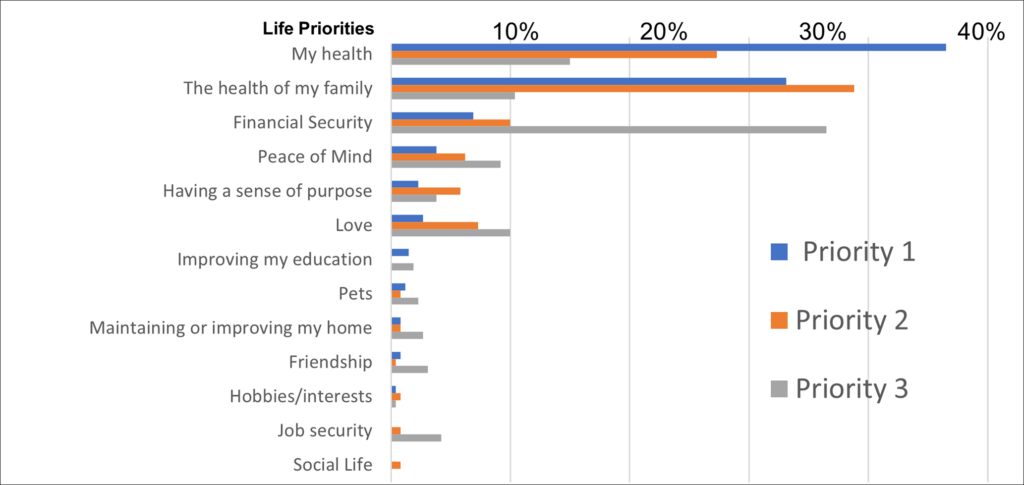
    Understanding where your staff need the most support is the best place to start. For our survey, we asked respondents to rank 13 important life factors in order of importance. The top three life priorities were ‘my health’, ‘the health of my family’, and ‘financial security’. This was also the case when we broke it down by income, age, or employment status.

    Life priorities results
    Life priorities results


    How do personal factors influence employee priorities?

    A variety of personal factors can affect employee needs. e.g., age, income, industry and location.

    Let’s focus on a couple of these:

    Life priorities by age:

    The Engage survey revealed that the top 3 priorities (health, health of family, financial security) remained the same across all age groups. The priorities following the top 3, however, saw slight differences between the older generation and younger. The older age group of employees were less likely to prioritise obtaining a sense of purpose, love, and friendships – focusing more on health.

    Meanwhile, the younger employees placed a higher emphasis on improving their education and boosting their careers, social life, and love.

    With such a wide range of priorities, businesses must work out how best to fulfil the needs of all.

    Life priorities by income:

    As with the different age groups, the top 3 priorities were consistent across income groups.

    An interesting finding that came out of this was how maintaining/improving the home, having a sense of purpose, and improving education, ranked higher amongst lower-income groups, compared to others. Perhaps this trend will encompass more people in the wake of rising living costs.

    There is a wide range of benefit options available to support these initiatives, so it’s important to consult with your teams and get a true understanding of what they most need.


    Current employee priorities: a surprise, or expected?

    With the current industry trends (such as remote/hybrid working), you would think there would be a move away from traditional priorities in employee benefits such as health – but no! Employee health and wellbeing still sit comfortably at the top of the list, reflecting how staff worries around how to best look after themselves has only been amplified by the pandemic.

    The pandemic has increased our awareness of mental wellbeing and how important it is to have a positive work-life balance. The pandemic, costs of living rising, world conflicts, remote/hybrid working, and the Great Resignation, have forced many to question the how, when, and where of workday expectations.

    Has a reset of priorities, perspectives, and work culture been on the cards for a while?

    Many workers are looking to employers to prioritise flexibility and skills development opportunities, allowing a sense of freedom and autonomy on flexible working options and a selection of benefits to suit their individual needs. And yet, despite the rising demand for these lifestyle perks, they still don’t trump the fundamental importance of health and wellbeing among people’s priorities.

    Looking for expert advice on how to establish the perfect employee benefits for your teams? Contact us at +44 (0)1273 974419 or click on the bottom right chatbox. We’re here to answer any queries, offering FREE no-obligation support.


    How the pandemic has influenced employee benefit demand

    More than two years on from the beginning of the pandemic and we are all still feeling its impact. This is particularly shown through the shift in life priorities and the added onus on looking after our health and wellbeing. The prominence of health remaining at the top of the list is likely a reflection of a growing sense of external threat.

    The strain on NHS services and concern over what support resources are available is another factor of likely concern – certainly one that points in the direction of private healthcare.

    Health is not the only issue. There are also concerns over personal finances. Earnings may have been hit during the pandemic, there are rising costs every which way you look and general increasing financial uncertainty. No surprise then that financial security sits firmly among the top three employee priorities.

    It’s worth noting that employees had these same needs pre-pandemic; their priorities have just been heightened over the past two years. Essentially, this raises the stakes for employers.


    Employee benefits which address staff needs

    If your teams are feeling listened to, appreciated, and supported, their output is inevitably only going to improve, and your business is going to be thriving.

    To target your employee’s top priorities (in particular health, family health, and financial security) you could offer:

    To help decide on which employee benefits your staff want, try consulting your team directly. This could be done through workplace surveys, setting up 1-2-1s, group meetings, or via email.

    Further reading: How to measure employee wellness in the workplace


    At Engage Health Group we help match employee benefits to the needs of your business and its employees – all within budgetary requirements. We offer FREE comprehensive advice, quotes and ongoing support to help alleviate the strain on HR teams.

    Contact us at Engage Health Group Ltd or call +44 (0)1273 974419 for FREE no-obligation advice and support.