Category: Knowledge Hub

  • 8 mental health insurance options for UK businesses

    8 mental health insurance options for UK businesses

    Insurers are only too aware of the growing demand for mental health support. That’s why they’ve been busy developing their policies to better support people with varying emotional and mental health needs.

    All health insurance providers offer some form of mental health support in their business plans, even if standalone mental health insurance is not available as a distinct policy.

    It’s easy to undersatand why insurer’s are making improvements in this area.

    Businesses today are increasingly looking to support employees with their mental health and wellbeing.

    According to the Health and Safety Executive (HSE), 46% of all work-related ill health cases are linked to stress, depression, or anxiety.

    In this article, we explore what the UK’s eight leading health insurers offer in terms of mental health support.

    Contact our award-winning team to receive free impartial advice and a complimentary quotation service. Engage Health Group compares policies across the market and reviews any policies you have in place to ensure they’re offering the best value.


    What mental health support is commonly offered by health insurers?

    All the leading health insurance providers offer some form of mental health support for their business customers. Many of the support mechanisms they offer are quite similar. For example, Employee Assistance Programmes (EAPS) are offered by all eight insurers featured in this article.

    EAPs are designed to provide emotional support across a wide range of issues. These include psychological stresses and strains related to work, finance, family relations, addiction issues and much more. Support is provided via an online platform which includes access to therapists and, often, specialists in different fields (such as legal and financial).

    EAPs usually come with general wellbeing advice and exercises too, so you don’t need to be experiencing a crisis to benefit. You can read more about EAPs here.

    Another important thing to mention is that mental health support is usually more advanced on Corporate Health Insurance plans which are typically offered to companies with 250-plus employees.

    Finally, as it’s 2024, all the leading Group Health Insurance providers provide some form of wellbeing app or online platform with their policies.


    8 insurers offering mental health coverage for employees


    1.     Aviva Health

    Aviva’s corporate health insurance plans support various mental health needs. Members can easily access its mental health support services through digital tools, which provide security to all its users.

    Aviva’s mental health offering includes:

    • Unlimited Mental Health Support: Aviva offers unlimited access to mental health specialists via a GP referral, ensuring you can get help when needed.
    • Counselling & Therapy: Up to 28 days of inpatient and day patient mental health treatment and access to outpatient services like cognitive behavioral therapy (CBT) and counselling.
    • Apps & Tools: Members can use the Aviva Digital GP app, which provides online GP consultations and self-management resources for mental health, including access to virtual therapy sessions. In addition, you can choose a GP by reviewing their profiles and also get repeat NHS prescriptions.

    NOTE: Access to services may vary depending on which Aviva Business Health Insurance plan you opt-for. Contact one of our expert advisors for expert assistance.


    2.     AXA Health
    AXA Health has a Defaqto 5-star rating and offers mental health coverage to support employees at different stages of their mental health journey. Many of its mental health support services are also available for SMEs, providing access to a wide range of specialists and treatments.

    AXA’s mental health services include:

    • Dedicated mental health line: 24/7 access to a confidential mental health helpline, where staff can speak directly with counsellors and mental health professionals.
    • Inpatient & outpatient support: AXA’s plans cover a range of treatments, from CBT and counselling sessions to more intensive psychiatric care.
    • Apps and tools: The AXA Health App allows staff access to personalised mental health assessments and resources that track your mental wellness over time. By being proactive with the app, you can make small recommended changes that lead to healthier habits over time.

    NOTE: Available services may vary depending on which Aviva Business Health Insurance plan you opt-for.


    3.     Bupa
    Bupa is well-known for its mental health support, providing flexible options to address mental health concerns. Preventive care and ongoing therapy are both catered for.

    Bupa’s mental health services include:

    • Unlimited mental health treatment: Bupa covers treatment for a variety of conditions, including stress, anxiety, and depression. This includes both inpatient and outpatient care.
    • No GP referrals needed: Members don’t need a GP referral to access counselling services, making it easier for them to get help.
    • Apps and tools: The Bupa Blua app offers articles, self-help guides, and tools to manage stress and anxiety. Bupa’s online resources hub, Healthy Me, also provides additional advice from experts.
    • 24/7 mental health support line: Bupa offers a confidential helpline that connects directly with trained counselors.

    NOTE: Available services may vary depending on which Bupa Business Health Insurance plan you select. Contact one of our experts to discover which policy best fits your needs.


    4.     Freedom Health Insurance
    Freedom Health Insurance provides coverage for mental health support via virtual and in-person options.

    • eMed Virtual GP Service: Offers quick access to unlimited mental health consultations with doctors via their eMed GP app, allowing you to get help from home 24/7, 365 days a year.
    • Inpatient & outpatient treatment: Freedom Health Insurance covers short-term and long-term mental health conditions, offering therapy, counselling, and psychiatric care when necessary.
    • Optional mental health coverage: Employers can add mental health support to their corporate plans, providing tailored mental health services based on the company’s needs.

    NOTE: Available services may vary depending on which Freedom Business Health Insurance plan you select.


    5.     Vitality
    Vitality LogoVitality takes a proactive approach to mental health insurance, focusing on wellness and preventative care. Its plans promote mental wellbeing and offer various tools to help its members manage mental health before it gets worse.

    Services included on Vitality’s business plans include:

    • Counseling & therapy: Coverage includes talking therapies such as CBT and counselling sessions, helping members access support in the early stages of mental health difficulties.
    • Subscription to Headspace: Including guided meditations, and yoga sessions
    • Apps and tools: The Vitality Member app offers a range of digital tools and resources for mental health self-care, including wellness trackers, guided meditations, and stress management techniques. The app also provides discounts from its partners to help you manage stress, eat better, lose weight, and quit smoking.
    • Comprehensive mental health cover: Vitality offers ‘bolt-on’ inpatient and outpatient mental health treatment.

    NOTE: Available services may vary depending on which Vitality Company Health Insurance plan you select. Arrange a free consultation with one of our expert advisors to discover which policy best fits your needs.


    6.     Western Provident Association (WPA)
    WPA is known for its personalised approach to health insurance. They focus on providing mental health care as an “add-on” to its core products, including access to treatment and ongoing support.

    Services included on WPA’s business plans include:

    • Extensive Mental Health Cover: WPA covers a wide range of mental health conditions, including anxiety, depression, and other psychiatric disorders – this includes access to treatment and ongoing support.
    • Employee Assistance Programs (EAPs): Like other insurers, WPA offers mental health support for employees, including counselling, advice, and work-life balance tools through its EAP. This cover is available to all WPA members and their families. In addition, remote access through the WPA Helpline is available to everyone above 16 years old every day of the year, 24/7.
    • Apps and tools: Members can use the WPA Health App, which provides access to mental health resources, wellness tracking, and virtual consultations. You can also make and track claims 24/7 through the app, view membership documents, and send and receive messages with WPA through a secure messaging system.

    NOTE: Available services may vary depending on which WPA Company Health Insurance plan you select.


    7.     Benenden Health

    Benenden Health provides affordable health care, focusing on mental health support for employees. They offer straightforward coverage to help employees manage mild to moderate mental health issues.

    Services included on Benenden’s business plans include:

    • Mental health support line: Employees can access free, 24/7 mental health support after six months of membership, giving them direct access to counsellors for issues like stress and anxiety.
    • Short-term therapy: Benenden provides up to 6 sessions of therapy or counselling for employees facing mental health challenges.
    • Apps and tools: The Benenden Wellbeing Hub offers mental health articles, self-help guides, and wellness tools to help employees manage their mental health independently.

    NOTE: Available services listed above may vary according to which Benenden Company PMI plan you select. Arrange a free consultation with one of our award-winning advisors to discover which policy best fits your needs.


    8.     YuLife
    YuLife is a tech-first provider that delivers its health insurance plans through Bupa. Along with Bupa’s mental health support services, businesses also get access to YuLife’s app.

    Services on YuLife’s offering include:

    • Insurance-free assistance: A major benefit of YuLife is that it’s available to anyone, even if your employees aren’t part of their insurance coverage. Your employees can access the app’s wellness and employee perks platform, which includes virtual GP consultations, EAPs, and wellbeing challenges.
    • Employee Assistance Programs (EAPs): YuLife provides access to counselling, mental health assessments, and emotional support through its EAP services.
    • Apps and tools: The YuLife Employee App includes wellness trackers, mindfulness exercises, and access to mental health support, encouraging mental health management.
    • Bupa mental health support: (See Bupa’s offering above.)

    NOTE: Available services may vary depending on which YuLife package you choose.


    Which policy best supports your employee’s mental health?

    The truth is there’s no one answer to this question. Each policy has its own strengths and weaknesses, while each business need differs.

    As an employee benefits consultancy we can help you make the best possible decision by doing the following:

    • Taking the time to understanding what kind of coverage you’re looking for, the number of people you’d like to cover and how much you’re able to invest
    • Gathering a range of quotes from different providers and outlining the key mental health services they offer
    • Considering how the policy will interact with any products or policies you already have in place. For example, do you already have a cash plan or EAP in place?
    • Reviewing any current health and protection policies you have in place to ensure you’re receiving the best value

    The award-winning advisors at Engage Health Group are here to answer all your questions and give advice in your best interests. Simple call 01273974419 or email enquiries@engagehealthgroup.co.uk to arrange a free consultation.

     

  • Engage wins Best International Group Advice Firm 2024!

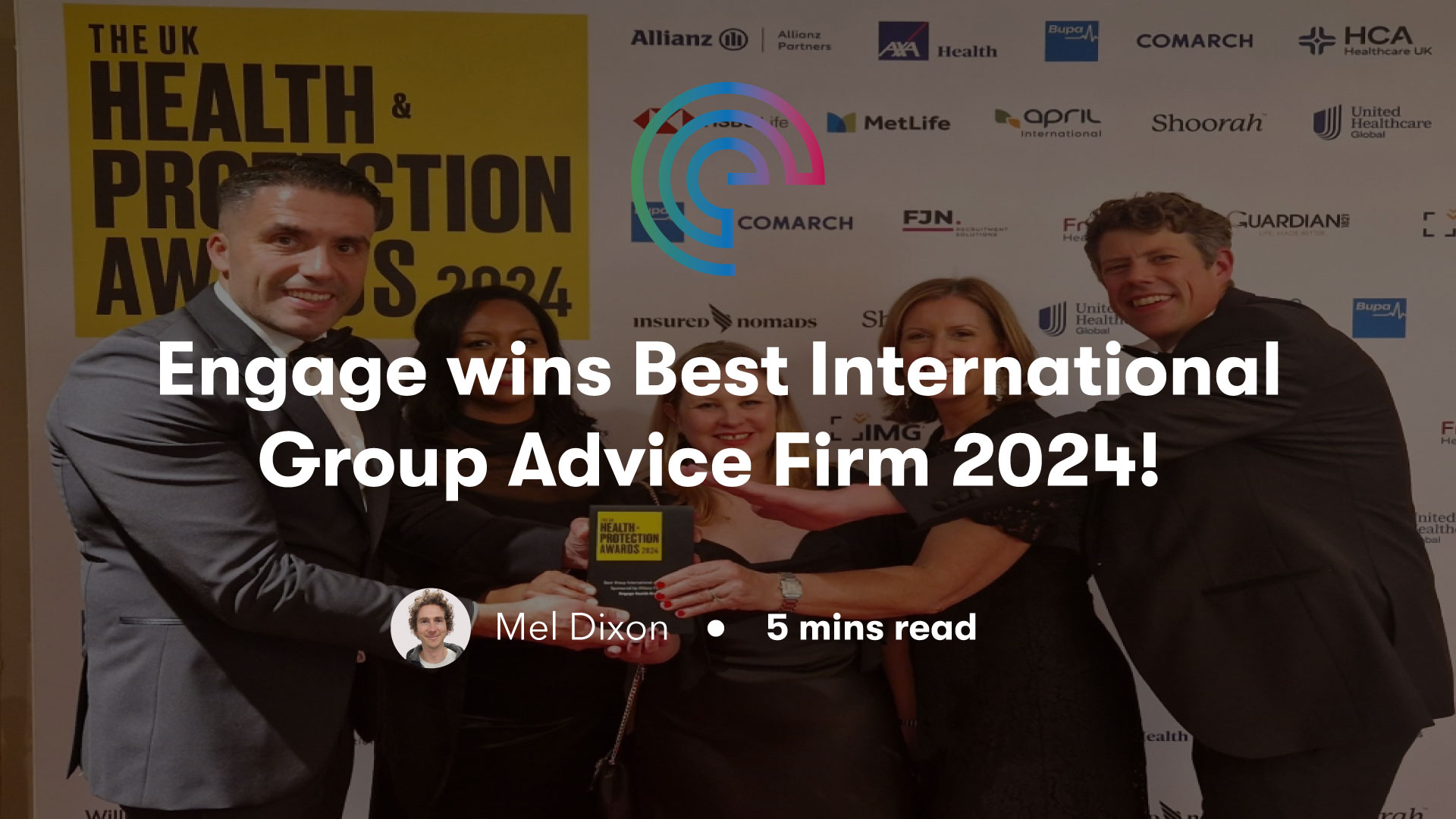
    Engage wins Best International Group Advice Firm 2024!

    Engage Health Group won Best International Group Advice Firm at the Health & Protection Awards 2024.

    The prestigious event celebrates the very best work from advisers and insurers in the employee benefits industry.

    It’s the second consecutive year we’ve won the award, and is testament to the hard work and expertise of our international team, led by Ian Abbott and Penny Pemberton.

    In this blog post, we explore the award win in more detail and outline how we help UK companies with global reach look after their employees through their health and protection policies.


    Why the Health & Protection Awards matter

    photo of penny pemberton receiving the award for Best International Group Advice Firm from comedian Kevin Bridges

    More than 700 advisers, insurers and other representatives attended the Health & Protection Awards ceremony at London Hilton Park Lane to celebrate high achievement within the industry.

    Penny Pemberton, Head of International Benefits, received the Best International Group Advice Firm from comedian Kevin Bridges on behalf of our international team.

    “I’m thrilled and proud that the team has been recognised for all their hard work. It’s great recognition for our amazing team.

    “Engage International has built a team of expert consultants with a vast array of experience in the world of international benefits. We genuinely care about our clients and enjoy working to find the best solutions to fit their benefit needs around the world.”

    Do you need international expertise for your business? Email enquiries@engagehealthgroup.co.uk or call 01273 974419 to arrange a meeting with one of our experts.


    How we achieved £250k savings for a global client

    Engage Health Group won this award due to the way we are able to leverage our expertise in the international employee benefits market and streamline our clients’ international benefits programmes.

    Ultimately, the goal is always to improve efficiency, reduce costs and improve employee support. Achieving this across different countries can be very challenging and many HR teams struggle to achieve global oversight on their benefits and achieve consistency in different territories.

    One client we worked with had rapidly grown to 40 separate entities operating across 19 countries. Each entity had separate benefits policies in each country with different insurers, leading to a splintered patchwork of policies to manage.

    The client’s policies included: International and domestic Private Medical Insurance, Life and Disability Insurance and a variety of Employee Assistance Programmes.

    Engage Health Group worked with the client to benchmark current benefits against best practice in each country and identify gaps. Where there were multiple benefit plans in one country, we looked to harmonise benefits with one insurer. Where possible, we brought benefits together under a single global plan while ensuring compliance with local regulations and leveraging economies of scale, which resulted in substantial savings.

    We achieved more than £250K in global savings for the client, with a 25% reduction in their International Medical Insurance premiums alone.

    Our work went beyond traditional consultancy by integrating directly with the client’s platforms, running webinars to educate employees, and acting as a concierge service for all member queries.

    The end result is that the client’s international employee benefits are more cost-efficient, easier to manage, and better aligned with their business growth strategy.


    Do you need help with your employee benefits policies?

    Engage Health Group provides free advice and policy reviews across a range of employee benefits both within the UK and around the world.

    If you’re seeking expert advice and support on your health and protection schemes, then please do get in touch for a no-obligation consultation.

    Email enquiries@engagehealthgroup.co.uk or call 01273 974419.

  • Can employee benefits platforms live up to the hype? A Q&A with Zest’s experts

    Can employee benefits platforms live up to the hype? A Q&A with Zest’s experts

    More companies are using digital platforms to house their employee benefits and make them available to their teams.

    Once upon a time, you needed a digital platform coded especially for your business – and it could get very costly, and complicated!

    Now, you can buy them “straight off the shelf” with the ever-looming promise of being intuitive, innovative and scalable.

    But the quality of the different products varies, as does the price and the sheer scale of what they’re capable of.

    So, in this special article, we quiz three people working at the forefront of employee benefits technology.

    Joy Waugh is Principle Consultant at multi award-winning employee benefits platform Zest. She works closely with clients and developers to ensure the platform is delivering on expectations and beyond.

    Graham Meinke oversees the design and evolution of Zest’s platform as Chief Product & Innovation Officer.

    Last but not least, Rob Perkins, Head of Partner & Client Success gives his perspective.

    So, how is the technology delivering on its promise of making life easier for businesses and employees? And how is the technology set to evolve?

    Read on for answers to these questions and a lot more…

    Engage Health Group is an employee benefits consultancy dedicated to helping businesses source the best health and protection policies for their staff. If you need free advice or reviews of existing policies from industry experts, we’re always happy to help. Contact 01273 974419 or enquiries@engagehealthgroup.co.uk.


    Q: How do employee benefits platforms help staff?

    joy waughEase-of-use is key here, says Joy Waugh, Principal Consultant at Zest:


    Employee benefits platforms significantly enhance the employee experience by providing easy access to all their benefit information in one centralised location, such as ‘what benefits do I have’ ‘why have it’, ‘how does it work’, ‘which options are available’, ‘how much is it going to cost’ and ‘do you benefit from any savings in tax and National Insurance’.

    These platforms offer personalised options, allowing employees to choose benefits that best suit their individual needs, whether it’s healthcare, wellness programs, retirement plans, or additional perks like discounts and rewards.

    This flexibility can lead to increased employee satisfaction and wellbeing, as staff feel valued and supported by their employer.

    Moreover, the convenience of having everything in one place, often accessible through a user-friendly interface or mobile app, makes it easier for employees to take full advantage of their benefits, leading to higher engagement and retention rates.


    Q: And what does the employer get out of it?

    Here, it’s a case of easing the administrative burden on busy HR and People teams but also making use of analytics. Joy explains:

    For employers, employee benefits platforms streamline the management and delivery of benefits, reducing administrative burden and improving efficiency. By offering a customisable and comprehensive benefits package, employers can attract and retain top talent, which is critical in today’s competitive market.

    Furthermore, these platforms often provide valuable insights through analytics and reporting tools, helping employers understand which benefits are most valued by their workforce and adjust offerings accordingly.

    This data-driven approach not only optimises the benefits package but also enhance employee satisfaction and loyalty, contributing to a positive workplace culture.

    Additionally, a well-implemented benefits platform can lead to reduced absenteeism and higher productivity, as employees who feel supported and appreciated are more likely to be engaged in their work.


    Q: Can it work for SMEs just the same as for larger corporations? 


    Benefits platforms have essentially closed the gap between smaller businesses and larger corporates in the benefits space, says Joy:

    Technology improvements and simplified configuration have allowed smaller companies to compete with larger organisations as the cost barriers to implement and manage platforms are being broken down.

    Also, the project time to implement means that fewer resources are needed, whether it’s a larger organisation or a smaller organisation.

    Large companies typically have a team available, but with smaller organisations there is a limitation on resource which has previously restricted their ability to implement platforms.

    But with more user-friendly platforms requiring less, resource, it means it’s much more viable to implement benefits and SME’s are really keen to attract talent and retain employees by offering compelling benefits. They love this innovative and intuitive platform which enables them to do just that.

    Also many platforms are scalable, meaning they can grow with the company, adding features and options as the business expands.


    Q: Do you encounter any common misconceptions about employee benefit platforms?

    Many companies feel that a benefits platform will actually put strain on busy HR teams, says Joy:

    One of the big barriers is the perceived administrative burden. Many companies see they’re implementing benefits, which means a platform which means more administration.

    There is also a fear of long project timelines and the resources needed internally to understand technical requirements, plus the fact that they would need to understand not only technical requirements, but then work on those platforms and need lots of training to ensure that they keep everything up to date. In reality, most modern platform as Zest are designed to be user-friendly and come with dedicated support teams to assist with setup and ongoing management.

    Another misconception is that employee benefits platforms are only suitable for large companies with extensive budget. As mentioned earlier, these platforms are highly scalable and can be just as beneficial for SME’s.

    There’s also a belief that these platforms only benefit employees and don’t much offer to employers. However, as discussed, employers gain valuable insights, streamline processes, and improve overall employee satisfaction which can lead to a more motivated and productive workforce.

    Lastly, some think that these platforms are rigid and don’t allow for much customisation. On the contrary, most platforms offer a high degree of flexibility, allowing employers to tailor their offerings and meet the specific needs of their workforce.

    photo of graham meinkeGraham Meinke, Zest’s Chief Product & Innovation Officer, agrees. But he also thinks a lot of it is caused by bitter previous experience using older, more cumbersome platforms:


    Technology has moved forward considerably in the last 10 years, and unfortunately lots of companies are still operating on the old legacy platforms and therefore they’ve got this misconception that setting up a benefits platform is complicated, and even renewing a benefits platform is a big, painful, complicated thing to do.

    The truth is, if you buy a modern benefits platform, where everything is codeless rather than coded to your individual implementation, then it’s a much more straightforward and a much less costly exercise than people often think it is.

    Other misconceptions about employee benefits platforms is that true automation isn’t possible when it absolutely is. Unfortunately, in the early days of employee benefits platforms, 15-20 years ago, a lot was over-promised around automation and failed to materialise. It will be delivered based on those existing solutions. Again, some platforms like ours have moved on in a considerable way and allow you to know the value of true automation.

    And they’ve got this misconception that a fair bit of manual administration is still needed and it’s just not true. It might be the case for their current platform, but it doesn’t have to be that way.


    Q: How much have benefits platforms evolved over the last 5 years?


    Joy suggests that some have evolved more than others:

    Some are still stuck in code-heavy platforms which require a lot of time, which is why you see some misconceptions.

    Platforms like Zest have undergone a significant transformation over the last five years, not only by expanding and enhancing their core services but also by integrating new areas such as employee engagement. This evolution has allowed them to offer a more comprehensive suite of tools that goes beyond traditional benefits management.

    Now, these platforms facilitate rich content and communication across a wide range of topics, including company culture, organisational values, and what it truly means to be part of the organisation. By doing so, they help create a more connected and engaged workforce, bridging the gap between benefits and the broader employee experience.

    And in a similar way, the breadth of benefits has expanded to focus on wellbeing areas such as mental health, menopause, elder care and financial wellbeing. There’s been a marked shift in offering more than just the traditional pensions, life insurance and PMI, with perhaps Cycle to Work or Gym Memberships thrown in – to a host of proactive initiatives.

    On the depth of service point, we are seeing greater integrations and data mapping – the automation of the flow of data from HR via a platform to payroll and providers including SSO (Single Sign-On technology) and API (synching information from one system to another).

    Additionally, mobile access has become a standard feature, allowing employees to manage and access their benefits anytime and anywhere.

    Graham highlights the impact of cloud-based technology which allows platforms to evolve with the needs of businesses:

    Oh, it’s massively evolved massively over the last five years. I think the fundamental thing that’s changed is just the way in which any multi-tenanted platform is architected now versus platforms that you saw 5-10 years ago. They are completely different, which means that they are cloud-native platforms.

    Scalability is built into the way in which they’re designed. Resilience is built into the way they’re designed. Performance is built into the way that they’re designed, and importantly, from a data perspective, it is a single implementation and that’s what enables all of those rich insights that wouldn’t have been possible 10 years ago when everyone had their own instance of an application that was coded for that specific need.

    The thing that’s probably moved on the least is the front end in the last five years, in terms of the same design patterns.

    Regarding best practice, it still holds true, but it’s all of the work to handle all of that complexity and take that complexity out of being a painful implementation. That’s what’s moved on in the industry and certainly some parts of the industry like ours, have taken complexity away from clients and made it super simple.


    Q: What are your predictions for the future of employee benefits platforms?


    Graham foresees a future of more personalised experiences and data which can feed into board level conversations:

    On the employee side there will be hyper-personalisation and that will involve a lot more targeted content based on the needs of that individual. This could be based around their personal situation, their work role, and the cohorts that they sit within.

    On the admin side of the business, the side of employee benefits platform, the insight in which people will be able to gain is going to be much more outcome-focused and tied directly to board level conversations.

    So, we’re going to move away from basic benefit information, such as uptake, benefit cost savings etc, and move much more into business outcome-based data. It will be so much more proactive, being able to identify the areas of risk of attrition within the business and highlighting the specific actions that people need to undertake to remedy those things.

    The insights can be much more focused on the fundamentals of how our actions are tied to attracting, retaining and engaging talent. And I think you’ll find from an engagement perspective, both for the business and for the employees, you’re going to see platforms becoming much more multi-channel in their campaign capabilities.

    So, whereas before people thought about communications in the context of putting some posters up on the wall and sending emails, now you’ll find that there’s many more options available. In-app content for mobile push notifications on top of emails and your hard copy campaign material too. Those will all be much more integrated into campaigns where individual actions can be tracked to make sure that messages have been understood and received by employees.


    Q: Have you noticed trends this year in terms of most popular employee benefits accessed via your platform?

    Joy is noticing a wider range of benefit take up:

    We’ve observed a consistent year-on-year increase in holiday trading and a general rise in the overall uptake of benefits. This trend highlights the importance of recognising employees with unique needs and preferences. Offering a broader range of benefits allows employees to select options that truly resonate with them. As a result, while certain benefits might not see the same level of participation as in previous years, we’re noticing a more diverse and widespread engagement across the entire spectrum of benefits. This broader uptake underscored the value of providing a wide array of choices that cater to the varied priorities of a workforce.


    Q: Mental wellbeing seems to be a big issue right now, how can benefit platforms help in this respect?

    Benefit platforms can help in three main ways says Jo:

    Mental wellbeing has indeed become a critical focus for both employees and employers, especially in light of the increased stress and uncertainty brought about by global events like COVID-19 pandemic. Employee benefits platforms can play a crucial role in supporting mental wellbeing by providing access to a wide range of resources and services.

    Firstly, it’s about communicating the mental health support channels available. Whether that’s via an EAP (Employee Assistance Programme), or an in-house team or occupational support. These tools offer employees confidential and convenient access to mental health support. This can be crucial for those who might be reluctant to seek help though traditional means.

    Additionally, benefits platforms can help foster a culture of mental wellbeing by offering wellness challenges, resilience training, and peer support networks, all of which can help reduce the stigma around mental health issues and encourage employees to prioritise their wellbeing.

    By integrating mental health resources directly into the platform, employers can ensure that support is easily accessible and normalised as part of the overall benefits package. This not only helps employees manage stress and prevent burnout but also contributes to a more engaged, productive, and satisfied workforce.


    Q: Give us the hard sell!! What differentiates Zest from the competition?


    Rob Perkins, Head of Partner & Client Success waxes lyrical about the features and functionality that make things simpler and more accessible for employees and management alike:

    Zest benefits platform stands out in several key ways, starting with our exceptional Net Promoter Score (NPS) of 82, which is a testament to the high level of satisfaction and loyalty our customers have.

    One of our key differentiators is the platform’s ability to centralise all employee benefits in one accessible place, simplifying the process of managing and utilising benefits. Employees can effortlessly navigate and optimise their benefits though a personalised experience tailored to their specific needs and preferences. This personalised approach ensures that each employee feels uniquely values, leading to higher engagement.

    Our mobile app further enhances accessibility, providing employees with the flexibility to manage their benefits on-the-go. Whether checking benefits, tracking usage, or receiving timely notifications, the app keeps everything at their fingerprint.

    We also offer a comprehensive Total Reward Statement, which provides employees with a transparent view of their entire compensation package, beyond just salary. This clear and detailed overview helps employees appreciate the full value of what they receive, fostering a stronger connection to the company.

    For employers, our platform is a game-changer in terms of efficiency and flexibility. It allows  for the creation and management of complex benefits schemes, catering to the diverse needs of different employee groups. HR and People teams can also see and deliver targeted, personalised email campaigns to promote specific benefits to particular cohorts, ensuring that the right information reaches the right people at the right time.

    Automation is another area where our platform excels. Routine tasks, such as adjusting benefits when employees update their lifestyle or when employee data changes, are seamlessly automated. This reduces administrative overhead and ensures that employee’s benefits are always aligned with their current life circumstances.

    Additionally, the platform provides automated and scheduled reports, along with real-time data insights, empowering HR teams to make informed decisions. Our marketplace is another standout feature, offering employers the opportunity to explore and select additional perks that enhance their benefits strategy.

    Zest platform’s excellence is recognised industry-wide, as evidenced by our awards for Best Employee Benefits Technology and WorkTech of the Year. These accolades highlight our commitment to innovation and our leadership in the employee benefits space, providing a robust, flexible, and user-friendly solution that meets the needs to both employees and employers.


    While Zest is an award-winning platform provider, Engage Health Group is an award-winner in the field of employee benefits consultancy. We provide free reviews of health insurance, life insurance, income protection and other policies. Contact 01273 974419 or enquiries@engagehealthgroup.co.uk to arrange a call with one of our expert advisors.


  • Combatting the rising costs of Company Health Insurance renewals

    Combatting the rising costs of Company Health Insurance renewals

    Many businesses face a hike in their health insurance premiums during renewal season. But why does this happen, and can you do anything to keep costs down?

    In this blog post, we’ll break down the renewal process, explore why costs tend to rise, and share how you can combat these price increases.

    Need help renewing your Group Health Insurance scheme, but unsure where to begin? Get FREE one-to-one advice from our award-winning experts on 01273 974419 or email enquiries@enagehealthgroup.co.uk.


    Why Health Insurance renewal costs tend to rise

    Health insurance premiums typically rise each year and right now the industry is seeing bigger increases than usual. Demand for health insurance has soared in the face of concerns around NHS waiting lists, which the Health Foundation predicts will top 8 million this year.

    As more people turn to private health insurance to avoid delays in NHS services, the number of claims on private policies is rising. A record of nearly £3bn was paid out in 2022.

    Meanwhile, the number of people with private health insurance in the UK has reached 7.3 million, according to LaingBuisson. This is the highest level since 2008.

    The increase in claims, combined with rising medical expenses and heightened demand for health services, results in businesses often facing higher premiums year after year​.

    However, if your business is faced with a steep premium rise, it doesn’t mean you have to accept it. The renewal period allows you to reassess your policy and ensure it provides value for your business and its employees.


    How the renewal process works

    When your Group Health Insurance policy is in place, the premium rates are typically fixed for 12 months. However, as the renewal date approaches — usually 6-8 weeks before the annual renewal — your insurer will update you on any changes to the policy, including price adjustments and any changes to services or features included.

    This renewal period, which begins around 4-6 weeks prior to policy expiration, is your opportunity to review and adjust your policy:

    Is it still providing value for money?

    Are your employees making good use of it?

    Have there been changes in the terms and conditions that might affect your decision to renew?

    At this point, you can decide whether to renew the current policy, make changes to better suit your current needs, or explore alternative options. If you choose to renew, you must provide updated employee data, claims information, and any amendments you wish to make.


    How Health Insurance renewal premiums are calculated

    Company Health Insurance renewal premiums are determined based on several factors specific to your organisation:

    • Age: If the average age of employees covered by the plan has changed, it could impact your premium.
    • Employee number: Changes in the number of employees on the scheme will impact the premium.
    • Base rate: Insurers may increase base rates across all schemes, often due to inflation.
    • Claims: The number of claims made on your company’s policy affects its performance and can influence the renewal premium. Being part of a claims pool means that your premium is influenced by the overall claims activity of similar policies. Therefore, your premium can still increase, even if your company hasn’t made many claims.

    Engage Health Group’s expert consultants negotiate on behalf of clients, striving to save them money on health insurance renewals. Email enquiries@engagehealthgroup.co.uk or call our brokers on 01273 974419 for FREE no-obligation advice.


    How Engage Health Group helps lower renewal costs

    When it comes to renewals, our brokers start with a comprehensive fact-finding process to understand your business, your employees’ needs, and the details of your current policy. We then conduct a full market review, gathering quotes from various insurers to offer you a range of options.

    A great example of our work involves our Senior International Manager, James Carrick, who assisted a leading gambling organisation with their multi-country health insurance and employee benefits package. Initially, their International Group Health Insurance premium was set to increase by 8-9%, which would have raised their premium to approximately £90k.

    Through negotiation, James managed to reduce the increase to just 1%, saving the client around £80k.

    James then redirected the savings to enhance the company’s employee benefits, through purchasing International Life Insurance and International Disability Coverage.

    I’d seen a gap in their employee benefits package compared to their competitors so it was important to get that covered,” said James.

    Policies like life insurance and group disability reassure employees that if anything untoward is to happen, there is a financial safety net in place.”

    A few other tips and tricks to help lower premium rises:

    • If certain features of a policy are receiving no use, you might consider taking those features away in order to help lower the premium.
    • Speak to other providers to see if any better deals are available.
    • Consider adding or raising the excess to lower your premium. The excess is the amount you pay towards a treatment. But a word of caution – this approach doesn’t always provide the best value and can even end up being more expensive depending on the number of claims made.
    • Consider enlisting the services of an impartial broker like Engage Health Group, who can use their book of business and negotiating power to potentially lower premium increases.


    Finding the right support from a Health Insurance broker

    At Engage Health Group, we guide you through all available options and gather quotes from across the market to ensure you receive the best deal on your health insurance scheme. At the renewal stage we always review any policies your company has in place to ensure you are receiving the best value for money.

    Contact our expert team at enquiries@engagehealthgroup.co.uk or call 01273 974419 for FREE advice and support.

  • The real truth about neurodiversity in the workplace

    The real truth about neurodiversity in the workplace

    “When I started here, I realised I was very good at spotting errors, calculating numbers and focusing on single tasks. My emails can be very dry and to the point which can be a strength or a weakness depending on how you look at it. Sometimes being concise is a very useful thing!”

    Joanne Lloyd, Client Services, Engage Health Group

    Engage Health Group employs people who fall under the term ‘neurodivergent’, including Joanne Lloyd who is part of our employee benefits client services team. Her eye for detail ensures that clients receive the most accurate and up-to-date information when seeking out quotes or information related to policies.

    It’s estimated that one in seven people think, behave or process information in a way that differs from the norm. While Joanne has become an essential part of our team, too often people who are neurodivergent are seen as a problem to manage rather than a talent to support.  


    Exposing myths around neurodiversity

    Most people are aware of conditions like autism, attention deficit hyperactivity disorder (ADHD) and dyslexia. Other forms of neurodiversity include dyspraxia (affecting physical coordination), dyscalculia (affecting understanding of numbers), dysgraphia (affecting the ability to write) and Tourette’s syndrome.

    Many famous faces, past and present have had one or more of these conditions. Elon Musk discussed one of the challenges of being autistic in a TED Talk last year:

    “Social cues were not intuitive, so I was just very bookish. Others could intuitively understand what was meant by something. I would take something very literally, as if the words that were spoken were exactly what they meant. But that turned out to be wrong. [People are] not simply saying exactly what they mean. There are all sorts of other things that are meant. It took me a while to figure that out.”

    Awareness of the issue has grown in HR circles and from employers generally, as these recent headlines show:

      half of neurodiverse people missing work due to lack of workplace support   neurodiversity can be a huge superpower says manx care  

    Yet, misconceptions still remain.

    Joanne herself was diagnosed with autism as a child. It took her until the age of five to learn to speak. And it wasn’t until the age of 15 that Joanne was diagnosed as being dyslexic too. She has experienced first-hand how some companies take a wide berth of neurodiverse people.

    “I once ran a test when I applied for jobs online. On one CV I disclosed I had autism and dyslexia, and I wouldn’t get an interview. But when I used exactly the same CV, and didn’t disclose it, I would get an interview.

    “I also worked at a shop where the store manager said very bluntly that if I’d mentioned my autism or dyslexia at the interview I wouldn’t have got the job.

    “A lot of it comes down to a lack of awareness. People have a stereotype in their head and it’s because they don’t know what it is.”

    Equipped with these experiences, Joanne chose not to disclose her autism or dyslexia during her job interview with Engage Health Group. It seems that many consider neurodiversity as a disability, when in fact it’s a complex mix of neurological traits that in some cases can be almost like a superpower. Joanne has taken an academic interest in the subject, studying Neuroscience at the University of Sussex. She makes the point that even people with the same form of neurodivergence will be very different in how they operate.

    “It’s not a one-size-fits-all situation. For example, two people with ADHD won’t be the same – they’ll need different levels of support. Sometimes it goes unnoticed unless it’s pointed out.”


    The challenge of entering a new workplace

    Image by louisehoffmann83 from Pixabay

    Entering a new workplace is a challenging experience for anyone. There are new people to meet, new processes to get used to, and often new skills to learn. For neurodiverse people, the challenge can be more acute.

    “When I first started working at Engage, it took some getting used to. I’d never worked in an office environment before or on a telephone,” said Joanne. “Little things were a challenge like the size of the office and all the different people. It can be quite overwhelming and for me it was sensory overload.

    “It took me a little while longer to grasp things than most people, but once I did, it really clicked and then everything became easier. One of my colleagues really took me under his wing which was a big help.”

    “To begin with I was very quiet. An office feels very professional and I felt I needed to be reserved but over time I realised you can be yourself and talk about your interests.”

    Joanne talks about the process of “masking” whereby people camouflage their natural personality to conform to perceived social pressures.

    “Everyone does it but for neurodiverse people it can be quite mentally taxing and I was like that at first. But over time I realized I didn’t need to be like that here. If I want to be quiet I can be quiet and I won’t be judged. But sometimes I can be chatting all the time.”


    Why smart companies think individual

    Forward-thinking employers are taking an increasingly flexible approach with their employees, treating them as individuals rather than as a homogenous group. We see this trend in the employee benefits space where tools and policies have evolved to provide a wider range of services targeting different employee needs. More obviously, we see it in the wide embrace of remote and hybrid work policies.

    “There is growing awareness of the need to accept flexibility, and not just with neurodiverse people,” says Joanne. “Employers who are flexible can help ensure their employees are able to work to the best of their ability.

    “In some cases, it might be as simple as helping someone juggle family life or avoid commuting costs. For people with learning difficulties, it can be a bit more specific.

    “The one positive thing coming out of the pandemic was the increased awareness of mental health and the ability to work from home. The option to work from home is something that has helped people with physical disabilities and neurological differences.

    “And insurers have started to do a lot more around mental health support and this has shed light on neurodiversity as it’s an adjacent topic, so it’s brought more attention from insurers.”

    Evidence of this growing awareness can be seen in a survey by AXA which found 47% of companies planning to further support neurodiversity in the next two years.


    Workplace adjustments can vary greatly


    charlie o'brien - breathe

    Charlie O’Brien, Head of People at Breathe says that many neurodivergent people spend time quietly adjusting their work environment to suit their needs when they come into a new workspace.

    “For a neurodiverse individual or team to thrive, we need to create a culture that openly speaks about our differences and celebrates them – loudly.

    “Be transparent with your policies and working environment, both internally and externally; future hires need to feel safe about discussing their needs, you can do this by sharing what you do openly without being asked first.

    “Every single person should get a personalised onboarding plan, tailored to their specific needs and adjustments, which means you break down communication barriers from the get-go, this creates a culture where everyone feels safe to be themselves.

    “Continuously educate your staff, at Breathe our colleagues take the lead and educate each other on things that impact them or their loved ones, this can be a slack message with information and an open invitation for people to reach out to talk or a lunch and learn.”

    Joanne is keen to emphasise that workplace adjustments can, in many cases, be minimal.

    “When people hear the term ‘workplace adjustments’ some people think it will be expensive but it can be very simple things. For example, someone with dyslexia might need speech-to-text software which Google provides for free anyway.”

    While Joanne hasn’t required any specific workplace adjustments, a level of understanding helps.

    “It’s harder for me to pick up on some social cues, particularly around tone of voice. My grammar and spelling aren’t great. In fact, someone rarely has just autism, there’s usually something else too.”

    However, her attention to detail and her high-level ability to focus on a task and see it through to completion is a major strength. Multi-tasking might be a weakness – but, she says, Pipedrive helps with that!

    “Compiling evidence is another one of my strengths. I’m good at presenting facts, bullet points and detailing a sequence of events. I’m good at providing a book of instructions but something more personalized and sensitive can be quite difficult.

    “People often talk of autism as a scale but actually it’s more like a dial of different strengths and weaknesses. So a person might be high or low on different things.”

    Attention-to-detail, verbal skills, written skills, creative thinking, ability to focus – these are capabilities that vary from one person to the next. Joanne summarises it thus: “Think differences, not deficits”.


    How health insurance policies are evolving

    Health insurers are becoming more aware of neurodiversity as a topic and some have started to develop guidance and policies around it. AXA has developed its own Neurodiversity Assessment and Support service which provides employees and qualifying family members with a rapid assessment. If a positive diagnosis is made, support is offered according to the specific needs of the individual.

    “I like AXA’s benefit which speeds up referrals to get a diagnosis. At the moment there’s a lot of pressure on the NHS and long waiting lists,” says Joanne. “Some people slip under the radar as children and might not have received a diagnosis yet. They may have developed coping mechanisms, so it might not be obvious from the outside yet could still benefit from support.

    “Mental health support is useful. Even though neurodiversity is a different thing, things like anxiety and depression are more common in neurodiverse people. Although I haven’t used the services myself, it’s reassuring to know that I have access to them if I need them.”

    It’s early days for neurodiversity benefits. Many insurers are scrambling to play catch-up as they realise the demand for such services.

    Vitality is providing support for ADHD and autism assessments from January 2024 as an additional benefit to its corporate offering.

    The benefit will cover employees and their dependents over the age of seven. A positive ADHD diagnosis is followed up with six psychiatric follow-ups, plus coverage for eligible medical costs and two annual reviews. However, a positive autism diagnosis doesn’t open the door to any additional support services beyond its core policy offering.

    Similarly, Bupa is launching its neurodiversity benefit in January to corporate clients. Clients must have mental health benefits in place and a minimum outpatient allowance of £1,500 for each employee on the scheme. It will cover a diagnosis for autism, ADHD, dyslexia, dyscalculia,  and dysgraphia. It also applies to dependents aged six and older.

    Aviva offers a Neurodevelopmental Pathway on their corporate plans which helps speed up initial assessment and diagnosis of ADHD, autism and Tourette’s syndrome. The pathway provides support and access to private diagnosis. No GP referral is needed and members receive a comprehensive report. It’s also available to group members and their dependants aged seven and over.  


    Dispel the myth, grasp the opportunity

    Neurodiversity is all around us. Some of the highest-performing people across a broad range of fields are neurodivergent. Yet, it covers such a broad spectrum of traits, that it’s impossible to generalise. Employers must keep an open mind and do the things that any good employer should do: listen to the needs of employees and address them in the most helpful way. Nick Hale, Founding Director at Engage Health Group, reflects on how his understanding has evolved:

    “Of course, every individual is different, and we all have our strengths and weaknesses both personally and professionally.  I’ve learnt that those with neurodivergence are really the same in this regard, but that there is simply a greater understanding needed of where their strengths are best deployed.

    “I do worry how many individuals with applicable skills are overlooked for roles due to ill-informed preconceived views, but the important work that we, our valued clients and our insurer partners are doing is helping to break down stigmas and move the discussion forward, and it’s fantastic to part of it.”

    Increased awareness is often the first step towards progress, and as increasing numbers of business leaders and HR personnel become more attuned to what it means, then workplaces and well-being policies will evolve to better cater for people whose minds function differently to the norm. A failure to support neurodiverse employees is a failure to support some of the most talented and capable people out there.

    Engage Health Group is an employee benefits consultancy that helps UK businesses navigate the world of employee benefits and source policies tailored to their unique needs. This article first appeared on HR News.

  • Here’s how an International Health Insurance broker can help…

    Here’s how an International Health Insurance broker can help…

    A good International Health Insurance broker provides impartial advice to any individual or business looking to offer health coverage to its global employees. 

    Brokers can be the make or break factor in the success or otherwise of a global health plan.

    However, all brokers have their own ways of operating – some offering their services for free, others charging, and all with varying levels of expertise across different countries.

    In this blog post you will learn:

    • The role of an International Health Insurance broker
    • How the business model works
    • The benefits of employing an expert broker
    • Real-life examples of how a broker can help

    Need help creating the perfect blend of international employee benefits and health insurance for your global staff? Contact our expert international insurance brokers on 01273 974419 or click on the chat box on the right. 


    What does a Global Health Insurance broker do?

    A health insurance broker should be dedicated to the needs of its clients – rather than the interests of an insurance provider. A broker’s mission is to find you the best policy at the right price point by using their connections with numerous providers and their knowledge of the industry. 

    For example, there are several elements to the service at Engage Health Group:

    • Initial discussion and fact-finding: Businesses come to us with various questions related to the global health insurance market. It usually centres around how such policies work and how much it costs. We provide all our answers in plain English.
    • Advice and guidance: We advise clients about the best route forward after we’ve learnt about the business’s needs and scope of coverage required. 
    • Delivering quotes: We gather policy price-points from across the whole market, tailored to the needs of a business.
    • Claims assistance: We assist with claims, should any disputes arise or any further guidance be required.
    • Review policies: We review global healthcare policies to ensure they are providing value for money by comparing against other policies on the market. We will highlight any better, more cost-effective, alternatives.

    Launching or reviewing a global health insurance scheme is a daunting and time-consuming process for HR departments. But a broker can ensure the process runs more smoothly.  

    Insider tip: Brokers are usually paid a commission by the insurance providers meaning their services can be provided free of charge to the business. Look out for any brokers that come with their own fees – these are ones to avoid! Also check if they are members of the AMII as this shows they are dedicated to providing impartial advice and are not tied to an insurer.


    Why turn to an International Health Insurance broker?

    The International Health Insurance market is full of insurers competing for your attention, all claiming to have the ideal policy for your business. International Healthcare is a considerable investment and that only puts more pressure on HR teams to achieve return-on-investment.

    A reputable Global Health Insurance broker can:

    • Increase you chances of finding the optimal global healthcare policy
    • Reduce the time and stress involved in searching for and managing policies
    • Ensure you budget is spent wisely

    Below we have listed a few issues that can be encountered when looking into International Health Insurance for your staff: 

    • Location-specific requirements: Different countries can pose specific challenges that need to be addressed. For example, in the UAE it is essential to have health insurance in order to obtain a work visa. Meanwhile, in the US, health insurance is mandatory for many employers
    • The range and breadth of global insurance providers: There are a huge number of global health insurers, each with different policies and expertise in different territories.
    • Vast number of products and options: There are potentially thousands of product combinations, exclusions/inclusions and price points to consider.
    • Choosing between domestic and international policies: In some cases, opting for separate domestic policies could be better than investing in a global scheme. Brokers will balance up cost factors, compliance requirements and how best to simplify its administration.

    International Health Insurance brokers will essentially take on the heavy lifting to remove as much stress as possible from the process. 

    Further insights: How to gather the best International Health Insurance quotes. 

    Would you like to speak with an international insurance broker right now? Give our award-winning team a call on 01273 974419 for FREE no-obligation advice and support.


    What are the benefits of using an Global Health Insurance broker?

    The surge in companies employing talent from around the world has led to increasingly complex demands on HR teams. And this trend is set to continue. So, how do employers ensure that all employees are equally supported wherever they are in the world? 

    Here are some of the key benefits of employing an International Health Insurance broker:

    • Global market-wide quotes: An independent broker is constantly reviewing policies available in the global healthcare market, providing the pick of the bunch to you. 
    • Free expert knowledge: Receive expert knowledge on each insurance company’s terms and conditions – all relayed clearly to you, entirely free of charge.
    • Country-specific knowledge: Gain detailed knowledge on how different health systems operate, what the statutory requirements are and more.
    • Personalised approach: Brokers take the time to fully understand the unique requirements of your business, leading to a plan that fits your specific needs.
    • Broader employee benefits advice: A broker like Engage can also advise on other areas of workplace benefits, including protections schemes, EAPs, corporate wellness, cultural training and more – and explain how they all fit together.
    • Policy implementation: Some brokers also help implement schemes – providing educational materials to employees and generally help onboard employees to ensure they are fully aware of the benefits they have and how to use them.
    • Claims assistance: If there are any disputes with an insurer, a broker can take it up on your behalf.
    • Independent expertise: Assuming they are an impartial broker, you can be assured they are working in your best interests – and not on behalf of the insurance industry!


    Examples of a global health insurance broker in action

    The Engage International team work with a wide range of clients across various sectors, offering expert advice and industry experience. To share more insight into what we do, we’ve provided a few revealing testimonials from our client-base.

    Remote:

    Global hiring specialist and Employer of Record, Remote, has worked with Engage on its global medical plans. 

    “They helped us establish a comprehensive medical plan that covers our employees globally, with competitive and flat rates. Additionally, they act as advisors, providing us with valuable guidance on best practices in countries where we lack local knowledge.

    “Engage Health’s expertise and network of brokers have been instrumental in navigating the complex world of global benefits. They match us with brokers who share our values and goals, ensuring that we have the right coverage and support for our employees worldwide.

    “We highly recommend Engage Health for their exceptional service and expertise. We are grateful for their partnership and look forward to continuing to work with them in the future.”

    Joana, Senior Expert, Global Benefits Strategy and Design, Remote

    Timber Trading Agency (International):

    Helping to establish a detailed benefit scheme for employees working in medium-high risk countries. 

    “Engage Health Group have been very helpful with our members, many of whom are based in third world countries. They have solved the problems raised regarding the COVID pandemic especially relating to evacuation if needed.”

    Eva Maguire, General Manager of Timber Trading.

    Global IT Company:

    Covering 60 employees in Europe/New Zealand/Australia.  

    In this instance, this organisation had been quickly scaling their international tech pool, hiring remote global employees working in various parts of the world from the get-go. 

    “They went out of their way to provide us with the best quote and negotiated with our current provider, they managed to increase our level of cover and drop the cost. They provided support during the change over to the new policy and came to our office to do an all company presentation explaining how to get the best out of our cover.”


    BCB Group:

    Europe’s leading payment service provider.

    “James at Engage was super helpful with explaining all our potential options, he understood the requirement for ensuring the level of cover was appropriate whilst also balancing financial impact.

    “Throughout the process, from market review through to cover in place, there was regular and quick communication, keeping us in the loop with any developments.

    “I would have absolutely no hesitation in coming to James and the team again for any future support required.”

    Take a look at more testimonials here.


    Reach out to Engage Health Group!

    The international health insurance and employee benefits market can be difficult and confusing to navigate through. 

    At Engage Health Group, we have a global reach spanning more than 70 countries, enabling us to help international clients streamline their global benefits. We offer genuine expertise and the most competitive quotes in the market. 

    Contact us at enquiries@engagehealthgroup.co.uk or call 01273 974419 for FREE no-obligation advice and support. 

  • 5 borderless benefits designed for international workforces

    5 borderless benefits designed for international workforces

    Is your workforce scattered around the world? If so, you’ll need to rise to the challenge of providing a consistent level of employee benefit.

    Group Health Insurance, Income Protection and Life Insurance are a few of the typical policies that businesses provide to employees. They might be relatively simple to arrange for a single country, but how do you implement them for a global workforce?

    One common solution is to invest in a single multi-country scheme, as opposed to buying separate national policies.

    So, in this blog post we look at five employee benefits which are designed to extend beyond borders.

    Need one-to-one professional advice and support to find the best international benefits package for your global teams? Contact us at Engage Health Group Ltd on +44 (0)1273 97449. We’re here to answer any queries and offer FREE expert advice.


    1. International Group Health Insurance

    UK businesses employ over 5 million people overseas.

    Source: ONS

    Health insurance is consistently amongst the most in-demand working benefits. But it becomes a whole lot more complicated when you’re trying to serve a global workforce. However, a single International Group Health Insurance policy can cover employees in several countries all at the same time.

    This means just one policy to manage and just one person to contact for all your policy queries. This makes it a lot simpler to navigate and less of a headache for HR teams.

    International health schemes are also more comprehensive than single country ones. You’ll typically get a higher level of maternity support, emergency evacuation, travel vaccinations, private doctor visits and access to top healthcare facilities around the world.

    As with any healthcare policy, what’s included will vary.


    2. International Group Life insurance

    International Group Life insurance provides a lump sum to covered employees’ families or beneficiaries in the event of that employee passing away.

    International Group Life covers multiple employees across a range of countries, all under one centrally managed plan. This provides your staff with a consistent level of benefit, efficient administration, and all done through a single contract.

    The policy payout can be calculated as either a fixed amount or based on a percentage of an employee’s salary. This provides businesses with an element of cost control, which is always welcome.

    Need help finding an international solution designed to the needs of your business? Engage helps businesses better understand the global benefits marketplace and find ‘perfect fit’ policies. Contact us at enquiries@engagehealthgroup.co.uk or call 01273 974419 for FREE no-obligation advice and support.


    3. International Group Income Protection

    Global Group Income Protection ensures employees have financial support if they fall ill or become seriously injured, leaving them unable to work. Coverage is offered on the simple basis that an employee is no longer able to carry out the functions of their job – encompassing many ailments under one cover.

    International Group Income protects your international staff by paying a chosen percentage of their salary (most policies set a maximum limit of 80% of the employee’s wage).

    Expect to receive a host of rehabilitation support included with the package – these are designed to help the employee return to full health faster.

    This borderless benefit acts as a form of international sick pay insurance, supporting your employees all over the world and ensuring guaranteed financial security.


    4. Cross-cultural training

    Cross-cultural training programmes help staff learn how to handle cultural differences amongst colleagues or in destination countries. The training programme is accessible for all levels of employees – multicultural teams, business travellers, expatriates, HR teams, short-term international assignees and remote workers.

    Businesses have a range of training programmes to pick from, each targeting specific needs and job roles. These programmes set the foundation for a cohesive workplace, where differences are celebrated, and problems can be managed, providing staff with the tools to navigate people’s difference.

    A successful business with international and borderless teams must embrace cultural differences but also understand differences and how to manage them. Offering cultural training helps international teams stay productive and acclimatise well with different cultures.


    5. International Employee Assistance Programmes

    40% of companies are supporting increased flexibility over the country or office employees work from over the next three years.

    Source: HSBC

    International Employee Assistance Programmes (iEAPs) provide a range of employee support services offered under a single platform, addressing the health and wellbeing of your international teams. IEAPs are designed to help each employee, wherever they are in the world, to deal with work-related stresses and personal challenges.

    What’s included in this borderless benefit?

    • Confidential support services 24 hours-a-day
    • Face-to-face counselling
    • Digital tools supporting health & wellbeing
    • Practical employee support for specific issues e.g., legal, childcare, financial, elderly care, work-life balance, relationships, stress, anxiety & depression, life transitions, emotional support (grief, trauma, loss)
    • Employer support for critical/traumatic workplace incidents
    • Multilingual
    • Global access

    The capacity for resilience is important for anyone making their way in the world – and an iEAP is designed to help develop it.

    Investing in iEAPs reflects the growing recognition that a top priority for employers is to support and protect the mental and physical health of their workforce wherever they are in the world.


    Which international benefits are right for your company?

    Choosing the right international employee benefits can be challenging, and knowing where to even begin is often half the challenge. As international benefits and health insurance consultants, we understand how important it is to take the time required to ensure that a benefits scheme is precision-engineered to match business and employee needs.

    The award-winning team at Engage Health Group have a wide reach of global partnerships spanning 61 countries and territories meaning we can give you the best advice and the most competitive quotes on the market. By consulting with an experienced international benefits broker you can ensure you’re getting the best cover at the most competitive price point.

    Contact us at enquiries@engagehealthgroup.co.uk or call 01273 974419 for FREE no-obligation advice and support.


    Further reading: Why utilising an insurance broker is important for finding the right International Private Medical Insurance policy.

  • Engage compares & contrasts all major UK health insurers (so you don’t have to)

    Engage compares & contrasts all major UK health insurers (so you don’t have to)

    You’ll find many insurance brands vying for your attention when looking for Group Health Insurance.

    At Engage Health Group, we consider all insurers and their various offerings before matching our clients with a policy. There are eight main insurers we work:

    • Aviva Health
    • AXA PPP
    • Bupa
    • Freedom Health Insurance
    • Vitality
    • WPA (Western Provident Association)
    • Benenden Health
    • YuLife

    (Note: other brands exist, but they sell insurance offerings from one of the main providers rather than a distinct offering.)

    Most insurers offer similar core medical benefits, but each has its own unique terms & conditions and pricing structures. The typical exemptions include chronic conditions (incurable and long-term ailments) and pre-existing conditions experienced before the policy starts.

    It’s worth noting too that each provider is expanding the digital services they offer to support mental health and broader employee wellbeing.

    Which insurer has the right policy for your business? Our team of award-winning brokers compare and contrast policies from all the providers to ensure businesses get the best available deals. Call 01273 974419 or email enquiries@engagehealthgroup.co.uk for a FREE consultation.


    1. Aviva Health 

    Aviva Health is one the biggest players in the UK health insurance scene, offering a wide range of packages aimed at different business types. Some of its highlight offerings include: extensive cancer cover, dedicated mental health support through its ‘Mental Health Pathway’ and a ‘BacktoBetter’ initiative designed to help those with musculoskeletal disorders.

    A notable characteristic of Aviva’s health offerings is choice. Businesses can opt for relatively simply plans or, for corporate businesses, fully customisable plans.

    Main office locations:

    Eastleigh / Sheffield

    Businesses catered for:

    • Small businesses (one to 99 employees)
    • Medium-sized businesses (100 to 249 employees)
    • Corporate businesses (250+ employees are served under its flexible ‘Optimum’ package)

    Origins:

    • Founded as Norwich Union Healthcare 1990
    • Merged with CGU to become CBNU 2000 – to then become part of the Aviva Group


    2. AXA PPP

    As the second-largest health insurer in the UK, AXA PPP provides wide and varied offerings. It provides all the things you would expect, including: standard inpatient treatment, cancer cover, and diagnostic tests and scans. Again, AXA’s plans can be easily tailored to include added-value services such as mental health cover, therapy, travel insurance, and optical and dental care.

    Main office locations:

    Tunbridge Wells / Leicester

    Businesses catered for:

    • Small-Medium businesses (1 to 249 employees)
    • Corporate (250+ employees)

    Origins:

    • Established as the London Association for Hospital Services 1938
    • Acquired by the wider AXA Group 1999
    • Acquired Bournemouth-based specialist online PMI provider, Health-on-Line 2012
    • Acquired SimplyHealth / Permanent Health Company 2015


    3. Bupa

    A not-for-profit organisation, Bupa is one of the most recognisable names in the UK health insurance industry. Bupa offer the classic health insurance options (in-patient / day-patient treatments), with the option to incorporate full out-patient cover.

    Bupa offers four different options for small businesses, ranging from Select Custom up to Select Complete (the latter, as the name would suggest, offering the most comprehensive cover).

    Main office locations:

    Staines / Manchester

    Businesses catered for:

    • Small-Medium businesses (1-249 employees)
    • Corporate businesses (249+ employees)

    Origins:

    • Founded 1947 (one year prior to NHS)


    “Not only did Engage Health save us a lot of money on our health insurance and benefits, they also did all the hard work for us in an area that can be a bit of a minefield!”

    For a free consultation and impartial advice contact our award-winning team on 01273 974419 or enquiries@engagehealthgroup.co.uk. 


    4. Freedom Health Insurance

    freedom health insurance logo

    Freedom Health Insurance is a specialist health insurer offering innovative products and services to businesses. But it’s also underpinned with the kind of services you would expect from a Group Health policy, including full cover for inpatient and day-patient treatment, accommodation in private hospital rooms and extensive cancer cover.

    Main office locations:

    Bournemouth

    Businesses catered for:

    • Small-Medium business
    • Corporate

    Origins:

    • Freedom Health is a family-run company founded in 2003.


    5. Vitality

    Vitality is an innovative provider in the UK, particularly in the digital space. For example, its Active Rewards Scheme rewards members for keeping fit and living healthily. This digital app allows members to log their healthy activities (e.g., step-count, gym workouts, swimming metres), and in return members build up points for discounts on products/perks with partner companies!

    However, it also offers the classic health insurance services – inpatient and day patient coverage (covering hospital and consultant fees), outpatient surgery, cancer care, virtual GP appointments, mental health support and more.

    Main office locations:

    Bournemouth / Stockport

    Businesses catered for:

    • Small-Medium business (1 to 249 employees)
    • Corporate (for 100+ employees)

    Origins:

    • Originally PruHealth: 2004 marked the beginning of a joint venture between Prudential / Discovery Group
    • 2010: Became Vitality after Discovery bought Prudential out of their share
    • Acquired Standard Life Healthcare


    6. WPA (Western Provident Association)

    WPA is a well-established not-for-profit health insurer in the UK market, offering flexibility in their health and wellbeing initiatives. Their schemes can suit specific business needs, with a wide range of services including at-home nursing, private ambulance transport, EAPs, private cover, cancer care, and mental health support.

    Some of the optional extras include things like Overseas Emergency Treatment, GP Services, Dental Care and a Cash Plan arrangement.

    Main office locations:

    Taunton

    Businesses catered for

    • Small-Medium business
    • Corporate

    Origins:

    • Founded 1901


    7. Benenden Health

    A not-for-profit organisation, Benenden Health offer private healthcare that complements the NHS, giving members access to a range of services – private diagnostic tests, treatments, 24/7 virtual GP, mental health support, physiotherapy and more. While Benenden doesn’t offer the same depth of coverage as other providers on this list, it can be a useful option for businesses with a lower budget.

    Benenden function as a ‘mutual’ society, meaning it is run both by and for its members. Members have a say in how the organisation is run, helping with key decisions. The lowest-cost private healthcare offering from Benenden comes in at £12.80 per employee, per month.

    Main office locations:

    Kent

    Businesses catered for:

    Best suited to smaller businesses which cannot afford more extensive policies.

    Origins:

    • Founded 1905: originally to provide treatment for postal workers suffering from Tuberculosis


    8. YuLife

    YuLife is a tech-driven insurance company, allowing customers to access healthcare and wellbeing services through its digital app. The YuLife app is aimed at rewarding small behavioural changes in everyday life. Now partnered with Bupa, customers can access private group health insurance directly through YuLife. The aim is to combine cutting edge technology with the resources of a major health insurance provider.

    Main office locations:

    London

    Target audience for health insurance:

    • Small-Medium Business
    • Corporate

    Origins:

    • Founded 2016


    Need help with your Group Health insurance scheme?

    Engage Health Group is a health insurance brokerage and consultancy which helps businesses negotiate the health and wellbeing marketplace. We work on behalf of businesses, not the insurance industry, so you can be rest assured that you’re getting advice you can trust.

    As well advising on Group Insurance, we also advise on Group Life, Group Income Protection, Group Critical Illness and many other aspects of workplace health and protection.

    Contact our expert team at enquiries@engagehealthgroup.co.uk or call 01273 974419 for FREE no-obligation advice and support.

  • 4 ways to help your staff return after a leave of absence

    4 ways to help your staff return after a leave of absence

    Returning to work after an extended period away can be daunting and even stressful for any employee. No matter why your staff are taking a leave of absence, transitioning back to the workplace can naturally leave staff feeling anxious and overwhelmed. 

    Long term leave can occur for a variety of reasons: maternity or paternity leave, ill health, mental health issues, or for compassionate leave. Either way, a return to the workplace can be a shock to the system.

    In this blog, we’ve detailed four ways to support your staff make a smooth transition back to work.

    Need helping finding the right employee benefits to support the wellbeing of your staff? Give our award-winning team of brokers a call on 01273 974419 or email us at enquiries@engagehealthgroup.co.uk


    Build good communication throughout the process 

    It’s important to keep in touch with your staff during their absence and after their return to work. Ultimately, this is about finding out what kind of help you can offer and letting them know that support is there when they need it. 

    Also, ensure your staff are fully aware of what to expect when returning to work, such as any new working arrangements, or if there is additional training required to get them up to speed. Ongoing support might be required, so arrange one-to-one meetings if necessary. 

    The same goes for keeping in touch during the absence period. Communication lines need to stay as open as possible to make sure your away staff feel in the loop with the rest of the business. Though it’s important not to overstep the mark and bombard them with updates they don’t want! 

    Another key area of communication in your business lies with your line managers. They need to be able to hold difficult and sensitive conversations with other employees and understand the support services available to them. Such services might include online resources, wellness apps, Employee Assistance Programmes, health insurance policies and counselling services.

    Adopt the flexible approach 

    Each one of your employees is different, so what might work for one person, might not work the same way for another. So, be ready to adapt to the needs of the person in front of you. But some conditions, both mental and physical, can fluctuate, which in itself requires a little ‘flex’ from an employer.

    Flexibility can also extend to the way in which work is done. Most digital companies are already exercising some form of remote working (whether partial or full time), but flexibility can also be offered in the hours that employees work, AKA ‘flexi time’.

    Flexible working arrangements can be helpful to anyone returning from a leave of absence, not just working parents. Giving your people the opportunity to move at their own pace will reduce the chances of them becoming overwhelmed and suffering any further setbacks – whether they continue to recover from illness, emotional distress, burnout or any other related malady. 

    Address stigma 

    Educate your team! Addressing any potential stigma or lack of understanding in the workplace, especially around mental health issues, will create a supportive and inclusive environment for returning staff. This could be achieved through:

    Recognising that returning to work can be difficult and stressful for a lot of employees is also a way to break down any stigma surrounding the transition. For example, staff could have concerns about their ability to perform their role or anxiety regarding other colleagues. Businesses must be sensitive to this and provide appropriate support and zero judgement to help the transition. 

    Offer the right employee benefits and insurance 

    Setting up the right employee benefits and health policies can help your staff in multiple ways. Below we have listed a handful of employee benefits that can directly help your staff when they are returning to the office, or if they are still on a leave of absence. 

    Group Income Protection

    One of the most direct ways of helping your staff is via an Income Protection scheme. Not only does it pay extra money beyond the scope of statutory requirements, policies also offer expert assistance designed to help employees recover quickly and make a speedy return to work, and sometimes even support them with that transition.

    Group Health Insurance 

    Group Health Insurance gives staff access to private health coverage for a range of treatments and services. Time is often of the essence when it comes to health concerns, so receiving fast treatment is important to help them return to work, but also get follow-up checks as and when required. Services can include mental health support and physiotherapy, but policies will vary so it’s important to check the fine detail.

    Group Health Cash Plans 

    Group Health Cash Plans are a lower-cost option to help support the routine everyday health needs of your staff, with services such as physiotherapy, online GP services, health screenings, eye tests, counselling services and more. This is a great way to get support to your teams which they can access themselves with ease. 

    Employee Assistance Programmes 

    Employee Assistance Programmes (EAPs) equip staff with a toolkit designed to help them to build emotional resilience when dealing with difficult circumstances. Support and services related to mental, financial and emotional wellbeing are provided in one accessible location, at the touch of a button. 

    EAPs are a great offering to help staff access the support services they need whenever and wherever they need them, providing autonomy over their own health and access to professional counselling services.

    Online benefits and wellness platforms

    There are a wide range of digital benefits platforms which host a range of wellbeing tools. Some may include a full service EAP (see above), while others simply have a wide range of wellness tutorials and support tools covering a range of issues related to physical and mental wellbeing. Such platforms can vary massively in terms of features and functionality, from simple phone apps to platforms which integrate with HR software.


    Need extra help in knowing how to best support your staff? 

    Having the right support systems and services in place is vital to get your employees back up and running after taking time off from work. As you can see, it encompasses people management, working practices and your employee benefits offering.

    We can help with the latter. Our expert team of award-winning brokers at Engage Health Group will take you through your options and gather a variety of quotes from across the whole market, whether it’s related to Group Health Insurance, Life Insurance, Income Protection or Corporate Wellness Programmes. 

    Contact us at enquiries@engagehealthgroup.co.uk or call 01273 974419 for no-obligation advice and support.

  • International Accidental Death Insurance explained

    International Accidental Death Insurance explained

    No one likes to think about it. And we hope it never happens. But there’s always an outside chance that staff could end up involved in a serious accident – particularly in higher risk job roles.

    Should a fatal accident occur, it’s important that financial and emotional support is in place for bereaved loved-ones. International Group Accidental Death Insurance exists to help families deal with the financial impact.

    Let’s delve deeper into this often overlooked area of life coverage.

    Looking for the perfect international benefits and insurance policies for your global employees? Give our award-winning expert team a call on 01273 974419 or email us at enquiries@engagehealthgroup.co.uk.

    What is International Group Accidental Death Insurance?

    International Group Accidental Death Insurance can be taken out as an addition to an International Company Life policy. It is designed to provide a lump sum to an employee’s beneficiaries should they die because of an accident.

    This lump sum is either set at a specific amount, or is calculated as a percentage of that employee’s salary. It’s a suitable policy for companies with employees based abroad or with expatriate staff on assignment and travelling to different locations.

    The insurance is designed to cover fatalities caused by incidents such as the following:

    • Exposure to the elements
    • Traffic accidents
    • Falls
    • Accidents involving heavy equipment

    Note: it’s always worth checking an individual policy’s list of included incidents as it may vary from provider to provider.

    This type of insurance covers accidental death, not death from natural causes. So, it’s advised to add this onto a Group Life Insurance policy to ensure coverage is there for all circumstances.

    How does this policy work?

    International Accidental Death Insurance can be added onto a Group Life policy. For the beneficiaries to receive the payment, the death must take place within 365 days of the accident and the employee must be actively at work during the time of the event, and not working against any medical advice.

    The lump sum payment (based on the agreed limits) is there to financially protect an employee’s family members in the event of their sudden death.

    Note: the policy doesn’t apply to employees who have engaged in risky activities which has led to death. e.g., drug or alcohol-related accidents, skydiving, mountain climbing or other high risk activities.

    How do you calculate the costs?

    Insurance providers will make their calculations based on your company’s unique risk profile.

    An annual policy is usually better for those organisations with a global workforce present throughout the entire year. On the other hand, monthly or per-trip rates can be a better option for companies with expatriate staff or staff away on occasional work trips abroad.

    Who’s not eligible for this policy?

    This depends on the individual risk and exposure of your global employees. In general, some industries and organisations not eligible for this policy can include marine and military personnel, sports teams, and companies operating in Canada, Switzerland, Australia, and the U.S.

    Need expert help? Contact out team of award-winning advisors for FREE advice and the latest quotes taken from across the insurer marketplace. Email enquiries@engagehealthgroup.co.uk or call 01273 974419. 

    What are the benefits to both business and staff?

    If lots of your staff are working in an environment with either a heightened risk profile or locations with an increased level of danger, having this insurance in place will guarantee some level of support if the worst was to happen. It will help to cover an employee’s family with any unplanned additional costs, providing peace of mind to your staff that their loved ones will be provided for.

    Some more benefits that come from investing in International Accidental Death insurance:

    • Easy to administer (can be added on to a Group Life plan)
    • Adds value to a benefits plan with minimal extra outlay
    • Can cover all staff across multiple countries
    • Protects staff’s loved ones from financial risk
    • Cost-effective way to further show your commitment to protecting your global teams

    Losing a loved so suddenly will be a huge shock for anyone, and the last thing a bereaved family will want to do is deal with the financial ramifications while processing their grief.

    When an Accidental Death scheme is paired with a Group Life policy, you might have access to have additional benefits, such as Employee Assistance Programmes, which provide services to help families deal with the loss of a loved one.

    Upgrade your international employee benefits scheme

    By investing in International Accidental Death Insurance, you are ensuring that employees and their families are protected in the face of unforeseen circumstances while working or traveling abroad. In doing so, businesses will be providing an extra layer of financial security, while demonstrating a clear commitment to the people that work for them.

    It’s crucial to carefully consider any insurance policy, especially when entering the global market. Terms and conditions can vary from provider to provider, while quotes can also differ markedly.

    By consulting with an experienced international benefits broker (like our award-winning Engage team), you can ensure you’re getting the best cover available at the most competitive price point.

    Our expert international team will talk through all your options at a pace that suits you, laying everything out in the clearest possible terms.

    Engage Health Group has huge global reach spanning 61 countries and territories, ensuring you get the best advice available in the global healthcare and protection market.

    Contact the Engage team at enquiries@engagehealthgroup.co.uk or call 01273 974419 for FREE no-obligation advice and support.