Category: Knowledge Hub

  • 5 workplace trends every company should know about in 2023

    5 workplace trends every company should know about in 2023

    We didn’t need a crystal ball to compile the five biggest workplace trends for 2023. That’s because many of these trends had already gained momentum over the last two years. However, businesses must be aware of them as they can have a major impact on your ability to attract and retain the best people.

    Read on to discover five workplace trends that we predict are going to be increasingly important in 2023.

    Are you looking for a FREE chat with an award-winning employee benefits broker? Contact our expert independent brokers on +44 (0)1273 974419 or click on the bottom right chatbox.

    Trend #1: The growing demand for flexible working 

    The idea of remote working or working flexible hours, has become widespread in many industries since the beginning of the pandemic, and it looks set to advance further as we enter 2023. 

    The 4-day Week Campaign emerged from 2022 with 2,500 people working at 100 UK companies trialling the four-day working week while being paid their normal wage. And it was hailed a success! Employers have reported no loss of productivity and huge gains for staff retention and wellbeing, with 86% of participating companies saying they are extremely likely/likely to consider adopting it permanently. 

    Of course, every business is different – and a four-day week won’t suit everyone. But employee demand – and expectation – for some form of flexibility is growing. The key lies in finding a solution which suits the needs of the employee and employer in equal measure. 

    Can flexi-working arrangements create a healthier and happier workforce AND a more productive business? Finding the answer might just be the key to improving employee retention as we enter 2023. 

    Trend #2: The power shift in the workplace

    There is set to be a big shift in workplace dynamics as more and more members of Gen Z enter the workforce and senior positions are increasingly taken up by millennials. Surveys suggest that younger members of the workforce have less qualms about leaving their jobs and looking for new career opportunities if the company isn’t valuing them and providing them with the opportunity to progress and develop their skills.

    Around 2 out of 3 workers said they were likely to leave their company due a lack of opportunity for developing their skills development and advancing their career. More and more staff are wanting to boost their skills and employability, so employers will need to be increasingly mindful of this demand.

    Trend #3: The demand for greater autonomy 

    If your organisation finds itself battling away in the war for talent, then providing staff with greater levels of autonomy ought to be a priority in 2023. At a recent Bupa talk entitled: ‘Shaping the Future of Workplace Wellbeing’, the discussion centred on how healthcare needs to move away from a one-size-fits-all approach and shift towards an individualised one. That’s true of healthcare but also employee benefits more widely. Staff are looking for a greater sense of control over their health, working lives, and personal lives. 

    Today’s employees are more demanding. They increasingly expect more of a say in how they work, when they work, where they work, how their employee benefits are set up, and how their personal health is managed. 

    Thankfully, digital tools now make it possible to allow employees to tailor their benefits to their own needs. For example, digital benefits platforms allow employees to opt in to particular benefits and access health tools and support as and when they need it. This ensures that businesses can serve the individual needs of each employee.

    If you want to learn more about how to better manage your employee benefit scheme and address the needs of your people, then arrange a FREE chat with one of the expert brokers at Engage Health Group. Call +44 (0)1273 974419 or click on the bottom right chatbox.

    Related reading: Where are your staff’s priorities in the wake of the pandemic? 

    Trend #4: The growing global talent pool

    Due to ever better connectivity around the world, the number of companies employing talent from around the world is set to continue in 2023. Flexible and remote working means employees can now work from anywhere in the world and also means that companies can hire the best talent from overseas. 

    UK businesses alone employ over 5 million people overseas – this is likely to continue increasing with technology enabling these businesses to find new international markets. Being able to work from anywhere also holds great appeal, especially following pandemic related restrictions. 75% of global workers believe that remote work is now the new normal. 

    Employing an international workforce can pose challenges for HR. This is particularly true when it comes to employee benefits. For this reason, it’s worth working with a consultant like Engage which has expertise in implementing international employee benefits schemes. 

    Further insights: How to keep employee benefits simple in the age of the global workforce

    Trend #5: The increased demand for economic support 

    Our fifth and final 2023 trend prediction is the demand for more financial support, during a time of high inflation. Companies will need to consider whether they can provide further support to help their staff with the costs of living. 

    Organisations can be offering: 

    • Grocery discount schemes
    • Financial advice and learning opportunities 
    • Traditional financial benefits, such as pension matching 
    • Sick pay insurance – to provide additional financial support if a staff member is off work due to sickness
    • Life insurance – to ensure that a worker’s loved-ones are financially supported should they die
    • Bonus schemes

    It’s safe to say everyone has been impacted by 2022’s economic crisis so the expectation on businesses to financially help out staff where they can is going to be at an all-time high.

    Further reading: A beginner’s guide to financial and non-financial rewards 

    Staying ahead of the game in 2023

    As businesses continue to grow and evolve, they must learn to adapt to the shifting priorities of their teams. The best way to keep ahead of the game in 2023 is to speak to your staff and consider whether your employee benefits and protection plans are keeping up with what they want. 

    At Engage Health Group, we go above and beyond to ensure your employee benefit scheme is the best fit for your people and business. We specialise in negotiating with insurance companies and finding the best quotes – often not publicly available – all free of charge. 

    Contact us at enquiries@engagehealthgroup.co.uk or call +44 (0)1273 974419 for FREE no-obligation advice and support. 

  • AXA Global Healthcare: is it the right option for your business?

    AXA Global Healthcare: is it the right option for your business?

    AXA Global Healthcare is an International Health Insurance product available to both UK individuals and businesses. Essentially, it’s a single policy which can be used to provide health coverage in multiple countries.

    But what do our expert brokers think?

    Engage Health Group’s International Director, Ian Abbott, and Senior International Manager, James Carrick, provide their expert insight into AXA’s international health insurance products and the level of service customers can expect.

    Contents:

    • An overview of AXA Global Healthcare
    • The AXA Global product range:

    – Personal
    – Small business
    – Medium-sized business
    – Large corporate business
    – NGOs and IGOs

    • The broker’s verdict: Key strengths & issues to consider
    • Summary: Is AXA Global Healthcare right for you?


    Would you rather speak one-to-one with an AMII-accredited independent expert? We’ll advise on the various health insurance options available for your global business. Call 01273 974419 or email enquiries@engagehealthgroup.co.uk


    AXA Global: a brief overview

    AXA Global Health Insurance logo

    AXA Global Healthcare is one of the leading providers of International Health Insurance, with a particularly strong reputation across Europe. Its core international products consist of the following plans:

    • Personal: for individuals and families
    • Small business: covering businesses with 1-74 employees
    • Medium-sized business: covering 75-149 employees
    • Large corporate: covering 150-plus employees
    • NGO/IGOs

    Many international insurers are tied to a particular customer type, such as large corporates. But AXA Global offers something for anyone seeking out a health insurance policy which works around the world.

    It’s worth noting that all International Health Insurance schemes, whoever the provider, will cover what you’d expect in a typical domestic health insurance plan. This includes in-patient, day-patient and out-patient services. However, international schemes offer a greater range of services which typically includes:

    • A wider range of cancer treatments
    • Emergency evacuation and repatriation
    • Unlimited virtual consultations
    • Second medical opinions
    • A personal account manager to answer all your queries


    The AXA Global product range

    > Personal plans

    AXA provides personal plans for individuals and families covering a range of circumstances, including:

    • Expats
    • People living or working in one other country
    • People living or working in more than one country


    Coverage can be provided on a short-term or long-term basis.

    Short-term is designed for those:

    • Living or working abroad for less than a year
    • Unsure whether they will need coverage beyond a year
    • Needing cover while in the process of applying to a local healthcare system

    Long-term coverage is designed for those who require coverage for longer than a year.


    > Small business plans: 1-74 employees

    A global AXA small business policy provides five different levels of cover which cater for varying budgets and business needs. As with AXA’s other international schemes, customers get their own account manager, virtual doctor, mind health access and emergency medical evacuation services where claims made don’t impact allowances or excesses – plus everything you would get in a regular business health insurance scheme in the UK.

    Other features included in all five tiers of coverage include:

    • Ambulance transport
    • Accidental damage to teeth
    • Medical issues arising from pregnancy
    • Surgery
    • Parental accommodation (should a child be hospitalised)
    • Access to a Healthcare Hub and online account, providing information on how to make the most of the services available.

    It’s worth noting that this plan is very much a “set menu” which means there is little room for tailoring these plans to the distinct needs of a business. On the plus side, customers can benefit from the simplicity of knowing that what they see is what they get. If you like what you see on the shelf, the process of buying the scheme is relatively straightforward.


    > Medium-sized businesses: 75-149 employees

    Medium-sized businesses can get a more flexible plan compared to what’s available on AXA’s small business scheme. Expect all the services mentioned above, plus a few extra features.

    There are four core products to choose from, with the main variable being the maximum insurance payout amount allowed in any given year. I.e. the higher the maximum, the higher the premium.

    Added extras include the following ‘cost control’ features:

    • A guarantee that premiums won’t increase at first renewal, if your claims stay under a set amount.
    • A range of excess options designed to help you cut your costs
    • Different ways of covering existing medical conditions (underwriting options)
    • A profit share arrangement – you’ll get money back if claims add up to less than 75% of the premium (minus tax)
    • A £35,000 cap on high value claims – meaning any amount claimed above that will not be added to your renewal premium.
    • A variable treatment allowance which you can set differently for different groups of employees (higher risk/lower risk)


    You’ll also receive support from a dedicated account manager along with performance dashboard helping you to manage your scheme.

    > Large corporate plan: 150+ employees

    The large corporate plan is entirely bespoke rather than a tiered plan. Under this plan, AXA will work with you to design a scheme according to your exacting needs.

    Expect all the features which have been outlined in the plans for small and medium-sized businesses, plus regular detailed reports which monitor the performance of your plan, plus extra support for cancer diagnosis via a dedicated case manager.

    Broadly speaking, whatever features you desire in your international health insurance policy, AXA Global Healthcare can deliver.

    Whether you’re an SME or a large corporation, the independent experts at Engage Health Group are here to help you make the wisest decision. Simply call us on 01273 974419 or use the contact form on the right for objective analysis and individually tailored advice.


    The broker’s verdict on AXA Global Healthcare

    Key strengths

    Strong reputation across Europe

    “Their European heritage makes them a very strong brand across Europe,” says Ian Abbott, International Director at Engage Health Group. “It means that when you turn up to a hospital, you don’t have to put your hand in your pocket and pay the bill yourself before later getting it back from the insurer.

    “Instead, you can simply show your AXA card and the hospital will immediately know what to do and the insurer will directly settle most in-patient and day-patient cases themselves.

    “Conversely, if you were with a smaller provider or one with a weaker reputation, the response might be ‘who are they?’ and ‘are we going to get paid?’ and so more checks will be required in order to get the payment settled.

    “In this sense, the AXA brand holds a tangible value because it enables a smooth process, which is exactly what you need when you’re ill. AXA is very trusted on the continent – more so than a UK brand like Bupa.”

    Excellent customer service

    “AXA’s customer service is excellent,” says James Carrick, Senior International Manager at Engage. “Their claims turnaround time is very quick compared to the rest of the industry, with online claims usually paid within 24 to 48 hours.”

    “They provide twenty-four seven support, so they’re very supportive to HR teams. They’ve also received a stellar rating for customer service from their customers.”

    Ian concurs: “When we surveyed one client’s employees, the feedback was all very positive. The main comments centred around fast turnaround of claims, and ease with which they could always get hold of someone for support.”

    “We’ve never had a client with AXA Global who’ve had a problem with their service or wanted to leave because of it. The feedback we get is always positive. They’re definitely one of the better insurers in terms of the experience the employees get by being a member with them.”

    Simplicity of scheme

    “It’s a simple product to understand because it has a tiered structure for SMEs,” says Ian. “Yes, it has less flexibility compared to some plans, but for companies who are buying for the first time it’s easier to put in place and ticks a lot of boxes in one go.”

    Clearly, this simplicity can be both a strength and a weakness. However, for medium-sized businesses of over 75 employees, or large corporates with more than 150 employees, schemes can be individually tailored.

    Low price rises at renewal

    Some insurers hit their customers with a major hike at renewal, but AXA Global Healthcare has been performing well in this respect.

    “They offer sustainable premiums, most likely owing to their big footprint in Europe which essentially means they probably get the best discounted rates,” says James. “This means that customers pay less over a longer period of time. For example, one of our clients had a two percent increase with AXA Global this year but in the wider industry you’re typically looking at ten percent year-on-year in medical inflation. So for AXA to offer such low increases year-on-year is testament to how they manage their claims.”

    Indeed, this is reflected by AXA’s own data which shows an average annual increase of just over 6% over three years which is below the industry average.


    Issues to consider

    Lack of flexibility for SMEs

    While the simplicity of AXA Global Healthcare’s SME products is often a selling point, it also means the policy is somewhat rigid in nature for some businesses.

    “They are quite inflexible in certain areas which is something they are addressing,” admits James. “A lot of other insurance providers have become more modular, so you can add and remove features. A lot of companies would want that flexibility. AXA’s global offering is still very much an off-the-shelf package for SMEs, though there are certain optional upgrades such as dental and rotine pregnancy cover.  They’ve tried to change that, but it’s not as modular as Allianz, Aetna or Cigna.

    “However, it’s more flexible for bigger businesses because for anything over 74 employees there is more room for customisation and for over 150 employees you can pretty much have whatever you want. You can add or remove benefits and include anything ranging from infertility to gender dysphoria treatments.”

    Limited coverage for local nationals

    Many businesses employ local nationals in different parts of the world. It’s often a key reason why they seek out health insurance with global coverage. However, while AXA Global Healthcare has strong coverage in Europe, in other parts of the world there have been limitations.

    “Historically, AXA have been unable to quote for a number of locations in which other insurers have done so,” says James. “However, they have started to relax their stance. Whether they can provide a quote largely depends on the company, the makeup of the census, percentage of locals on the plan and where payment is being received from.”

    If you’re a company looking to provide health insurance to employees living in different parts of the world, it’s worth arranging a FREE call with our international brokers. We’ll provide the latest advice and guidance, and gather personalised quotes from across the whole market.

    Provides health insurance only

    Other international health insurers may also provide other international policies such as Life Insurance, Global Income Protection and Global Critical Illness Cover. AXA Global Healthcare provides these policies, but only for companies based outside of the UK, due to Brexit. This means UK-headquartered companies can only access AXA’s International Health Insurance products. On the plus side, you can be assured that they have a dedicated team who know this market very well.


    Summary: Is AXA Global Healthcare right for you?

    The answer to this question really depends on the precise needs of your business. It may be that a simple-to-administer global health insurance policy, which works particularly well across Europe, is just what you need. However, the lack of customisation for SMEs may make those businesses question whether it will provide true value for money.

    As ever, with the complex topic of health insurance, we recommend speaking to an independent broker like Engage Health Group. We provide expert help and guidance on all the complex issues facing international businesses. We will also deliver a range of FREE quotes according to your exacting requirements.

    And our assistance doesn’t end there. We’ll also help you implement a new scheme, introduce any new employee benefits to your global teams and help with the claims process.

    Call us 01273 974419 or use the chatbox in the bottom right to start the conversation.


    Title image by Laurent GrassinCC


  • Why it’s time to alleviate the burden on HR teams

    Why it’s time to alleviate the burden on HR teams

    Managing employee benefits and insurance schemes can be a troubling issue for HR. Human Resources currently find itself encircled by a perfect storm of challenges some of which have been exacerbated by the pandemic and the cost-of-living crisis.

    In this blog post, we shine a light on three key elements which are impacting HR’s ability to manage employee benefits effectively:

    • The sheer scale of existing HR duties
    • The rising demand from employees
    • The complexity of employee benefits themselves


    Looking for ways to better manage employee benefits and insurance policies for your business? Contact our team at +44 (0)1273 974419 or click on the bottom right chat box for advice and support.


    Challenge #1: The sheer scale of HR duties

    HR duties will vary from company-to-company, but usually encompass a wide range of disciplines and responsibilities.

    • Recruitment and staff training
    • Improving the daily lives of employees
    • Improving the overriding company culture
    • Listening to staff concerns and providing solutions wherever possible
    • Acting as a conduit between the workforce and senior management
    • Establishing and maintaining relationships with staff
    • Ensuring employee records are maintained
    • Overseeing payroll
    • Keeping up to date with workplace legislation
    • Resolving workplace conflicts
    • Setting up, implementing, and maintaining employee benefits and reward schemes

    But if HR becomes overstretched, it stifles their ability to support the wider team – and everyone suffers. Sadly, this happens far too often. According to the 2021 State of People Strategy Report, 42% of HR teams cited emotional exhaustion and burnout as their top challenges.

    Employee benefits won’t receive the required care and attention if those responsible are overwhelmed. A layperson with limited time on their hands will be hamstrung in their ability to make the best choices and allocate budget in the most effective way or effectively review any schemes currently in place.


    Challenge #2: Rising demand from employees

    Today, there seems to be an ever-increasing pressure placed upon individuals’ physical, mental, and financial health.

    We call these the “three pillars of wellbeing”, each closely related and inherently linked to the other.

    When one pillar falls, the others tend to follow. The pandemic and current economic-social state have impacted all three, increasing the pressure on HR to find new and improved ways to provide the support they need.

    Let’s examine each one separately…

    Mental Wellbeing

    An apt summary would be to say that HR exists to ensure the right people are in the right jobs and performing to the best of their ability. No wonder they are widely considered the backbone of any company!

    While mental health was already a major issue pre-pandemic, there’s no doubt that the anxieties created by the presence of Covid, and the sense of isolation created by social restrictions, have exacerbated the problem.

    According to a study by MITSloan, more than three-quarters (78%) of workers said that the pandemic had negatively affected their mental health, with a similar number (76%) indicating that companies should be doing more.

    Meanwhile, meditation app Headspace has reported a 500% increase in interest from businesses trying to grapple with the mental health issue.

    Multiple surveys point towards the same trend – the demand for mental health support is increasing. HR will be the ones tasked with addressing this issue whether via employee benefits schemes or as part of their daily duties.

    Physical Wellbeing

    Nine in 10 employees selected ‘health’ as the top life priority in our survey – encompassing both personal health and family health. Meanwhile, private health insurance was employees’ third most desired workplace benefit (behind flexi and homeworking arrangements).

    In the first eight months of 2021, demand for private health insurance policies jumped by 46% compared with the same period in 2019, according to health insurance comparison site CompareNI.

    With concerns around NHS capacity issues, the employee demand for a safety net in the form of private healthcare is still high.

    Robert Smith, Sales Director at Freedom Health Insurance has observed this trend first-hand:

    “We have seen an increased interest in group health insurance since the pandemic here at Freedom Health Insurance. Due to NHS waiting times, corporate clients are looking for solutions that can help staff access medical treatment quicker.

    “From a business perspective, this could help with absenteeism and presenteeism rates, ultimately impacts the bottom line. But having this access to private healthcare through company policy while the cost-of-living crisis and the continued pressure on public medical services remains – is for many employees and their families a huge weight off their shoulders.”

    Financial Wellbeing

    In this difficult environment, HR is tasked with helping the workforce as best they can – not just via the day-to-day support but also via the employee benefits package they provide for staff.

    The rising cost of living has created financial difficulties for many. According to new research, over half of Britons (52%) are feeling stressed about their financial situation as the economic cost of global lockdown restrictions, the energy crisis and other factors begin to bite.

    Altogether, we are looking at a perfect storm of events which are challenging people’s mental, physical, and financial wellbeing. It’s clear to see how one impacts the other: financial difficulty can cause heightened anxiety and concern, a major downturn in mental wellbeing can itself lead to physical illness – and ill health can lead to loss of income.

    And let’s not forget the needs of HR themselves. At the height of the pandemic, a striking 90% of HR professionals said their stress levels had increased, while almost half (47%) said their stress levels had increased dramatically.

    While some of the anxieties surrounding the pandemic may have alleviated, times remain turbulent. HR is not immune to these forces and yet they are tasked with being the rock upon which colleagues can depend.


    Challenge #3: Complexity of employee benefits

    As readers are likely aware, employee benefits often demand vast amounts of time and attention from HR departments. This stems from the following factors:

    • Planning, sourcing, and implementing an employee benefits scheme
    • Ensuring every employee’s needs are considered and served in the most effective way
    • Managing policy claims with the insurer on behalf of employees
    • Introducing benefits to the workforce and demonstrating how to use them
    • Performing annual reviews to ensure schemes are providing maximum ROI


    Despite its complexity, busy HR teams are expected to manage employee benefits alongside all their other duties.

    The list of available workplace perks is almost endless and includes:


    Are you ready to provide the best support for employees and HR?

    With so many employee benefits available for tackling a broad range of employee needs, it’s no wonder that many workplaces are struggling to meet demand in the most optimal way. The problem for HR teams is that it further entangles them in administrative duties which rob them of the time required to do what they do best – cultivate a happy and productive workforce.

    Instead of shouldering the burden, HR is best advised to offload it to experts in the field of workplace benefit schemes. The Engage team offer expert assistance free of charge, advising on issues surrounding employee benefits and insurance policies. We source FREE quotes, help implement benefit schemes and will be there to advise on the claims process and renewals.

    Contact us at enquiries@engagehealthgroup.co.uk or call +44 (0)1273 974419 for FREE no-obligation advice and support.

  • What’s next for digital healthcare? L&G reveals all…

    What’s next for digital healthcare? L&G reveals all…

    COVER Magazine posed the question ‘What’s next for digital healthcare?’ in a recent webinar hosted with Legal & General.

    The webinar explored the key factors currently impacting the digital healthcare space, including:

    • Personalised health approaches
    • Advancements in data and technology
    • The prevention of health risks
    • Support for long-term/chronic conditions
    • Interventions for mental health


    In this article, we’ve delved into the most interesting insights from this webinar, exploring how digital healthcare is in a constant state of growth and development, and what this means for employers and employees.

    Looking to invest in digital healthcare options and employee benefits? Contact our team of experts for FREE quotes and advice. Call +44 (0)1273 974419 or fill in the contact form on the right.


    5 things you should know about the future of digital healthcare

    “The digital arena is the arena in which we live and exist day-to-day – that is our everyday reality.”


    Digital healthcare has made big strides over the last few years, yet there is still more work to be done to ensure employee needs are effectively addressed.

    A panel of experts from L&G, Teladoc, and HCI tackled current developments in the healthcare and wellbeing arena.


    1. Healthcare must meet the needs of the “Netflix generation”

    There have been major changes within public and private healthcare as it has moved from an exclusively in-person model to one that increasingly utilises remote services. Virtual clinics and GP services are on the increase, and private healthcare packages can now provide multiple services within one digital platform.

    The acceleration of digital health services post-pandemic has moved everything up a step. Healthcare providers and services must be responding to this pace and ensure there are fully integrated approaches, so patients have a choice whether it’s via the NHS or through private routes.

    Even people with chronic and long-term health conditions (HCI) are increasingly able to benefit from digital support.

    A big part of the drive comes from consumer expectations. We now live in a world of smartphones, Spotify, Netflix, and constant access to just about everything you can think of at the touch of a button. Consequently, employees and clients have become more “consumerised” and expect fast-paced results or solutions. They will increasingly expect the same when it comes to health and wellbeing.

    2. Providing easy (and private) access is a must

    Digital healthcare makes a wider range of services more accessible, but it still needs to be signposted. Are they accessing the platform? Do they know how to access it? And do they know how to use it?

    There is still a stigma around many health conditions, so a platform that provides an individually tailored and confidential service is a big step forward. This means employees can gain direct access to the support they need, without needing to go through HR and management.

    But such services still need to be clearly promoted to employees. They need to know what’s available to them and how they can use it. That could mean giving bespoke tutorials on how to use the platform, for example. Also, the simple matter of providing health services under one easy-to-access platform is vital – too many platforms and access points are likely to lower uptake.

    Health and wellbeing can sometimes be an exploratory process. Having a digital portal enables employees to find their most trusted provider and access a range of services. Knowing that access to a healthcare provider is private and direct bypasses a barrier which too often stops people from seeking help.


    Digital healthcare platforms are often provided within Business Health Insurance policies. Find out how it knits together by contacting our expert team of brokers at Engage Health Group. Call +44 (0)1273 974419 or fill in the contact form on the right for FREE guidance.


    3. Technology can support new “health empowered” employees

    A perk of digital healthcare is how it promotes self-management and care when it comes to individual health. It can make clients feel more in control of their health. For example, if they know which service they require, they can quickly access it – all on their own terms. This enables them to engage as informed consumers/patients.

    People-centred healthcare using multi-disciplinary teams gives a truly holistic, individually tailored patient/employee experience and boosts the overall quality of life. The digital arena supports patients in their role as active participants, empowering employees to take an interest in their own health and wellbeing.

    4. Data-driven healthcare will improve outcomes

    Confidentiality and data usage are other major topics covered in the webinar. Quality assurance and confidentiality have always been important in any healthcare service. However, digital healthcare constantly monitors and uses data from its platforms to create successful evidence-based services.

    Interestingly, HCI offers a service where patients can capture and record their own health experiences to track their symptoms or general health and wellbeing. This record is patient-held, meaning it goes no further than the platform and the individual. It enables visibility, better self-management of health, and provides an insightful tool for progressing to the next step.

    5. Personalised experiences are key

    Landing on a fully personalised experience is THE aim of digital healthcare. It’s all about supporting the health journey of every individual employee.

    The expert panel referred to all the factors of a patient’s life as their “individual system”, which includes family and employer-employee dynamics. Recognising the employee’s needs in their individual system means supporting their families and loved ones as well.

    A great analogy that the panellists used to capture this reality was that nobody’s “homepage” is the same. Just as a homepage on Netflix or Spotify would capture the different elements of your life – family members, favourite shows, favourite songs – so must your digital healthcare portal.

    Having easy access, availability, and flexibility to create a personalised experience is vital to getting the best care for your employees.


    Looking for independent advice?

    The future of digital healthcare is a fascinating topic – and it was great to hear the views of industry insiders. It’s also encouraging for those businesses seeking the most effective way of supporting the health and wellbeing of their workforce.

    So, how do businesses make the most of the opportunity it offers?

    There is no one way to get started with digital healthcare, but we would always recommend getting expert advice. Digital health support is often provided within Company Health Insurance policies but can also be purchased separately.

    By speaking to an AMII-affiliated broker like Engage Health Group you can get independent advice on how best to navigate the world of employee benefits – and get FREE quotes in the process.

    Contact us at enquiries@engagehealthgroup.co.uk or call +44 (0)1273 974419 for FREE no-obligation advice and support.

  • 12 reasons why corporate wellness programmes fail, according to industry insiders

    12 reasons why corporate wellness programmes fail, according to industry insiders

    Every employer wants a workplace full of happy and healthy people driving the business forward. So it’s no surprise that the corporate wellness market is thriving. According to Allied Market Research, the market is expected to be valued at $66.2 billion by 2027.

    And yet, despite businesses making significant investments, many are failing to provide the return-on-investment hoped for. So why is this?

    In this special blog post, we’ve compiled insights from leaders across the corporate wellness field to provide an authoritative round-up of the key reasons why corporate wellness programmes fail.

    For business-specific, one-to-one advice you can arrange a FREE call with one of our independent consultants using the contact form on the right.


    1. Overburdening a team member with responsibility 

    Dr. Aldana, CEO of Wellsteps warns against asking a full-time employee to take on the duty of running the programme. They already have enough to do!:

    “It may start off well, but eventually the lack of time and expertise to manage and administer a comprehensive wellness program becomes apparent. These programs usually fail because of neglect.”

    This clearly points towards the importance of app-based solutions which allow employees to largely manage things for themselves. Even so, there will always be an important element of human oversight – and there will need to be a team of advocates who will be on-hand to help.

    Action: Consider whether you’d be better off setting up a team of advocates as opposed to giving all the responsibility to one person. Alternatively, you can also consider outsourcing to an external consultant.


    2. Lack of leadership and goals

    It’s perhaps obvious but still worth emphasising. Any successful corporate wellbeing policy must be led from the top. This is a point made by J. Michael McNamara at Impact Health:

    Wellness programs require strong leadership, clearly defined goals, and engagement-oriented communication designed to produce action and positive behavior change.”

    It’s worth reiterating the importance of goal-setting. There should be a tangible benefit that the programme is designed to achieve, related to:

    • Absentee rates
    • Employee satisfaction levels (tracked via surveys taken before the programmes implementation, after its implementation and regularly thereafter)
    • Employee retention
    • Perception of the business
    • Mental health – tracked via anonymously collected surveys


    Whatever result you wish to achieve, you need to seriously consider how it will be recorded. Results must be verifiable to ensure that value is being delivered.

    Action: Consider who will be leading the programme and be sure to set targets from the outset.


    3. Failure to update the programme

    A tendency to “launch it and leave it” is a common reason why corporate wellness programmes fail. David Sherman, Head of Wellbeing and Engagement at YuLife urged the importance of tracking performance and evolving the programme over time:

    “Regular assessment is key. You need to assess how your people are responding to your wellbeing programme. Are they aware of it? Are they utilising it? If you’re offering any benefits, look at take-up. Ask for reports. Seek out engagement stats.”

    This clearly ties into the importance of setting goals and tracking them, but it’s also about working out where improvements can be made. A key reason why corporate wellness programmes fail is simply a consequence of failing to evolve it over time in response to feedback and data.

    Action: Track performance regularly (every six months minimum) and address areas requiring improvement.


    4. Lack of incentives

    Wellbeing challenges are often a fun way of increasing participation in corporate wellness programmes. Earlier this year we arranged a step-count challenge against fellow employee benefits brokers, Hooray Health & Protection. When done well, they can be great fun – and add an extra element of camaraderie within a team. They can also inspire longer-term positive health changes.

    But they can go wrong if the incentives simply aren’t good enough. This point is taken up by the people at WellRight:

    “Say you have great sign-up numbers for wellness challenges, but employees continuously drop out before the challenges are complete. Or you can’t get enough participation in challenges to justify doing them. In either case, your program will ultimately lose support from senior leaders, and that’s the ballgame.”

    Action point: when setting a challenge, make sure the reward inspires participation. And if you can make it enjoyable, even better.

    Need help piecing together a corporate wellness programme that works? Contact our team of experts for a FREE consultation. Tel: +44(0)1273 20974419 or use the contact form on the right.


    5. Ignoring ‘social health’

    Shaon Shahnewaz, Head of Marketing at CircleCare raises the importance of cultivating “social health”. After all, we’re all social animals and therefore healthy social connections can have a major role to play in our mental wellbeing and, by extension, physical health too. In fact, even the WHO identified social health as important way back in 1948.

    “No matter which industry you work in or the background they are from social health is essential to ensure employee wellbeing, and yet only the “physical and mental well-being” aspect is covered by most corporate wellness programs.”

    In many ways this highlights how important simple activities such as post-Friday drink gatherings or team lunches can make to overall health.

    Action point: Could you improve morale across the business by strengthening a healthy social dynamic?


    6. Relying too much on incentives

    Incentives have long been used in corporate wellness programmes as a way of motivating people to take part. But the team at Sonic Boom Wellness have warned of the dangers of relying too heavily on them.

    “Incentives may draw some into a program and encourage those who would participate anyway to continue to engage. But incentives alone don’t typically create behavior improvement; people are engaging for all the wrong reasons.”

    The answer lies in ensuring employees fully understand the deeper benefits of adopting new habits or participating in challenges. Many wellbeing apps are very good at combining healthy activities with useful explainers.

    Action point: If you’re setting a wellbeing challenge, make sure you explain the health benefits it provides.


    7. Failure to address all areas of health and wellbeing

    We talk a lot about the three pillars of wellbeing: physical, mental and financial. Each is interconnected. Any wellbeing or employee benefits programme should ideally address each pillar. So often, the reason why corporate wellness programmes fail is because they focus too much on one area of wellbeing – usually physical.

    The team at Wellness 360 outline the problem as it exists today:

    “Despite the different wellness dimensions vital for holistic employee wellness, most of the time only physical health is emphasized upon. The recent COVID-19 pandemic has shifted the spotlight on many other employee wellness dimensions, and mental wellness is now prioritized equally as physical health.”

    It’s interesting to note how they’ve expanded the definition of wellbeing into other areas such as: social, occupational and cultural health.

    Action point: Ensure you wellness programme covers the three core pillars of wellbeing.


    8. A lack of convenience

    So often, convenience is king. The same is true with wellness programmes, as Zara Martirosyan from inKin Social Fitness explains:

    “In today’s busy, fast-paced society, convenience is the key to staying healthy. As part of your corporate wellness program, do you naturally make it easier for your employees to engage in health and wellness? For example, you might have an exercise room on the premises where your employees can get in their workout for the day during their lunch break.”

    Action point: It’s worth going over each element of your corporate wellness programme and considering whether it’s easy to access and action for employees.


    9. Not getting feedback

    Yes, it’s obvious but it still gets overlooked. Have you asked your staff what they want before you invest in the scheme? Have you been getting their feedback since its launch? Kaye Kennedy from MBS Wellness takes up the point:

    “Make sure you have a real time understanding of the needs of your employees. Employees are dynamic and ever-changing and your wellness program must also be… A survey is a good way to get valuable data and feedback. Furthermore, employees want very much to be heard. Let them tell you what matters most to them, what health issues they are facing and what they would like to learn more about.”

    Surveying employees is perhaps the most thing any company can do to ensure a corporate wellness plan is successful.

    Action point: Make sure you’re gathering feedback from employees – whether via surveys or one-to-one feedback.


    10. Lack of flexibility

    Closely related to the issue of convenience, another common reason why corporate wellness programmes fail is that they are simply too rigid. This encompasses different issues: ease-of-access, range of wellness activities on offer and adaptability to different employee preferences.

    Does it offer something for everyone? ClassPass addresses this very issue:

    “Health and wellness initiatives are extremely personal in nature and therefore, require flexibility to meet varying schedules, abilities and needs. While you can’t provide the perfect solution for every person, providing options and flexibility within the programs you do offer is possible and needed for maximum engagement.”

    Action point: Consider whether there is more you can do to make it flexible to the needs of each individual.


    11. Mismatch between wellness and organisational culture

    Does the programme preach one value while the organisation has a culture that runs contrary to it? Is there a mismatch? The people at BetterYou made this important point on their blog:

    “If an organization’s culture doesn’t match the employee wellness program goals, results are fleeting. Companies that offer wellness programs but continue to bring donuts to meetings, expect long work hours, or lack senior leadership buy-in should expect diminishing returns. Without shifting the organization to a culture that visibly and vigorously supports employee wellness, programs will fail.”

    Action point: While we wouldn’t want to discourage the occasional offer of donuts and pastries, it’s important that workplace culture supports the goals of the wellness programme.


    12. Alienation of employees

    What if your well-meaning health and wellbeing programme actually discriminated against certain employees? Rohma Abbas at Workable makes this very important point:

    “On the surface, these programs seem like win-wins, but crafting a workplace health and wellness program means defining health and wellness. When companies do that, they open the door to discriminatory health judgments. (For example, a tobacco cessation program will target smokers, and a FitBit competition can alienate non-walkers). These decisions can negatively affect employee engagement.”

    In many ways it’s inevitable that people will feel excluded by certain initiatives, which again highlights the importance of providing choice and flexibility within your wellbeing programme.

    Action point: Be aware of how an initiative has the potential to exclude certain team members or make them feel targeted in some way. That doesn’t necessarily mean cancelling the initiative. It may just mean making sure people are not feeling discriminated against.


    Making corporate wellness work

    There’s a continuing debate about the success or otherwise of corporate wellbeing programmes – with commentators making blanket claims one way or the other. But ultimately it depends on how well they are planned and executed. Get it right, and you can achieve tangible results including lower staff sickness rates, improved satisfaction levels and greater team morale – and this all impacts on productivity.

    If you want advice on how to set-up or improve your wellness programme, speak to our team of independent advisors. Engage Health Group has expertise covering the whole corporate wellness and employee benefits market – we will advise you on strategy and deliver FREE quotes.

    Contact us at Engage Health Group Ltd or call +44 (0)1273 974419 for FREE no-obligation advice and support.

  • 8 ways that Key Person Insurance benefits your business

    8 ways that Key Person Insurance benefits your business

    “Running a successful business means dealing with tough issues – and preparing for the unexpected is one of them” – Canada Life


    Each employee is important to the success of any business but there are often particular employees without whom the business would struggle to function.

    Key Person Insurance is a way of protecting your company in the case of an irreplaceable employee either passing away or suffering from a critical illness, ensuring the business can deal with the financial shortfall.

    Research shows that 46% of UK businesses would be forced to cease trading immediately if a key person died or was unable to continue working through illness or injury.

    In this article, we reveal 8 ways that Key Person Insurance can benefit businesses. But first, we’ll briefly explain how it works.

    Looking for professional help finding the best employee benefits and insurance policies to support your staff? Contact our team of impartial experts at +44 (0)1273 974419 or fill in the right-hand contact form.


    What is Key Person Insurance  

    Key Person Insurance (also known as ‘Business Protection Insurance’ or ‘Key Man Insurance’) is a form of coverage which allows a business to protect itself financially in the event of losing a vital member of the team due to terminal illness or death.

    An employer will receive a lump sum cash payment in the event of a successful claim. This insurance policy is paid for and owned by the employer, meaning that the payment goes directly to the business.

    Key Person Insurance benefits any company that relies heavily on one or more individuals and the process of claiming is also relatively simple.

    The process of taking out a policy is three-fold:

    1. An employer nominates a key person
    2. An employer then takes out Key Man Insurance on that specified employee
    3. An employer will pay for the premiums and becomes the beneficiary if there is a successful claim


    Who is a key person?

    A key person is an individual whose loss would lead to the biggest financial shortfall. For many small businesses, it is often the owner who holds the company together. For larger businesses, it might be the Chief Executive or a sales leader.

    Whoever it is, their financial value must be calculable, whether that’s due to their leadership skills, specialist knowledge, skillset, experience levels or creative nous etc. Typically, they will be one of the following:

    • Owners
    • Managers
    • Sales leaders
    • Technical staff
    • Creative talent


    8 ways that Key Person Insurance benefits your business

    Research from Legal & General revealed that 52% of businesses would have to stop trading less than a year after the death or critical illness of a key individual. Key Person Insurance is specifically designed to stop this eventuality.

    Key Man Insurance benefits a business in the following ways:

    1. Protects against loss of profits

    One of the most obvious drawbacks of losing a key team member is reduced income resulting from their loss. A typical example would be a highly knowledgeable and exceptional salesperson whose absence would lead to an immediate shortfall of income. But it could also be a CEO.

    2. Finances recruitment and training of a replacement

    It’s not just about covering the immediate downturn in profits. You will also need to find a replacement This might require the retraining of a current member of your team or looking externally. Either way, it’s going to require financing. Exceptional talent will require an exceptional replacement. However, if you do it, you will need to have money to invest.

    3. Safeguards against the loss of important business contacts

    Businesses often depend on personal contacts. A CEO may have existing relationships through which much business is directed. Without that link – and without access to their contacts book – business may well be lost. Indeed, those contacts may have a verifiable value and that loss can be covered within a Key Person Insurance scheme.

    4. Covers the cost of losing customers and suppliers

    If the success of a product or service is reliant on the reputation of a singular person, then you may be vulnerable to customers and suppliers looking elsewhere. As above, personal relationships may also have a role to play here. But most of all, if they experience a sudden disruption in the smooth running of the business – payment delays, sluggish email responses, inability to find someone to solve their problem – this will be sure to see some industry partners and customers go elsewhere.

    5. Funds the cost of repaying outstanding loans

    One of the biggest benefits of Key Person Insurance is that it can cover loan repayments which may be affected by all the above factors. So, it’s not just a short-term downturn in profits alone which is a problem, it’s how it affects a company’s ability to cover debts and loans.

    6. Protects against the loss of goodwill

    Some individuals have such a powerful presence and reputation that they almost ARE the business. This impacts on public relations and, crucially, the ability to attract fresh investment. Again, Key Person Insurance benefits the business by covering the potential shortfall.

    7. Alleviates the financial stress, allowing you to focus on the human impact

    We’ve talked a lot about the financial implications. But the loss of a key person through critical illness or death would be incredibly stressful for very human reasons. At least, by having the financial situation covered, you can attend to the people around you who may also be affected.

    8. Indirectly protects the futures of other employees

    If the business fails due to the loss of a key person, then everyone suffers. So not only does it financially protect the business, it also protects the finances of the people who work for it.

    “If Key Person Insurance benefits the business, it benefits everyone.”


    Discover the best protection for your business

    As you can see, Key Person Insurance benefits those companies that are highly dependent on one particular individual. If that’s true of your business, then it might be worth setting up a chat with one of our expert advisors to find out more about how the policy works and source FREE quotes tailored to your circumstances.

    Contact us at Engage Health Group Ltd or call +44 (0)1273 974419 for FREE no-obligation advice and support.

  • Is it possible to find health insurance that covers HRT?

    Is it possible to find health insurance that covers HRT?

    At Engage Health Group we get more and more enquiries about HRT and whether it can be covered in a business health insurance policy.

    The good news is that, yes, it can but only in certain policies – and we’ll explain which ones in this blog post.

    Why the menopause matters

    There are approximately 3.5 million women over the age of 50 in the UK workforce. A failure to provide necessary support for those going through the menopause will clearly have a major impact on businesses around the country.

    Just a quick glance at the different symptoms experienced by women at this phase of their life reveals how challenging it can be for them, both personally but also in the workplace.

    Potential symptoms of the menopause include:

    • Hot flashes
    • Tiredness
    • Inability to sleep
    • Heart palpitations
    • Itchy skin
    • Low sex drive
    • Brain fog
    • Poor memory
    • Night sweats
    • Joint pain
    • Mood alterations
    • Anxiety
    • Trouble concentrating


    For many it can feel like they’re being bombarded by a variety of physical and psychological symptoms. Anything that a company can do to cater for their needs at this time – in a sensitive way – can make a major difference.

    There are a number of different estimates as to the amount of women that stop working due to the menopause, but the latest report by the Fawcett Society calculated that 330,000 women between 45-55 have quit work because of it. And many have cited a lack of workplace support as a key reason.

    It’s no wonder then that many businesses are seeking out health insurance that covers HRT.

    Engage Health Group is a health insurance broker with expert knowledge covering the whole employee benefits marketplace. We pride ourselves on alleviating the strain on HR teams by being their single point of contact for all issues related to employee benefits and health insurance policies. Contact our team for a FREE consultation.

    What can workplaces do?

    Apart from investing in health insurance that covers HRT and other support mechanisms, there are simple adjustments that workplaces can make to cater for those going through the menopause.

    For example, offering remote/flexible working options or adjusting the workplace environment where appropriate – could you provide easier access to washrooms? Or provide fans for people affected?

    Most importantly, employers and HR need to have an open ear and provide a space for people to discuss these issues in the knowledge that they’ll be listened and understood.

    All of the above is vital. However, there’s even more that companies can do to support their staff via health insurance policies that cover HRT free-of-charge.

    How to find health insurance that covers HRT

    There’s good news and bad news.

    The bad news is that a standard Group Health Insurance policy does not include Hormone Replacement Therapy (HRT). On the plus side, an International Health Insurance plan will usually provide cover.

    Global Health Insurance comes at a significantly higher price than a standard Health Insurance scheme – because of its global coverage and the greater features included within it.

    So, if you’re a company with a global footprint, it’s important that if you have a health insurance policy – or are looking to invest in one – that you choose a single international scheme and not a patchwork of separate health policies drawn up in different countries. This will be more cost-effective while giving you access to a far wider array of treatments (which includes HRT) and other health-related services.

    As a health insurance broker with specialist expertise in the international market we can advise you on the different international policies available, including price points and inclusions/exclusions.

    Among the UK insurers providing international plans, are:

    • Bupa Global
    • AXA Global Health
    • April International
    • Freedom Worldwide
    • Integra Global
    • Cigna Global


    And many more.

    If you’d like FREE one-to-one advice from our team of international insurance brokers, simply use the contact form on the right. Alternatively, Tel: +44 (0)1273 20974419. We’ll be happy to take all your questions.

    Other ways of providing HRT and menopause support

    Even if it’s not possible to find health insurance that covers HRT, there are other ways to provide support. For example, Bupa provides a standalone ‘Menopause Plan’ which provides one-to-one consultations with a GP, access to tests/scans and further support thereafter. They may also prescribe HRT if it’s deemed necessary and safe by its specialists.

    But it’s worth noting how Business Health Insurance policies can provide extra support beyond HRT coverage too.

    For example, most health insurance policies – including UK and international plans – come packaged with an Employee Assistance Programme (EAP). EAPs are designed to provide support and guidance on general wellbeing, with tools designed to tackle various psychological and emotional issues experienced by employees whether it’s related to family, finances, health, or any other issue. EAPs can include one-to-one counselling sessions/talking therapies and are made available on a digital portal to team members.

    An International Employee Assistance Programme provides much the same service, except it makes it available globally and across different languages – and ensures a link-up with health specialists in the appropriate part of the world.

    Another option to consider is a Health Cash Plan. This form of insurance covers routine health needs but also includes consultations with specialists, access to counselling sessions, diagnostics and a 24/7 helpline – all of which can be of use for women experiencing the menopause.

    Summary: HRT coverage can help, but listening is key

    As you can see, there is a way of investing in health insurance that covers HRT. While this is incredibly helpful (it costs an average of more than £100/year for those living in England), there are other ways of providing support with wider symptoms experienced during the menopause.

    Helping employees requires a range of approaches and therefore should be an important consideration within a company’s corporate wellness strategy.

    And don’t forget: listening to the needs of those experiencing menopause symptoms and providing help where it’s needed most is perhaps the most important thing a company can do.

    Need help with your corporate wellness strategy? Engage Health Group provides advice incorporating the whole health and wellbeing landscape. Contact us using the form on the right.


    Further reading: Understanding the impacts of menopause in the workplace

  • Where are your staff’s priorities in the wake of the pandemic?

    Where are your staff’s priorities in the wake of the pandemic?

    When it comes to providing employee benefits, the best intentions can often be misdirected. Approaching the employee benefits process as a box-ticking exercise, or just providing a blanket policy for all, isn’t the best route to go down.

    This article looks at current employee priorities when it comes to benefits, reflecting on how the pandemic and the economic crisis have affected them. Findings from our ‘Work, Health, and Wellbeing’ survey reveal important trends for businesses wishing to attract and retain the best people.

    Need professional help finding the best employee benefits to support your staff? Contact our team of independent experts at +44 (0)1273 974419 or use the contact form on the right.


    Top employee priorities currently leading the way

    The needs and desires of staff are constantly shifting according to personal or external factors. Living through a pandemic really does take its toll, as does the rising cost of living.

    The question is: can you support your teams where they really need it?

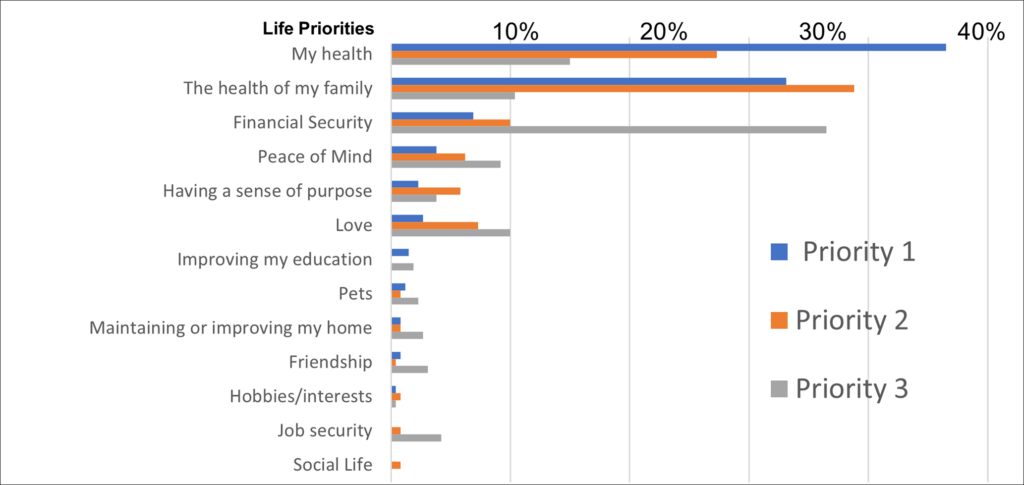
    Understanding where your staff need the most support is the best place to start. For our survey, we asked respondents to rank 13 important life factors in order of importance. The top three life priorities were ‘my health’, ‘the health of my family’, and ‘financial security’. This was also the case when we broke it down by income, age, or employment status.

    Life priorities results
    Life priorities results


    How do personal factors influence employee priorities?

    A variety of personal factors can affect employee needs. e.g., age, income, industry and location.

    Let’s focus on a couple of these:

    Life priorities by age:

    The Engage survey revealed that the top 3 priorities (health, health of family, financial security) remained the same across all age groups. The priorities following the top 3, however, saw slight differences between the older generation and younger. The older age group of employees were less likely to prioritise obtaining a sense of purpose, love, and friendships – focusing more on health.

    Meanwhile, the younger employees placed a higher emphasis on improving their education and boosting their careers, social life, and love.

    With such a wide range of priorities, businesses must work out how best to fulfil the needs of all.

    Life priorities by income:

    As with the different age groups, the top 3 priorities were consistent across income groups.

    An interesting finding that came out of this was how maintaining/improving the home, having a sense of purpose, and improving education, ranked higher amongst lower-income groups, compared to others. Perhaps this trend will encompass more people in the wake of rising living costs.

    There is a wide range of benefit options available to support these initiatives, so it’s important to consult with your teams and get a true understanding of what they most need.


    Current employee priorities: a surprise, or expected?

    With the current industry trends (such as remote/hybrid working), you would think there would be a move away from traditional priorities in employee benefits such as health – but no! Employee health and wellbeing still sit comfortably at the top of the list, reflecting how staff worries around how to best look after themselves has only been amplified by the pandemic.

    The pandemic has increased our awareness of mental wellbeing and how important it is to have a positive work-life balance. The pandemic, costs of living rising, world conflicts, remote/hybrid working, and the Great Resignation, have forced many to question the how, when, and where of workday expectations.

    Has a reset of priorities, perspectives, and work culture been on the cards for a while?

    Many workers are looking to employers to prioritise flexibility and skills development opportunities, allowing a sense of freedom and autonomy on flexible working options and a selection of benefits to suit their individual needs. And yet, despite the rising demand for these lifestyle perks, they still don’t trump the fundamental importance of health and wellbeing among people’s priorities.

    Looking for expert advice on how to establish the perfect employee benefits for your teams? Contact us at +44 (0)1273 974419 or click on the bottom right chatbox. We’re here to answer any queries, offering FREE no-obligation support.


    How the pandemic has influenced employee benefit demand

    More than two years on from the beginning of the pandemic and we are all still feeling its impact. This is particularly shown through the shift in life priorities and the added onus on looking after our health and wellbeing. The prominence of health remaining at the top of the list is likely a reflection of a growing sense of external threat.

    The strain on NHS services and concern over what support resources are available is another factor of likely concern – certainly one that points in the direction of private healthcare.

    Health is not the only issue. There are also concerns over personal finances. Earnings may have been hit during the pandemic, there are rising costs every which way you look and general increasing financial uncertainty. No surprise then that financial security sits firmly among the top three employee priorities.

    It’s worth noting that employees had these same needs pre-pandemic; their priorities have just been heightened over the past two years. Essentially, this raises the stakes for employers.


    Employee benefits which address staff needs

    If your teams are feeling listened to, appreciated, and supported, their output is inevitably only going to improve, and your business is going to be thriving.

    To target your employee’s top priorities (in particular health, family health, and financial security) you could offer:

    To help decide on which employee benefits your staff want, try consulting your team directly. This could be done through workplace surveys, setting up 1-2-1s, group meetings, or via email.

    Further reading: How to measure employee wellness in the workplace


    At Engage Health Group we help match employee benefits to the needs of your business and its employees – all within budgetary requirements. We offer FREE comprehensive advice, quotes and ongoing support to help alleviate the strain on HR teams.

    Contact us at Engage Health Group Ltd or call +44 (0)1273 974419 for FREE no-obligation advice and support.

  • FREE report: The employee’s perspective on workplace health and wellbeing

    FREE report: The employee’s perspective on workplace health and wellbeing

    We surveyed hundreds of UK employees spanning a wide range of sectors and industries from retail to professional services. The results tell us about employees’ priorities in the wake of the pandemic and how well companies are meeting demands.

    In our FREE 19-page report you will discover answers to the following questions:

    • What are employees’ priorities in the wake of the pandemic?
    • Do employees feel their workplace supports their wellbeing?
    • Is wellbeing considered a business priority?
    • How strong is the correlation between employee benefits and loyalty?
    • What employee benefits are being made available?
    • What are the most desired workplace benefits for employees today?


    Unsurprisingly, nine out of ten employees listed health as their number one life priority. But it’s interesting to learn what specific benefits are seen as the most important for supporting wellbeing.

    At Engage, we believe businesses should take a holistic approach to wellbeing in order to best support workers’ needs. Our survey explores this issue and much more.


    Click here to read the full report.


    Need help formulating an employee benefits scheme? Arrange a free chat with one of our expert advisors. Call 01273 974419 or use the chatbox and we’ll happy to answer your questions.

  • Looking for the right international insurance policy? Here are 9 to consider

    Looking for the right international insurance policy? Here are 9 to consider

    If you’re a company with employees spread across different countries, you might be wondering which international insurance policy or related benefits you should provide. Whether you have global offices, expat workers or a team of far-flung remote employees; it’s far easier to support them centrally rather than via separate policies and points of contact.

    The net benefit of implementing everything within one policy is less paperwork and reduced admin processes for HR teams – plus, a more cohesive offering for employees. Surveys show that over a third of businesses are increasing the number of international remote workers unaffiliated to a local office.

    In this context, offering attractive and easy-to-administer benefits will be key to winning the battle for talent.

    This blog post reveals:

    • The top 9 international insurance policies & related services
    • International Health Insurance trends and price ranges
    • 4 key benefits of investing in a single international scheme vs separate local schemes

    If you’d like one-to-one expert assistance call +44 (0)1273 974149 or use the chatbox on the right.


    9 international insurance policies and services to consider

    1. International Business Health Insurance:

    What does it do?

    Gives your employees access to private healthcare, wherever they are in the world. A specific short-term policy also exists for employees working abroad for between one and 12 months.

    Why provide it?

    Fulfils your duty of care to employees all over the world, gives them the medical support they need when they need it, reduces the chances of a failed expat assignment, and can also help diagnose problems before they occur thereby reducing absenteeism.

    Learn more about International Business Health Insurance

    2. International Group Life Insurance

    What does it do?

    Provides financial support to a team member’s loved-ones in the event of their death – wherever they are in the world.

    Why provide it?

    Reassures employees that their family is looked after should the worst happen. It’s also a relatively low-cost international insurance policy.

    Learn more about International Group Life Insurance

    3. International Group Income Protection

    What does it do?

    It provides financial support to an employee should they fall ill, wherever they are in the world. Essentially, it’s a form of sick pay.

    Why offer it?

    Rather than the business having to foot the bill for staff absence, the insurance policy covers it – avoiding a potential financial hit. For the staff member, it provides essential financial support. Income Protection is currently ranking as the most desired benefit in the post-pandemic era.

    Learn more about International Group Income Protection

    Looking for independent and impartial advice on international insurance policies and other benefits? Our team of expert advisors will be happy to answer all your questions. Call us on +44 (0)1273 974149 or use the chatbox on the right.

    4. International Group Critical Illness

    What does it do?

    Provides financial support to your international workforce in the event of a serious illness or, in some policies, if they suffer a disability.

    Why offer it?

    A serious debilitating illness is a major life event and many would struggle to support themselves or their families in the absence of a regular income. This international insurance policy comes to the rescue by providing support when it’s needed most.

    Learn more about International Group Critical Illness

    5. International Employee Assistance Programmes

    What does it do?

    While it’s not strictly an international insurance policy, it’s an important related service often included with a policy. An IEAP is a digital platform which provides practical health and wellbeing support to employees, either via a mobile or desktop app. Counselling services, financial advice, and stress support are among the services offered.

    Why offer it?

    Multi-lingual support means it’s easy to provide everyday wellbeing support to your global teams. In essence, it helps them help themselves, empowering them with the tools required to be happier, healthier and more at ease with whatever life and work throws at them. They are much vaunted for their ability to reduce staff sickness absence rates.

    Learn more about International Employee Assistance Programmes

    6. Group Travel Insurance

    What does it do?

    Provides insurance coverage for groups of employees travelling abroad, covering them for things such as: accidents, illnesses, lost possessions and travel cancellations.

    Why offer it?

    Particularly useful if you have teams travelling abroad for business trips. A comprehensive policy can massively reduce the burden on HR if employees’ get into difficulty, providing rapid support and guidance for all the issues covered within the policy. You might also be able to get travel insurance with Covid cover.

    Learn more Group Travel Insurance

    7. Pre-Assignment Screening

    What does it do?

    Provides a series of checks designed to assess an employee’s suitability for working overseas. Health screening, personal evaluation, pre-trip preparation and family support is often included.

    Why offer it?

    The failure rate of expat assignments can be quite high if not managed appropriately. Pre-assignment screening maximises the chances of a successful assignment by checking the psychological and physical wellbeing of the employee before they leave, and ensure that every potential challenge is considered or negated in advance.

    Learn more about Pre-Assignment Screening

    8. Kidnap & Ransom Insurance

    What does it do?

    It supports a business in the event of an employee’s kidnap or hostage. It covers consultancy costs (hostage negotiators, for example), care expenses (physical & mental), legal costs and/or employee replacement costs.

    Why offer it?

    If your business operates in a part of the world prone to such incidents, or you have high net worth individuals, then Kidnap & Ransom Insurance may be advisable. It helps protect both employee and business alike, both during and after the incident. This international insurance policy is often overlooked by businesses.

    Learn more about Kidnap & Ransom Insurance

    9. Cultural training

    What does it do?

    It’s a specific form of workplace training which essentially equips people (expats, multi-national workplaces and/or global leadership teams), with the knowledge and skills to communicate effectively across different countries and cultures, free of misunderstanding or cultural faux pas.

    Why offer it?

    Ultimately, improved communication leads to improved team dynamics – driving productivity and bolstering team morale.

    Learn more about Cultural Training


    International Health Insurance trends and price ranges

    Global health insurance provider, APRIL International, were happy to share with us some of the current trends they are witnessing. With over 30 years of experience and operations globally covering more than 150,000 insured members in 180 countries around the world, this is a market they know well.

        • Average International Business Health Insurance premiums: An employer can expect to pay on average £1,500 – £2,500 annual premium per employee but of course this can vary depending on the age, location and level of benefit required. For a basic Inpatient only policy with APRIL International we can expect an annual premium of around £1,200.
        • Average age range: The average age of an employee we typically see for an SME group is 35-40 years.
        • Percentage of ‘new to market’ business: 20-30% of group enquiries are businesses which have not purchased a policy previously. 70-80% are existing clients looking for an alternate offer to their renewal.
        • Mental health provisions are in demand: Over the last 5 years in general there has been a real emphasis on mental health awareness and therefore almost all brokers and customers query the cover in relation to this aspect.


    In a post Covid world, health insurance for global employees is likely to become ever more important. Global insurance providers such as APRIL International offer a route through the complexities of accommodating this risk.


    4 practical benefits of investing in single international insurance policies

    A single international employee benefits scheme provides several advantages over domestic, single country schemes:

    1. Consistency:

    International benefit schemes provide a consistent range of benefits and support for all staff across multiple countries creating simplicity and ease of administration.

    Even if an employee moves from one country to another, the scheme can be designed to move with them. This saves the trouble (and cost) of removing an employee from a pre-existing policy and enrolling them onto a new one.

    1. Generous terms

    When you have multiple employees under one policy, you can gain improved terms and conditions. This is the typical ‘bulk buy’ effect. For example, it’s possible to get Medical History Disregarded underwriting on an International Health Insurance plan – this means an individual’s previous medical conditions are overlooked in the pricing and/or terms of the policy. A single national policy is unlikely to offer such generous terms.

    1. Centralised and simplified

    Hundreds of HR hours can be saved by bringing together a range of insurance schemes and perks in one place. Different languages, renewal dates, currencies and points of contact can be brought into a centrally managed system.

    “Having one central point of contact to administer a group’s international healthcare cover across time zones and languages is costly, so if this burden can be borne by the insurer, the client will save valuable resource,” said Adam Vogt, Sales Director from APRIL International. “Equally, having clearly defined procedures and benefits centrally on a company intranet can ensure all have access and the rules and policy operation are made easier.”

    1. Superior quality

    Many international insurance policies will provide more extensive levels of cover than domestic policies. This is particularly true of global health insurance, where individuals may have access to extra services such as: maternity care, private GP visits, preventative health screening, dental, optical, wellbeing and medical evacuation.


    Would you like to outsource the workload?

    Many companies choose to utilise an insurance broker when seeking out an international insurance policy. A good broker can alleviate the strain on HR by doing all the legwork involved in sourcing and implemeting a scheme.

    Engage Health Group is a broker fully independent of any insurance provider. That means we can offer impartial advice free of charge and obligation.

    Tel: +44 (0)1273 974419 or use the chatbox on the right.