Blog

  • Engage compares & contrasts all major UK health insurers (so you don’t have to)

    Engage compares & contrasts all major UK health insurers (so you don’t have to)

    You’ll find many insurance brands vying for your attention when looking for Group Health Insurance.

    At Engage Health Group, we consider all insurers and their various offerings before matching our clients with a policy. There are eight main insurers we work:

    • Aviva Health
    • AXA PPP
    • Bupa
    • Freedom Health Insurance
    • Vitality
    • WPA (Western Provident Association)
    • Benenden Health
    • YuLife

    (Note: other brands exist, but they sell insurance offerings from one of the main providers rather than a distinct offering.)

    Most insurers offer similar core medical benefits, but each has its own unique terms & conditions and pricing structures. The typical exemptions include chronic conditions (incurable and long-term ailments) and pre-existing conditions experienced before the policy starts.

    It’s worth noting too that each provider is expanding the digital services they offer to support mental health and broader employee wellbeing.

    Which insurer has the right policy for your business? Our team of award-winning brokers compare and contrast policies from all the providers to ensure businesses get the best available deals. Call 01273 974419 or email enquiries@engagehealthgroup.co.uk for a FREE consultation.


    1. Aviva Health 

    Aviva Health is one the biggest players in the UK health insurance scene, offering a wide range of packages aimed at different business types. Some of its highlight offerings include: extensive cancer cover, dedicated mental health support through its ‘Mental Health Pathway’ and a ‘BacktoBetter’ initiative designed to help those with musculoskeletal disorders.

    A notable characteristic of Aviva’s health offerings is choice. Businesses can opt for relatively simply plans or, for corporate businesses, fully customisable plans.

    Main office locations:

    Eastleigh / Sheffield

    Businesses catered for:

    • Small businesses (one to 99 employees)
    • Medium-sized businesses (100 to 249 employees)
    • Corporate businesses (250+ employees are served under its flexible ‘Optimum’ package)

    Origins:

    • Founded as Norwich Union Healthcare 1990
    • Merged with CGU to become CBNU 2000 – to then become part of the Aviva Group


    2. AXA PPP
    As the second-largest health insurer in the UK, AXA PPP provides wide and varied offerings. It provides all the things you would expect, including: standard inpatient treatment, cancer cover, and diagnostic tests and scans. Again, AXA’s plans can be easily tailored to include added-value services such as mental health cover, therapy, travel insurance, and optical and dental care.

    Main office locations:

    Tunbridge Wells / Leicester

    Businesses catered for:

    • Small-Medium businesses (1 to 249 employees)
    • Corporate (250+ employees)

    Origins:

    • Established as the London Association for Hospital Services 1938
    • Acquired by the wider AXA Group 1999
    • Acquired Bournemouth-based specialist online PMI provider, Health-on-Line 2012
    • Acquired SimplyHealth / Permanent Health Company 2015


    3. Bupa

    A not-for-profit organisation, Bupa is one of the most recognisable names in the UK health insurance industry. Bupa offer the classic health insurance options (in-patient / day-patient treatments), with the option to incorporate full out-patient cover.

    Bupa offers four different options for small businesses, ranging from Select Custom up to Select Complete (the latter, as the name would suggest, offering the most comprehensive cover).

    Main office locations:

    Staines / Manchester

    Businesses catered for:

    • Small-Medium businesses (1-249 employees)
    • Corporate businesses (249+ employees)

    Origins:

    • Founded 1947 (one year prior to NHS)


    “Not only did Engage Health save us a lot of money on our health insurance and benefits, they also did all the hard work for us in an area that can be a bit of a minefield!”

    For a free consultation and impartial advice contact our award-winning team on 01273 974419 or enquiries@engagehealthgroup.co.uk. 


    4. Freedom Health Insurance
    freedom health insurance logo

    Freedom Health Insurance is a specialist health insurer offering innovative products and services to businesses. But it’s also underpinned with the kind of services you would expect from a Group Health policy, including full cover for inpatient and day-patient treatment, accommodation in private hospital rooms and extensive cancer cover.

    Main office locations:

    Bournemouth

    Businesses catered for:

    • Small-Medium business
    • Corporate

    Origins:

    • Freedom Health is a family-run company founded in 2003.


    5. Vitality

    Vitality is an innovative provider in the UK, particularly in the digital space. For example, its Active Rewards Scheme rewards members for keeping fit and living healthily. This digital app allows members to log their healthy activities (e.g., step-count, gym workouts, swimming metres), and in return members build up points for discounts on products/perks with partner companies!

    However, it also offers the classic health insurance services – inpatient and day patient coverage (covering hospital and consultant fees), outpatient surgery, cancer care, virtual GP appointments, mental health support and more.

    Main office locations:

    Bournemouth / Stockport

    Businesses catered for:

    • Small-Medium business (1 to 249 employees)
    • Corporate (for 100+ employees)

    Origins:

    • Originally PruHealth: 2004 marked the beginning of a joint venture between Prudential / Discovery Group
    • 2010: Became Vitality after Discovery bought Prudential out of their share
    • Acquired Standard Life Healthcare


    6. WPA (Western Provident Association)

    WPA is a well-established not-for-profit health insurer in the UK market, offering flexibility in their health and wellbeing initiatives. Their schemes can suit specific business needs, with a wide range of services including at-home nursing, private ambulance transport, EAPs, private cover, cancer care, and mental health support.

    Some of the optional extras include things like Overseas Emergency Treatment, GP Services, Dental Care and a Cash Plan arrangement.

    Main office locations:

    Taunton

    Businesses catered for

    • Small-Medium business
    • Corporate

    Origins:

    • Founded 1901


    7. Benenden Health

    A not-for-profit organisation, Benenden Health offer private healthcare that complements the NHS, giving members access to a range of services – private diagnostic tests, treatments, 24/7 virtual GP, mental health support, physiotherapy and more. While Benenden doesn’t offer the same depth of coverage as other providers on this list, it can be a useful option for businesses with a lower budget.

    Benenden function as a ‘mutual’ society, meaning it is run both by and for its members. Members have a say in how the organisation is run, helping with key decisions. The lowest-cost private healthcare offering from Benenden comes in at £12.80 per employee, per month.

    Main office locations:

    Kent

    Businesses catered for:

    Best suited to smaller businesses which cannot afford more extensive policies.

    Origins:

    • Founded 1905: originally to provide treatment for postal workers suffering from Tuberculosis


    8. YuLife
    YuLife is a tech-driven insurance company, allowing customers to access healthcare and wellbeing services through its digital app. The YuLife app is aimed at rewarding small behavioural changes in everyday life. Now partnered with Bupa, customers can access private group health insurance directly through YuLife. The aim is to combine cutting edge technology with the resources of a major health insurance provider.

    Main office locations:

    London

    Target audience for health insurance:

    • Small-Medium Business
    • Corporate

    Origins:

    • Founded 2016


    Need help with your Group Health insurance scheme?

    Engage Health Group is a health insurance brokerage and consultancy which helps businesses negotiate the health and wellbeing marketplace. We work on behalf of businesses, not the insurance industry, so you can be rest assured that you’re getting advice you can trust.

    As well advising on Group Insurance, we also advise on Group Life, Group Income Protection, Group Critical Illness and many other aspects of workplace health and protection.

    Contact our expert team at enquiries@engagehealthgroup.co.uk or call 01273 974419 for FREE no-obligation advice and support.

  • Engage wins Best International Group Advice Firm at the UK Health & Protection Awards 2023!

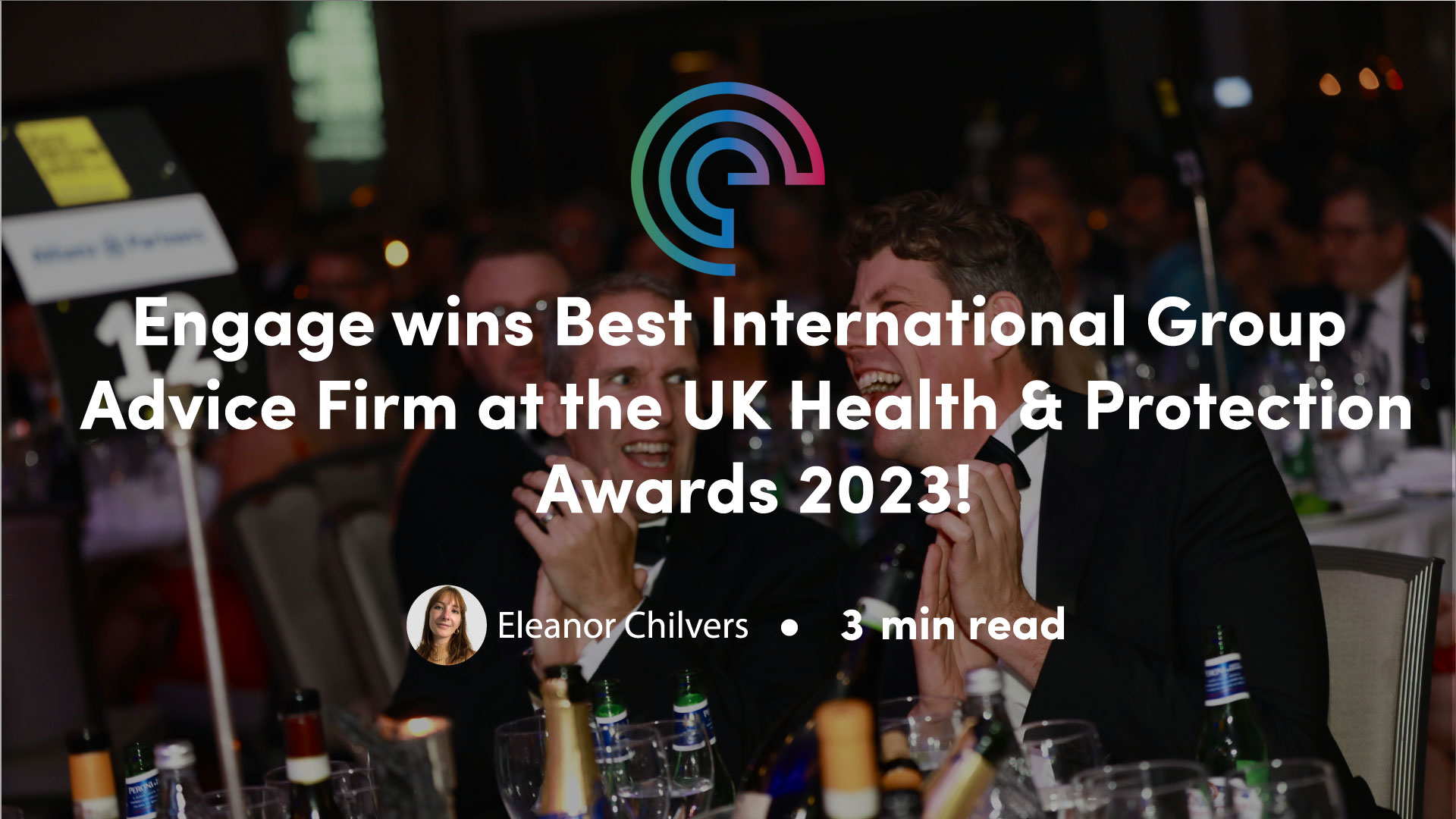
    Engage wins Best International Group Advice Firm at the UK Health & Protection Awards 2023!

    Engage Health Group were amongst the 750 brokers and providers at this year’s UK Health & Protection Awards which celebrated the very best the industry has to offer.

    Comedian Russell Kane led us through an evening of sharp quips and sharp suits as we kept our fingers-crossed for a second consecutive year of awards success.

    And we weren’t disappointed…


    A fantastic win for the Engage International team!

    Just being nominated for a UK Health & Protection Award is a big deal, but to actually win is a testament to the hard work the team has put in to providing a high quality service to our business clients.

    Winners: Best International Group Advice Firm

    The Engage International team, led by Ian Abbott, has dedicated itself to unravelling the complexity of global health and protection policies and making it simpler and more accessible to companies with employees in multiple countries.

    Our team of international brokers have gone the extra mile to win this award with their full commitment to keeping abreast of the latest trends and legislative changes, and sourcing the best health and protection policies in whichever country a company needs them.

    Providing innovative and client-specific solutions was a key reason for our success in this winning this award.


    A near-miss for Esme and Stuart

    Two of our team just missed out on individual awards. Stuart Box was nominated for the Best Health Insurance Adviser, and Esme Pearson for Outstanding Newcomer Award.

    While they didn’t win, we couldn’t be prouder for the acknowledgement they both so deserved.


    What Engage does differently…

    For the last seven years now we have been building a fantastic, dynamic team of brokers that can adapt to any specific client need, no matter how big or small. This could look like anything, from setting up global health insurance schemes, to helping new businesses launch their employee benefits strategies.

    Our International Director, Ian Abbott, shares why this award has meant so much to his team and Engage Health Group as a whole:

    “We set ourselves apart through the in-depth consultancy we offer on top of the typical broker remit of sourcing quotes and explaining how different policies work.

    “International benefits can be very complicated, but when a business comes through us, we can handle the whole process on their behalf regardless of the countries their employees are situated in or the policies they are seeking.

    “It’s nice to get the recognition for the hard work the whole team has put in, especially by industry peers.

    “We’re keen to grow the team and expand what we can do, by providing new innovative solutions for our clients.”


    Well done to Hooray Health & Protection!

    Our sister company, Hooray Health & Protection, came away with a couple of wins too. They won the Best Sales and Retention Advice Team and Best Small Health Insurance Advice Firm.

    Hooray specialises in assisting SMEs and start-ups. They continue to do brilliant work in making employee benefits more accessible to smaller businesses who have traditionally struggled to source the kind of high quality advice which is available to larger businesses. By pooling our expertise we’re able to assist businesses of all sizes with a consistent level of service.

    Charlie Cousins award collection
    Charlie Cousins award collection


    What next for Engage?

    Engage continues to seek innovative ways to better help UK-headquartered companies with their domestic and international employee benefits policies. Sourcing and implementing policies needn’t overburden HR teams. We make it our job to reduce their workload and maximise the ROI of any scheme they require.

    If you’d like FREE expert help and advice from an award-winning broker, get in touch on 01273 974419 or email enquiries@engagehealthgroup.co.uk.

  • How to spot disengaged employees (and what you can do to help)

    How to spot disengaged employees (and what you can do to help)

    “When employees are unhappy with their job, they underperform and they’re less productive. Smart employers invest in employee happiness.”

    Hendrith Vanlon Smith Jr, CEO of Mayflower-Plymouth

    A study by Perkbox found that disengaged employees cost the UK economy £340 billion every year due to the associated costs of training and recruitment, staff sickness, lost productivity and stifled innovation.

    The costs can quickly spiral unless you spot the warning signs and tackle the root causes at the earliest opportunity.

    In this article, we explore the tell-tale signs of disengagement and look at the four major causes businesses can tackle.

    Employee benefits play a vital role in improving workplace engagement. Get FREE one-to-one advice from our award-winning brokers on 01273 974419 or email enquiries@engagehealthgroup.co.uk.

    How to spot a disengaged employee

    When staff become disengaged, the signs can be right under your nose but easily missed, especially as these things tend to happen gradually. You might dismiss it as ‘this is just the way that he/she always seems’. However, some of the early warning signs to look out for include:

    • Lack of enthusiasm
    • Poor productivity
    • Lack of initiative
    • Sluggish responsiveness
    • Irritability
    • Careless errors
    • Low mood
    • Poor quality work
    • Reluctance to be involved in team events

    If disengagement is not addressed early, then it may lead to the following:

    • Increased staff sickness
    • Neglected work duties
    • Deteriorating work quality
    • Negative influence on colleagues
    • Keep quiet and stay unhappy
    • Quitting the company

    HR data and tools may also help diagnose such problems, especially if it includes staff satisfaction surveys and general statistics around staff sickness and staff retention – you might see general trends which point to an underlying problem with workplace culture.

    4 major causes of disengagement

    1. Burnout

    Sixty-eight per cent of UK adults mistakenly identify burnout symptoms with anxiety. This suggests it’s a bigger problem than a lot of people realise.

    Causes of burnout include:

    • Heavy workloads and persistent deadline pressures
    • Role conflict/confusion
    • Lack of constructive support e.g., feedback, participation, recognition
    • Lack of knowledge/expertise for the role
    • Long hours

    When staff are stretched too thinly, they may end up doing the bare minimum on several fronts. Work becomes a box-ticking exercise rather than an opportunity for employees do their best.

    Suggested solutions:

    The simple solution is to ensure that employees can report back any concerns about their workload, and figuring out ways to spread the work more fairly.

    2. Lack of opportunity for progression & personal development

    A big contributor to disillusionment is a lack of opportunity for progression or personal development. It’s important for staff to feel they are working towards something, whether that’s new career opportunities or learning new skills. Without this, you run the risk of your employees feeling stagnant at work and in life in general.

    Investing in staff development will help boost their confidence and motivation.

    Suggested solutions:

    Try investing in:

    • Short courses and classes which develop a range of soft or work-related skills
    • Professional development opportunities
    • Career pathways which employees can explore
    • Personal development days in addition to statutory holiday

    3. Ineffective employee benefits

    There are so many employee benefits that can help support a positive workplace culture. In turn, this helps staff remain engaged and able to give their best efforts.

    Suggested solutions:

    • Health and protection schemes: Private healthcare is still a hugely popular benefit as it gives quick access to consultations, diagnostic scans, mental health support and a wide range of treatments. Meanwhile, policies like Group Life Insurance and Critical Illness Cover support provide protection should the worst happen.
    • Employee Assistance Programmes: usually included with a Group Health scheme, an EAP promotes self-care and provides easy stress management tools to help staff with low concentration, poor sleeping habits, and provides them with the tools to tackle everyday health needs.
    • Health Cash Plans: a lower cost alternative to health insurance to help support staff with everyday health needs and problems, providing a range of support such as physiotherapy, counselling, acupuncture, financial training etc
    • One-to-one counselling sessions: these can be either be provided through Health Cash Plans, EAPs, as an add-on to health insurance, or as a standalone product
    • Apps and online mental health services: again, these can be offered with EAPs and benefits platforms, or purchased as a separate product for staff to manage however they need
    • Flexible work arrangements: an easy and cheap way to allow your staff the space and autonomy they need to work in a way that works best for their lifestyle.

    Some extra small workplace changes to help your staff feel heard/listened to:

    • Regular one-to-ones
    • Monitor workloads and scheduling
    • Seek further feedback from staff on certain issues
    • Regular team meetings
    • Regular social gatherings outside of the workplace: staff can connect with colleagues and express themselves in a more relaxed/open environment

    Need impartial advice about employee benefits and healthcare schemes? Engage Health Group’s expert brokers will review any schemes currently in place, or help you set one up for the first time. All FREE of charge. Email enquiries@engagehealthgroup.co.uk or call +44 (0)1273 974419.

    4. No recognition or rewards

    All employees need regular recognition for their work; without it they’ll be left feeling their efforts are going unnoticed. Investing in creative ways to reward the hard work of your employees will boost productivity, retention, and company culture, as well as helping staff feel connected to the company!

    Suggested solutions:

    • Team building events
    • Virtual gifts
    • Promotions
    • Peer-to-peer recognition
    • Employee recognition platforms
    • Performance bonuses
    • Company parties
    • Early Friday finishes
    • Vouchers and gifts
    • Staff discount schemes

    Further reading: 8 ways to recognise remote teams in 2023

    Finding the right support with Engage

    Every employee who feels happy, valued, and listened to at their place of work will be more likely to want to stay at that company and deliver their best work. It’s all about creating a supportive company culture in which employees feel valued and listened to.

    One important element of that is your employee benefits offering. An independent broker like Engage Health Group can help you negotiate the marketplace safe in the knowledge you’re getting advice from people who are working on your behalf and in your best interests. We take the time to talk you through all options available and gather the best quotes and terms from across the market.

    Contact our expert team at enquiries@engagehealthgroup.co.uk or call +44 (0)1273 974419 for FREE no-obligation advice and support.

  • Do you need Sick Pay to go global? There’s a policy for that…

    Do you need Sick Pay to go global? There’s a policy for that…

    Rules and regulations related to sick pay vary greatly in different parts of the world. In some countries you’ll be obliged to cover sickness absence (up to a point), while in others you won’t. But that doesn’t mean your approach to looking after employees should be inconsistent.

    Today’s global employers have the option of investing in a single International Group Income Protection scheme which provides financial protection to multiple employees in multiple countries.

    In this blog post, we put this policy under the microscope:

    • What is International Income Protection?
    • What’s the problem with separate local schemes?
    • Why is sick pay insurance important for remote workers?
    • How to get free expert help

    Looking for global employee benefits and insurance policies for your international staff? Call our award-winning team on 01273 974419 or drop us an email enquiries@engagehealthgroup.co.uk.


    International Group Income Protection (AKA Sick Pay Insurance) explained

    What is it?

    International Group Income Protection provides employees and their families with a lump sum payment in the event of them falling ill, having an accident, or developing a disability. Essentially a form of sick pay, it provides extra financial support to employees no matter where they are in the world, going further than the usual sick pay requirements.

    As an international insurance policy, it is designed to cover staff based in different locations and territories, supporting your teams wherever they are based or travelling to.

    How does it work?

    Global Income Protection is paid out if an employee is deemed no longer capable (both physically or mentally) to carry out their job role and duties. Unlike other health and protection schemes, there isn’t a list of included or excluded conditions – it’s merely down to whether they are fit to work or not. The claims process is therefore straightforward.

    Employers have the final decision on how much salary is covered as well as when the payment will kick in (13-25 weeks for short-term cover is typical for this policy). Staff won’t receive income until that time period kicks in. For most policies, employers set a maximum pay-out limit at 80% of the employee’s wage, placing a safety cap on the payments.

    If said employee returns to the workplace but ends up relapsing, payments will pick up again without any additional deferment period. However, remember, this only applies if the return-to-work period lasts less than 60 days and it is for the same health condition as before.

    Income Protection schemes will also provide some rehabilitation support and early intervention services which aid employees in their recovery and ultimately help speed up their return to work.

    How much does it cost?

    Just as it is with many other health insurance policies and products, landing on an exact price point varies depending on a variety of factors:

    • Age
    • Job role
    • Smoking
    • Medical history
    • Number of staff covered (e.g., the more covered, the greater the discount per employee)
    • Coverage provided (e.g., length of deferral period, agreed pay-out amount)
    • Number of countries covered
    • Indexing (coverage can be set to rise with inflation)
    • Extra value services offered by the insurance provider (such as online GP services, return-to-work support services and Employee Assistance Programmes]


    Why not go for separate local schemes?

    Investing in International Group Income Protection will provide your business and staff with one central contract, one set of paperwork, one renewal date, all under one language.

    As you can imagine, this makes for a much smoother and simpler process, compared to having lots of different policies in different locations. Doing this will save time and money for HR handling claims. This is true across most areas of employee benefits, whether it’s the systems used to manage and make them available, or the policies themselves. For example, Group Health Insurance, Life Insurance and Critical Illness schemes can be all be purchased as a single policy covering multiple countries – and all made available on a single platform.

    Would you like to ask an expert about International Group Income Protection? Call 01273 974419 or email enquiries@engagehealthgroup.co.uk. We can also gather quotes tailored to your business need without any charge or obligation.


    Why Sick Pay Insurance is important for remote workers

    Income Protection provides essential financial support to your staff, giving them peace of mind that they will be supported by the organisation they work for. This reassurance is particularly needed for expat employees, globally-distributed workers, and their families where they might not have access to the same safety nets as they would at home.

    Why else is it so important for a global remote workforce?

    • Provides employees working overseas with vital cover, especially if they have no access to a local business income protection policy
    • Provides one centralised policy covering everyone no matter where they are located, all handled with in one language and through one point-of-contact
    • Protects your business from the impact of long-term sick pay liabilities
    • Provides financial security and reassurance to staff and their families
    • Remote global staff feel more connected to the business and colleagues by being offered the same level of care
    • Provides support services to help employees in their recovery – reducing their recovery time and potentially speeding up their return-to-work
    • Most providers include wellbeing apps and services which give practical day-to-day help to employees across a wide range of issues


    Get further support from an international broker

    The first thing that most companies want to know about International Income Protection insurance is how much it is going to cost. The only way of knowing is by getting in touch with an impartial broker who will gather your details and source quotes from across different providers. So, if that’s you, contact us via the form on the right or via the contact details below.

    The award-winning team at Engage Health Group have a wide reach of global partnerships spanning 61 countries and territories which means we can give you the best advice and the most competitive quotes on the market.

    Contact us at enquiries@engagehealthgroup.co.uk or call 01273 974419 for FREE no-obligation advice and support.
  • 4 ways to help your staff return after a leave of absence

    4 ways to help your staff return after a leave of absence

    Returning to work after an extended period away can be daunting and even stressful for any employee. No matter why your staff are taking a leave of absence, transitioning back to the workplace can naturally leave staff feeling anxious and overwhelmed. 

    Long term leave can occur for a variety of reasons: maternity or paternity leave, ill health, mental health issues, or for compassionate leave. Either way, a return to the workplace can be a shock to the system.

    In this blog, we’ve detailed four ways to support your staff make a smooth transition back to work.

    Need helping finding the right employee benefits to support the wellbeing of your staff? Give our award-winning team of brokers a call on 01273 974419 or email us at enquiries@engagehealthgroup.co.uk


    Build good communication throughout the process 

    It’s important to keep in touch with your staff during their absence and after their return to work. Ultimately, this is about finding out what kind of help you can offer and letting them know that support is there when they need it. 

    Also, ensure your staff are fully aware of what to expect when returning to work, such as any new working arrangements, or if there is additional training required to get them up to speed. Ongoing support might be required, so arrange one-to-one meetings if necessary. 

    The same goes for keeping in touch during the absence period. Communication lines need to stay as open as possible to make sure your away staff feel in the loop with the rest of the business. Though it’s important not to overstep the mark and bombard them with updates they don’t want! 

    Another key area of communication in your business lies with your line managers. They need to be able to hold difficult and sensitive conversations with other employees and understand the support services available to them. Such services might include online resources, wellness apps, Employee Assistance Programmes, health insurance policies and counselling services.

    Adopt the flexible approach 

    Each one of your employees is different, so what might work for one person, might not work the same way for another. So, be ready to adapt to the needs of the person in front of you. But some conditions, both mental and physical, can fluctuate, which in itself requires a little ‘flex’ from an employer.

    Flexibility can also extend to the way in which work is done. Most digital companies are already exercising some form of remote working (whether partial or full time), but flexibility can also be offered in the hours that employees work, AKA ‘flexi time’.

    Flexible working arrangements can be helpful to anyone returning from a leave of absence, not just working parents. Giving your people the opportunity to move at their own pace will reduce the chances of them becoming overwhelmed and suffering any further setbacks – whether they continue to recover from illness, emotional distress, burnout or any other related malady. 

    Address stigma 

    Educate your team! Addressing any potential stigma or lack of understanding in the workplace, especially around mental health issues, will create a supportive and inclusive environment for returning staff. This could be achieved through:

    Recognising that returning to work can be difficult and stressful for a lot of employees is also a way to break down any stigma surrounding the transition. For example, staff could have concerns about their ability to perform their role or anxiety regarding other colleagues. Businesses must be sensitive to this and provide appropriate support and zero judgement to help the transition. 

    Offer the right employee benefits and insurance 

    Setting up the right employee benefits and health policies can help your staff in multiple ways. Below we have listed a handful of employee benefits that can directly help your staff when they are returning to the office, or if they are still on a leave of absence. 

    Group Income Protection

    One of the most direct ways of helping your staff is via an Income Protection scheme. Not only does it pay extra money beyond the scope of statutory requirements, policies also offer expert assistance designed to help employees recover quickly and make a speedy return to work, and sometimes even support them with that transition.

    Group Health Insurance 

    Group Health Insurance gives staff access to private health coverage for a range of treatments and services. Time is often of the essence when it comes to health concerns, so receiving fast treatment is important to help them return to work, but also get follow-up checks as and when required. Services can include mental health support and physiotherapy, but policies will vary so it’s important to check the fine detail.

    Group Health Cash Plans 

    Group Health Cash Plans are a lower-cost option to help support the routine everyday health needs of your staff, with services such as physiotherapy, online GP services, health screenings, eye tests, counselling services and more. This is a great way to get support to your teams which they can access themselves with ease. 

    Employee Assistance Programmes 

    Employee Assistance Programmes (EAPs) equip staff with a toolkit designed to help them to build emotional resilience when dealing with difficult circumstances. Support and services related to mental, financial and emotional wellbeing are provided in one accessible location, at the touch of a button. 

    EAPs are a great offering to help staff access the support services they need whenever and wherever they need them, providing autonomy over their own health and access to professional counselling services.

    Online benefits and wellness platforms

    There are a wide range of digital benefits platforms which host a range of wellbeing tools. Some may include a full service EAP (see above), while others simply have a wide range of wellness tutorials and support tools covering a range of issues related to physical and mental wellbeing. Such platforms can vary massively in terms of features and functionality, from simple phone apps to platforms which integrate with HR software.


    Need extra help in knowing how to best support your staff? 

    Having the right support systems and services in place is vital to get your employees back up and running after taking time off from work. As you can see, it encompasses people management, working practices and your employee benefits offering.

    We can help with the latter. Our expert team of award-winning brokers at Engage Health Group will take you through your options and gather a variety of quotes from across the whole market, whether it’s related to Group Health Insurance, Life Insurance, Income Protection or Corporate Wellness Programmes. 

    Contact us at enquiries@engagehealthgroup.co.uk or call 01273 974419 for no-obligation advice and support.

  • International Accidental Death Insurance explained

    International Accidental Death Insurance explained

    No one likes to think about it. And we hope it never happens. But there’s always an outside chance that staff could end up involved in a serious accident – particularly in higher risk job roles.

    Should a fatal accident occur, it’s important that financial and emotional support is in place for bereaved loved-ones. International Group Accidental Death Insurance exists to help families deal with the financial impact.

    Let’s delve deeper into this often overlooked area of life coverage.

    Looking for the perfect international benefits and insurance policies for your global employees? Give our award-winning expert team a call on 01273 974419 or email us at enquiries@engagehealthgroup.co.uk.

    What is International Group Accidental Death Insurance?

    International Group Accidental Death Insurance can be taken out as an addition to an International Company Life policy. It is designed to provide a lump sum to an employee’s beneficiaries should they die because of an accident.

    This lump sum is either set at a specific amount, or is calculated as a percentage of that employee’s salary. It’s a suitable policy for companies with employees based abroad or with expatriate staff on assignment and travelling to different locations.

    The insurance is designed to cover fatalities caused by incidents such as the following:

    • Exposure to the elements
    • Traffic accidents
    • Falls
    • Accidents involving heavy equipment

    Note: it’s always worth checking an individual policy’s list of included incidents as it may vary from provider to provider.

    This type of insurance covers accidental death, not death from natural causes. So, it’s advised to add this onto a Group Life Insurance policy to ensure coverage is there for all circumstances.

    How does this policy work?

    International Accidental Death Insurance can be added onto a Group Life policy. For the beneficiaries to receive the payment, the death must take place within 365 days of the accident and the employee must be actively at work during the time of the event, and not working against any medical advice.

    The lump sum payment (based on the agreed limits) is there to financially protect an employee’s family members in the event of their sudden death.

    Note: the policy doesn’t apply to employees who have engaged in risky activities which has led to death. e.g., drug or alcohol-related accidents, skydiving, mountain climbing or other high risk activities.

    How do you calculate the costs?

    Insurance providers will make their calculations based on your company’s unique risk profile.

    An annual policy is usually better for those organisations with a global workforce present throughout the entire year. On the other hand, monthly or per-trip rates can be a better option for companies with expatriate staff or staff away on occasional work trips abroad.

    Who’s not eligible for this policy?

    This depends on the individual risk and exposure of your global employees. In general, some industries and organisations not eligible for this policy can include marine and military personnel, sports teams, and companies operating in Canada, Switzerland, Australia, and the U.S.

    Need expert help? Contact out team of award-winning advisors for FREE advice and the latest quotes taken from across the insurer marketplace. Email enquiries@engagehealthgroup.co.uk or call 01273 974419. 

    What are the benefits to both business and staff?

    If lots of your staff are working in an environment with either a heightened risk profile or locations with an increased level of danger, having this insurance in place will guarantee some level of support if the worst was to happen. It will help to cover an employee’s family with any unplanned additional costs, providing peace of mind to your staff that their loved ones will be provided for.

    Some more benefits that come from investing in International Accidental Death insurance:

    • Easy to administer (can be added on to a Group Life plan)
    • Adds value to a benefits plan with minimal extra outlay
    • Can cover all staff across multiple countries
    • Protects staff’s loved ones from financial risk
    • Cost-effective way to further show your commitment to protecting your global teams

    Losing a loved so suddenly will be a huge shock for anyone, and the last thing a bereaved family will want to do is deal with the financial ramifications while processing their grief.

    When an Accidental Death scheme is paired with a Group Life policy, you might have access to have additional benefits, such as Employee Assistance Programmes, which provide services to help families deal with the loss of a loved one.

    Upgrade your international employee benefits scheme

    By investing in International Accidental Death Insurance, you are ensuring that employees and their families are protected in the face of unforeseen circumstances while working or traveling abroad. In doing so, businesses will be providing an extra layer of financial security, while demonstrating a clear commitment to the people that work for them.

    It’s crucial to carefully consider any insurance policy, especially when entering the global market. Terms and conditions can vary from provider to provider, while quotes can also differ markedly.

    By consulting with an experienced international benefits broker (like our award-winning Engage team), you can ensure you’re getting the best cover available at the most competitive price point.

    Our expert international team will talk through all your options at a pace that suits you, laying everything out in the clearest possible terms.

    Engage Health Group has huge global reach spanning 61 countries and territories, ensuring you get the best advice available in the global healthcare and protection market.

    Contact the Engage team at enquiries@engagehealthgroup.co.uk or call 01273 974419 for FREE no-obligation advice and support.
  • Top 5 EAP providers for UK businesses

    Top 5 EAP providers for UK businesses

    Employee Assistance Programmes (EAP) are a fantastic way to help staff handle anything that life and work might throw at them, providing proactive support with a range of emotional and psychological issues. But there are many EAPs out there on the market, each with their own set of price points and features.

    We’ll explain exactly how they work and look at the services offered by five leading EAP providers in the UK.

    Need helping finding the right EAP for your business? Get FREE one-to-one advice from our award-winning friendly team on 01273 974419 or drop us an email at enquiries@engagehealthgroup.co.uk.

    What is an Employee Assistance Programme?

    Employee Assistance Programmes are designed to support the general mental health and wellbeing of staff. EAP providers offer a range of services which usually include access to professional counselling sessions, self-help tools and activities, and discount schemes.

    EAPs are accessible under one platform, helping employees to manage problems in work and in life in general. An EAP can help with the stresses and strains associated with:

    • Financial worries
    • Work-related issues
    • Family problems
    • Legal difficulties
    • Housing insecurity
    • Substance abuse
    • Gambling addiction
    • Stress, anxiety, depression
    • Bullying and harassment
    • Feelings of isolation
    • Domestic violence
    • General health and lifestyle issues

    An EAP is not just designed to help those in serious need and you don’t need to be going through a traumatic event to benefit from it’s services! The resources provided are there to improve general emotional resilience, teaching staff how to reach their own inner calm, and feel equipped to handle anything life throws at them.

    Employee Assistance Programmes are accessible for many types of company – big or small – due to its adaptable nature and the wide range of services on offer!

    5 EAP providers to check out

    #1 TELUS Health (Formerly LifeWorks)

    TELUS Health is an EAP provider that covers over 20,000 different businesses, offering support for over 26 million individuals internationally, having joined forces with LifeWorks in 2022. TELUS Health has developed a modern EAP service, with 24/7 counselling and online wellbeing resources to help staff reach their fitness goals and bolster their inner resilience. They also offer savings and discounts on daily essentials and key life events.

    On top of the core coverage, TELUS Health also offers some innovative extras to their programme:

    • Access to a digital news feed providing resources on general wellbeing and the latest updates
    • Discounts on retailers, restaurants, fun activities, daily grocery shop
    • Tools for business owners to track analytics, engagement, talent retention, and productivity
    • Work-life balance support

    #2 Care First

    Care First is an international EAP provider experienced in working with small businesses, as well as larger organisations from across different industries varying in size from 25 to 220,000 employees. Care First has a particular focus on its counselling services and people management tools, including all the traditional EAP features.

    An incredibly helpful option Care First offers is its service integration, ensuring that there are no overlaps or interference with any pre-existing services, potentially helping businesses save money in the process. Every client is unique and so should their EAP service be! Care First works to fit the services seamlessly with any existing business services such as Occupational Health and Absence Management.

    Care First also includes specialist SME solutions to provide the most efficient and affordable cover for small businesses. They have designed a bespoke service for businesses with between 35 to 1,000 employees.

    Would you like to speed up your fact-finding mission by talking to an impartial broker? We’ll be happy to field all your questions about EAPs and give our expert verdict. Get in touch at enquiries@engagehealthgroup.co.uk or call 01273 974419 for no-obligation advice and support.

    #3 Spectrum Life

    Spectrum Life provides mental health and wellbeing support to members and staff of over 2,000 organisations across both Ireland and the UK. Its EAP supports over 4 million active users. Spectrum Life provides Total Mental Health (a professionally accredited mental health resource), digital clinics covering everything from parenting to ergonomics and a range of wellbeing support services. Spectrum Life use its digital platform to provide a single connected solution, combining onsite wellness, digital wellbeing, Employee Assistance Programmes, and health screening.

    Spectrum Life also provides access to a catalogue of mental health seminars and workshops, as well as a variety of digital wellbeing events. They have more than 6,000 wellbeing events booked each year! These can provide extra support and insight to staff and employers, improving their mental health and wellbeing even more – and learning along the way!

    #4 Health Assured

    Health Assured is an award-winning EAP service provider, offering support to over 15 million people in over 160 countries, making them the largest independent UK and Ireland provider. Health Assured offer a variety of services, providing support to many organisations across a range of industries from public, private, and non-profit sectors all the way through to student assistance programmes.

    Health Assured also includes:

    • 24/7 helpline to counsellors, legal, and financial specialists – always answered locally in the UK.
    • My Healthy Advantage: smartphone app and personalised wellbeing tools and content; including videos, webinars, health checks, coaching.
    • Access to a global network of over 1,500 counsellors, trainers and critical incident responders across different communication platforms.
    • Report analytics, management information, organisational benchmarking.

    #5 ComPsych

    ComPsych is a leading international EAP provider based in the US, with one of the largest customer bases in the world, providing support to over 68,000 businesses and 139 million individuals globally. ComPsych’s ‘GuidanceResources’ platform includes its EAP, alongside behavioural health, wellness, and absence management services.

    The company’s global reach and network enables multinational employers and businesses to have a centrally managed EAP to offer to all their staff wherever they may be based. ComPsych, like any good EAP, looks at things from a holistic perspective with a extensive team of in-house specialists on hand to help address a wide variety of needs.

    Employees can access their EAP services in different formats and languages, boosting the overall accessibility for businesses for those with a global reach or expansion goals. Training resources are also provided on wellbeing subjects, including mindfulness and management skills to help members address any life challenges they may face.

    Which EAP provider is right for your staff?

    Finding the right EAP provider can quickly become overwhelming with hundreds of international and UK-based providers all offering different features and price points. However, as an independent benefits and health insurance broker, we can advise on the one which works best for your business and how it interacts with any other benefits you already have in place.

    Remember: most health insurance providers also offer a free EAP with their policies. For example, Bupa’s EAP and AXA’s EAP both come included with their Group Health Insurance plan. So if you’re considering buying a health policy, it might be wise to delay making a decision right away.

    Our expert team of award-winning brokers at Engage Health Group will take you through your options and gather a variety of quotes from across the whole market. We advise on all things employee benefits and health insurance, ensuring your staff’s wellbeing is protected and their needs fully addressed.

    Contact us at enquiries@engagehealthgroup.co.uk or call 01273 974419 for no-obligation advice and support.

  • What health coverage MUST businesses provide to US employees?

    What health coverage MUST businesses provide to US employees?

    Health insurance is one of the biggest hurdles for businesses seeking to hire employees in the US.

    There’s no denying that it can be both outrageously expensive and infuriatingly complicated.

    Four out of five (79%) of SME business owners in the US said that health insurance costs risked eating up their profitability, according to a report by Enterprise Bank & Trust.

    Some companies are legally required to provide health insurance to US employees. But even if your business is exempt, employees are likely to expect it anyway – most working age people receive health insurance from their employer.

    In this blog post, we examine the legal requirements placed upon businesses and reveal what US employees commonly expect from their employer.

    Need one-to-one advice related to healthcare requirements in the US? Speak to our award-winning team of international experts for FREE advice without obligation. Call us on +44 (0)1273 974419 or email enquiries@engagehealthgroup.co.uk

    What are the mandatory requirements and who do they apply to?

    Companies with an average of at least 50 qualifying full-time employees (defined as a minimum of 30-hours a week) in the prior calendar year must offer a health insurance plan.

    Under ‘employer shared responsibility’ regulations, at least 95% of full-time employees must be offered “adequate and affordable” health coverage, including to qualifying ‘dependents’ under the age of 26 (i.e. an employee’s son or daughter).

    Failure to meet obligations will see employees hit with a fine which may be greater than what the group healthcare plan would otherwise cost.

    How much coverage should an employer offer? 

    To provide what’s deemed ‘minimum value’, the health plan must cover at least 60% of overall medical costs for a standard (or average) population. Medical costs are calculated based on an estimate of the cost of services likely to be claimed on the plan. The employee then pays the rest of the cost (a maximum of 40%) – BUT, you can only ask an employee to pay up to 9.12% of their household income towards the cheapest health plan you’re offering.

    Under the Affordable Care Act (ACA), a health plan must cover, as a minimum:

    • Outpatient care (hospital services that don’t require an overnight stay, including consultations, tests and outpatient surgeries)
    • Emergency care
    • Prescription drugs
    • Hospitalisations
    • Maternity and newborn care
    • Mental health counselling services
    • Laboratory services (diagnostic tests including X-rays, blood tests and more)
    • Substance abuse services, including counselling
    • Rehabilitation and habilitation services (services which assist with recovery from injury or illness, and disability assistance)
    • Paediatric services (including routine check-ups, vaccinations, oral and optical care).
    • Preventive and wellness services (such as health screenings, vaccinations, and support for chronic conditions)

    Employers can of course choose to add more services such as dental and optical care or birth control.

    What’s the penalty for failing to meet ACA requirements?

    There are two different ways that a business can fail to meet requirements:

    1. They fail to offer coverage to their employees
    2. They offer coverage to all employees but fail to cover enough of the cost

    In the first case, they need to cover at least 95% of full-time employees (those working 30+ hours a week). Failure to do so attracts a fine of $2,880 per full-time employee, as of 2023.

    In the second case, the penalty for an employer that offers coverage that isn’t affordable and/or doesn’t provide minimum value is $4,320 per full-time employee who obtains a premium tax credit in the marketplace.

    Figures are updated each year at the IRS website.

    To receive business-specific advice related to US healthcare and global employee benefits, contact our team of international specialists. Our advice is given free of charge and there is no obligation to take things further. Call us on +44 (0)1273 974419 or email enquiries@engagehealthgroup.co.uk

    What do employers typically offer?

    Almost all multinational companies provide supplementary medical benefits through a Group Health Insurance plan, and approximately 50% of SMEs also offer coverage in this way.

    (Note: the largest companies self-insure, which means they pay for health treatments through their own finances rather than out of an insurance policy.)

    Companies typically buy a US Group Health Insurance plan in one of the following ways:

    Preferred provider organisation (PPO) plan:

    A PPO plan is provided by around two-thirds (66%) of large employers, making it the most common means of purchasing healthcare, according to data gathered by Axco. The employer or the insurer can negotiate fees with the PPO to gain access to a network of hospitals and medical professionals. They can also get access to medical services outside of the network, which makes this a higher cost means of Group Health Insurance in the US.

    High deductible health plans (HDHP)

    HDHP’s are rising in popularity with approximately 58% of large businesses now providing health insurance through it. The employer pays a lower premium, but then has higher payout costs in the result of a claim. This often makes it a better choice for businesses with a younger, healthier workforce who are less likely to make a claim. Emergency and urgent care may be provided outside of the network if it’s with an approved provider, but non-urgent care isn’t covered.

    Health maintenance organisations (HMO)

    An HMO is a lower cost alternative to a PPO, which requires the selection of a primary care physician upon enrolment and in-network coverage only (no coverage out of network).  These can work for regional provider access areas. This means that healthcare is usually restricted to a particular locality, though emergency services can be accessed. Around 18% of large organisations provide a HMO according to Axco.

    Miscellaneous health provisions:

    Other health benefits typically offered by businesses include:

    • Dental insurance (offered by 40% of employers)
    • Optical insurance (25% of employers)
    • Wellness programmes (65% of multinationals and leading local employers, 25% amongst SMEs) – may include EAPs, health screenings, exercise programmes, counselling and more
    • Telemedicine (offered by around 95% of medium-to-large organisations)

    Source: Axco

    What are US employers expected to provide?

    We now understand what businesses are obliged to do, but what are they expected to do? Even smaller companies free of any legal requirement to provide health coverage, may have a commercial pressure to do so explains US healthcare broker, Ed Ligonde:

    “It’s a war on talent right now and if you don’t have a fairly comprehensive benefit package, then you’re going to lose out on the talent you’re looking for.  Employees are looking for a benefits package that helps them both at work and in their personal lives.  Therefore, investing in a benefits package, but also something that’s pretty strong, is becoming table stakes now and expected from applicants.”

    In other words, offering a basic healthcare package to US employees is a minimum requirement if you want to employ capable people.

    “Company health provision ranges in strength from offering only medical, to offering retirement plans, lifestyle benefits, wellness initiatives and dental, vision, life insurance, disability insurance… benefits that promote overall wellbeing,” adds Ed.

    “But medical coverage is the number one driver, since the healthcare system here is at times difficult to understand and pay for that having medical coverage is expected for any employer even with less than fifty employees.”

    Need help navigating the US health market?

    US healthcare is fiendishly complicated for any business expanding into the US. It’s also rather expensive. This means that getting impartial advice from experts is so important. At Engage Health Group we have a team of international specialists ready to field your questions related to US healthcare and they won’t charge you a penny.

    Call us on +44 (0)1273 974419 or email enquiries@engagehealthgroup.co.uk

  • Charting the evolution of employee benefits with The HR World

    Charting the evolution of employee benefits with The HR World

    “By taking a look back over the last ten years and charting progress, we can understand a little bit about the pressures, the trends, and the influences that are brought to bear on employee benefits.”


    Engage recently participated in a webinar hosted by The HR World which explored the evolution of employee benefits over the last decade. The expert panel comprised of our Founding Director, Nick Hale, Kate Palmer (HD Advice and Consultancy Director Peninsula UK), and Alison Richardson (Director of HR Operations Yodel). The event was hosted by Head of Content at The HR World, Simon Kent.

    The illuminating discussion covered the following issues:

    • The evolution of employee benefits
    • The impact of a positive workplace environment
    • The importance of communication
    • The growing role of technology

    Read on for a summary or watch the whole thing at The HR World.

    Need help creating the ideal employee benefits scheme for your business and staff? Get FREE one-to-one advice from our award-winning team of brokers at enquiries@engagehealthgroup.co.uk or call us on 01273 974419.


    The evolution of employee benefits

    Employee benefits have changed radically over the last decade. From a top-down discussion, it’s now very much bottom up as employees have gained more of a voice.

    Mental and financial wellbeing has joined physical health as a top priority for businesses and their employees. A holistic approach is very much in fashion.

    Nick Hale:

    • “Businesses really viewed employee benefits simply as a cost, a business expense, sometimes a low-level HR initiative, rather than a meaningful part of their overall business strategy. The attitude of benefits was around frills, bells, and whistles – very much a secondary consideration.”
    • “All the focus was on physical wellbeing and insurance mechanisms. Things like Health Insurance, Group Life, for example. More preventative measures simply weren’t part of the conversation.”
    • “Whereas what used to be offered was exclusive and pretty vanilla, things are now improving significantly. Today, businesses are now trying to align their benefits more with their own internal values.”
    • “Employers are looking at the objectives of their business and trying to offer something which is more inclusive and far-reaching.”
    • “Employees are much more empowered to now ask what’s in it for them, viewing their relationship with their employer really as a partnership.”

    Kate Palmer:

    • “The interview process, the recruitment process, is very much the employer being interviewed as well as the employee.”
    • “You’re very much selling your business in the face of the talent shortage.”


    The impact of a positive work environment

    As remote work is clearly here to stay, our panellists discussed how important it is to create a positive “family-like” workspace and dynamic – almost as important as offering the right employee benefits. But how do you create that feeling within a work environment?

    Kate Palmer:

    • “At the core is a really good, strong leader. We’ve worked a lot with our clients over the past two years, in particular, around emotional connection and emotional resilience and understanding of your people. I think that’s an area a lot of businesses need to focus on.”
    • “It’s brilliant having all the products and certainly peripherals, but emotional connection, understanding someone’s mental health position, supporting with that, caring – these are what’s important.”

    Alison Richardson:

    • “As you walk around and you talk to people within the network, I think much more than in past years, people talk about things like bereavements, loneliness, menopause, fertility issues, those sort of things.”
    • “Within that family environment, they do pull together, they support each other.”


    Communication really matters

    Many businesses will spend weeks, if not months, designing their employee benefits scheme, but forget a crucial step – successfully communicating it to staff. Technology can play an important role in this:

    Alison Richardson:

    • “We rely on multiple streams, so it would be things like your internet and SharePoint and push messages, through to apps where people access pay slips or connected screens on the wall as you walk in to one of our service centres across the country.”

    Tech is useful, but over-obsessing on providing the latest tech isn’t always recommended:

    Nick Hale:

    • “There are lots of options based on what your budget is and there’s no one-size-fits-all. I don’t think anybody should feel under duress as an employer to be out there spending tens of thousands of pounds on really expensive snazzy benefits tech.”
    • “The point is to try and get the comms out there in whatever way you can, by whatever means you can. And there’s various options available depending on where you are in your business.”


    The significant role of technology

    The use of technology allows for greater choice, flexibility, agility, and immediacy in selecting workplace perks while improving access to services like telemedicine, virtual GPs, and private medical insurance. However, keeping up with technology can end up feeling like an endless loop for businesses as the next new thing is always just around the corner:

    Kate Palmer:

    • “I was thinking how historically we have the TV channels. We were told what to watch, when to watch it, and that it’s going to be good. This is your Saturday night! Now we’ve got Netflix, choice, immediacy, a toolbox or a sweet shop to choose from. We’re greedy, we want it quick, we want it now. We want to be able to be empowered to choose what we want.”
    • “A platform where it’s a bit of a sweet shop and you can have flexible benefits which change, being quick and fresh. That’s certainly what I see people wanting now as opposed to being told what they’re going to like and what’s going to keep them in a job.”

    But tech moves fast and brings its own challenges:

    Nick Hale:

    • “There’s so much that it brings in, but you are chasing it all the time. The moment you’ve spent 18 months, which is sometimes the case, putting in a really top-level employee benefits platform, which is all singing, all dancing, can deliver total reward statements, can link in with your group life provider, your PMI and everything else that’s rolled out. It’s out of date, and you’ve got to start again!”


    How will you evolve your benefits?

    There was clear agreement from across the panel that choice in what you’re offering staff is incredibly important – and technology is key in being able to deliver that. However, it’s easy to get lost in trying to provide absolutely everything, for everybody. As an employee benefits consultancy we’ve helped disentangle overly complex benefit schemes,which have provided more difficulty than it has rewards.

    So, how do you provide choice while keeping things simple and delivering a strong ROI? This is where an expert team of consultants like Engage Health Group can help.

    Our award-winning team will review your employee benefits scheme and ensure it’s delivering optimal benefit for employee and business. And our services come at no extra cost to your business.

    Contact us at enquiries@engagehealthgroup.co.uk or call +44 (0)1273 974419 for FREE no-obligation advice and support.
  • Is it worth investing in a global Employee Assistance Programme?

    Is it worth investing in a global Employee Assistance Programme?

    How do you look after the mental and emotional wellbeing of employees working from different countries? It can be a tough ask when your employees are scattered here, there and everywhere!

    International Employee Assistance Programmes (iEAPs) have been designed to meet this very challenge. 

    And they are increasingly popular: the number of UK employees seeking support from their Employee Assistance Programmes leapt by nearly 350,000 between 2020 and 2021.

    In this article, we provide a jargon-free guide to iEAPs which explains:

    • How an iEAP works
    • The process of buying an iEAP
    • How much it will cost
    • The benefits it can bring to your business and employees

    Need help finding the perfect international benefits for your global staff? Give our award-winning team a call on 01273 974419 or email us at enquiries@engagehealthgroup.co.uk

    What is an International Employee Assistance Programme? 

    An International Employee Assistance Programme (iEAP) is designed to provide global staff with the tools they need to tackle work-related problems, personal issues, and general everyday health and wellbeing needs. 

    iEAPs can be accessed from just about anywhere in the world, using a mobile or desktop app. This toolbox of health and wellbeing services enables staff to take control of their own health and prepares them for anything they might encounter which impacts their physical and mental wellbeing. 

    What’s typically included? 

    The services usually offered with iEAPs vary from provider to provider, but most will offer the following tools and services: 

    • 24/7 confidential support services 
    • Legal support
    • Financial advice 
    • Childcare support 
    • Work-life balance management tools 
    • Stress support
    • Relationship support 
    • Alcohol/drug abuse support
    • Anxiety and depression services 
    • Life transition tools
    • Grief, bereavement, trauma, loss services 
    • Multi-lingual capabilities
    • Counselling services e.g., CBT, face-to-face sessions, virtual sessions 
    • Data confidentiality 
    • Employer support to help with critical incidents/traumatic workplace incidents 
    • Access to staff engagement stats to measure what’s being most useful 


    How do you buy a Global EAP? 

    Global Employee Assistance Programmes can either be bought as a standalone product from iEAP providers, or as an additional service included in an International Business Health Insurance plan

    If opting for the standalone option, your selected iEAP provider will set everything up for you and  your staff as quickly as possible. This also includes all the necessary documentation, guidance and contact information for staff. 

    If you’ve purchased an iEAP as part of an International Health Insurance policy, it’s important to promote it to your staff – so they know that it exists and how to use it. We are surprised by how often this is forgotten (but as a broker, we always help our clients with this step!). 

    For an iEAP to be a good investment, it’s important that staff know it’s there and how to use it!

    Would you like one-to-one advice about Global Employee Assistance Programmes and the practicalities of investing on one? Engage Health Group is an expert brokerage and consultancy which offers its advice for FREE. Contact our award-winning team on 01273 974419 or email us at enquiries@engagehealthgroup.co.uk.

    How much does an iEAP cost? 

    There is no set menu of price ranges for iEAPs. However, according to the UK Employee Assistance Professionals Association, the rough estimation for an EAP lies between £5 and £15 per person. Price points are influenced by a range of factors, each based on the specific and unique needs of your business:

    • Number of employees: products are designed for different workforce sizes, the more employees the bigger the per person discount
    • Location of employees: it’s more expensive to provide in different areas of the world due to the varying costs for professional services attached to the product, such as counselling support 
    • Features included: there is often some choice on which features to include, for example an employer can set an upper limit on access to consultations
    • Purchase method: it can be bought as a standalone service or bolted on to a global health insurance policy

    What benefits will an iEAP deliver?

    Investing in an iEAP can deliver a range of benefits, including:

    • Provides a broad range of wellbeing services that anyone can benefit from, all accessible under one platform 
    • Multi-lingual capability and services, making it truly accessible to the whole global team 
    • Supports staff to better handle whatever life and work throws at them
    • Reduces staff absence rates
    • Boosts productivity and wellbeing 
    • Reduces pressure on HR  
    • Low-cost support compared to other global insurance benefits 
    • Highly beneficial to expat staff where the stresses and strains of being away from home can be particularly challenging
    • Support from therapists and psychologists who can assist both on-location employees and HR teams should any major incidents occur such as terrorism, social unrest or natural disaster.
    • Impressive ROI: according to the Employee Assistance Professionals Association (EAPA), every £1 spent on an EAP will return £8


    Get FREE one-to-one advice on iEAPs

    Finding the right International EAP service provider that fits with your business needs can be challenging. There are hundreds of providers each vying for attention with a range of price points and services included. Speaking to an independent broker, like the team at Engage Health Group, can help.

    Our friendly and expert international team will talk through your options at your pace and explain in practical terms how it might address the needs of your specific business and at what price point. 

    At Engage Health Group, we have a huge global reach spanning 61 countries and territories. We guarantee the best advice and deliver the most competitive quotes in the global healthcare and protection market to help support your remote international workers. 

    Contact our award-winning team at enquiries@engagehealthgroup.co.uk or call 01273 974419 for FREE no-obligation advice and support.