Blog

  • How does health insurance excess work?

    How does health insurance excess work?

    There are many factors that influence the cost of a health insurance policy. But one factor that’s often overlooked is the ‘excess’ – and it can make a big difference to premiums.

    So how does health insurance excess work? And is it best to raise or lower it for you or your business? We’ll answer these questions and more in this blog post.

    Looking to set up a health insurance policy for your organisation? Contact our team for FREE quotes & one-to-one guidance. Call +44 (0)1273 974419 or fill in the form on the right.


    What is health insurance excess?

    Quite simply, health insurance excess is the amount you will pay out of your own pocket towards a treatment (or consultation) before the actual insurance payout kicks in. When first applying for a health insurance policy, the insurer must establish whether you’re going to add excess – and if so, how much. This excess amount can be set up as zero (where the insurer will meet 100% of medical costs) or up to £5,000, depending on your own requirements.

    But remember – the higher the excess, the lower the premium. This can make for a tricky cost-benefit analysis!

    How does paying for excess work?

    To get a health insurance quote, you will need to choose an excess amount as this will impact the overall cost of your cover.

    The most common way of paying excess is to pay it upon each claim. For example, if you require treatment which costs £2000 and you’ve agreed on an excess amount of £200, then you will need to pay that £200 and the insurer will cover the £1800 that’s leftover. In this case, every time you make a claim, the same excess is due. As you can imagine, the costs can mount up.

    Alternatively, an insurer may require you to pay an excess once per policy year – this means your excess payment goes towards your first treatment and you won’t have to pay any more excess regardless of how many claims you make.

    If you are likely to make multiple claims per policy year, then the latter option will likely be best. Therefore, before choosing a payment option it’s worth considering how often you are likely to claim.

    How do you choose the right health insurance excess amount?

    When first assessing health insurance excess, most people are aiming to keep their premiums low – one way to do this is by choosing a high voluntary excess. However, this is not a one-size-fits-all situation – some people will prefer to make a greater initial investment safe in the knowledge they won’t need to make any unplanned payments later on down the line. A sudden extra cost at short notice may come as a nasty surprise!

    Keep in mind, that at policy renewal you have the chance to change your mind. If you need advice about excess levels or any other aspects of your Business Health Insurance scheme, then it’s worth speaking to the team at Engage Health Group as we’re an independent broker who can provide genuinely impartial advice – for free.

    Why is health insurance excess so important?

    Establishing the right level of excess can significantly impact your premiums. Although you are paying towards healthcare costs, it’s often the best way to save money on premiums without compromising the level of cover. For example, adding an excess of £200 can reduce premiums by as much as 10%.

    So, the higher your excess, the lower the premium but the more you will contribute towards healthcare costs. Alternatively, if health insurance excess is set at zero, you won’t be needing to pay anything for individual claims, as the insurer will meet the medical costs. However, this will leave your premiums more expensive.

    If an insurer isn’t providing much in the way of choice, it will be worth considering changing providers. As a broker, we understand how working across the market is the only way of guaranteeing the best deals on health insurance. If you’re a business looking to set up or review a policy, leave a note in the contact form on the right and we’ll be happy to advise.

    Enlisting the help of a broker

    Should I lower the excess and raise the premium so I won’t get any unplanned bills further down the line? Or should I lower the upfront costs by raising the excess? Should it be a lump sum excess or per-claim excess?

    Everyone’s circumstances are different – depending on the health profile of the people covered by the scheme, the likelihood of claims and, of course, the available budget.

    The best plan of action is to first speak to an AMII-affiliated health insurance broker. Brokers can advise on striking the perfect balance based on budget and strategic business needs.


    At Engage Health Group, we work to your specific budget and help businesses establish the perfect blend of health insurance and employee benefits. We provide expert advice on the best options and source FREE quotes tailored to your circumstances.

    Contact us at Engage Health Group Ltd or call +44 (0)1273 974419 for FREE no-obligation advice and support.

  • 8 ways that Key Person Insurance benefits your business

    8 ways that Key Person Insurance benefits your business

    “Running a successful business means dealing with tough issues – and preparing for the unexpected is one of them” – Canada Life


    Each employee is important to the success of any business but there are often particular employees without whom the business would struggle to function.

    Key Person Insurance is a way of protecting your company in the case of an irreplaceable employee either passing away or suffering from a critical illness, ensuring the business can deal with the financial shortfall.

    Research shows that 46% of UK businesses would be forced to cease trading immediately if a key person died or was unable to continue working through illness or injury.

    In this article, we reveal 8 ways that Key Person Insurance can benefit businesses. But first, we’ll briefly explain how it works.

    Looking for professional help finding the best employee benefits and insurance policies to support your staff? Contact our team of impartial experts at +44 (0)1273 974419 or fill in the right-hand contact form.


    What is Key Person Insurance  

    Key Person Insurance (also known as ‘Business Protection Insurance’ or ‘Key Man Insurance’) is a form of coverage which allows a business to protect itself financially in the event of losing a vital member of the team due to terminal illness or death.

    An employer will receive a lump sum cash payment in the event of a successful claim. This insurance policy is paid for and owned by the employer, meaning that the payment goes directly to the business.

    Key Person Insurance benefits any company that relies heavily on one or more individuals and the process of claiming is also relatively simple.

    The process of taking out a policy is three-fold:

    1. An employer nominates a key person
    2. An employer then takes out Key Man Insurance on that specified employee
    3. An employer will pay for the premiums and becomes the beneficiary if there is a successful claim


    Who is a key person?

    A key person is an individual whose loss would lead to the biggest financial shortfall. For many small businesses, it is often the owner who holds the company together. For larger businesses, it might be the Chief Executive or a sales leader.

    Whoever it is, their financial value must be calculable, whether that’s due to their leadership skills, specialist knowledge, skillset, experience levels or creative nous etc. Typically, they will be one of the following:

    • Owners
    • Managers
    • Sales leaders
    • Technical staff
    • Creative talent


    8 ways that Key Person Insurance benefits your business

    Research from Legal & General revealed that 52% of businesses would have to stop trading less than a year after the death or critical illness of a key individual. Key Person Insurance is specifically designed to stop this eventuality.

    Key Man Insurance benefits a business in the following ways:

    1. Protects against loss of profits

    One of the most obvious drawbacks of losing a key team member is reduced income resulting from their loss. A typical example would be a highly knowledgeable and exceptional salesperson whose absence would lead to an immediate shortfall of income. But it could also be a CEO.

    2. Finances recruitment and training of a replacement

    It’s not just about covering the immediate downturn in profits. You will also need to find a replacement This might require the retraining of a current member of your team or looking externally. Either way, it’s going to require financing. Exceptional talent will require an exceptional replacement. However, if you do it, you will need to have money to invest.

    3. Safeguards against the loss of important business contacts

    Businesses often depend on personal contacts. A CEO may have existing relationships through which much business is directed. Without that link – and without access to their contacts book – business may well be lost. Indeed, those contacts may have a verifiable value and that loss can be covered within a Key Person Insurance scheme.

    4. Covers the cost of losing customers and suppliers

    If the success of a product or service is reliant on the reputation of a singular person, then you may be vulnerable to customers and suppliers looking elsewhere. As above, personal relationships may also have a role to play here. But most of all, if they experience a sudden disruption in the smooth running of the business – payment delays, sluggish email responses, inability to find someone to solve their problem – this will be sure to see some industry partners and customers go elsewhere.

    5. Funds the cost of repaying outstanding loans

    One of the biggest benefits of Key Person Insurance is that it can cover loan repayments which may be affected by all the above factors. So, it’s not just a short-term downturn in profits alone which is a problem, it’s how it affects a company’s ability to cover debts and loans.

    6. Protects against the loss of goodwill

    Some individuals have such a powerful presence and reputation that they almost ARE the business. This impacts on public relations and, crucially, the ability to attract fresh investment. Again, Key Person Insurance benefits the business by covering the potential shortfall.

    7. Alleviates the financial stress, allowing you to focus on the human impact

    We’ve talked a lot about the financial implications. But the loss of a key person through critical illness or death would be incredibly stressful for very human reasons. At least, by having the financial situation covered, you can attend to the people around you who may also be affected.

    8. Indirectly protects the futures of other employees

    If the business fails due to the loss of a key person, then everyone suffers. So not only does it financially protect the business, it also protects the finances of the people who work for it.

    “If Key Person Insurance benefits the business, it benefits everyone.”


    Discover the best protection for your business

    As you can see, Key Person Insurance benefits those companies that are highly dependent on one particular individual. If that’s true of your business, then it might be worth setting up a chat with one of our expert advisors to find out more about how the policy works and source FREE quotes tailored to your circumstances.

    Contact us at Engage Health Group Ltd or call +44 (0)1273 974419 for FREE no-obligation advice and support.

  • Is it possible to find health insurance that covers HRT?

    Is it possible to find health insurance that covers HRT?

    At Engage Health Group we get more and more enquiries about HRT and whether it can be covered in a business health insurance policy.

    The good news is that, yes, it can but only in certain policies – and we’ll explain which ones in this blog post.

    Why the menopause matters

    There are approximately 3.5 million women over the age of 50 in the UK workforce. A failure to provide necessary support for those going through the menopause will clearly have a major impact on businesses around the country.

    Just a quick glance at the different symptoms experienced by women at this phase of their life reveals how challenging it can be for them, both personally but also in the workplace.

    Potential symptoms of the menopause include:

    • Hot flashes
    • Tiredness
    • Inability to sleep
    • Heart palpitations
    • Itchy skin
    • Low sex drive
    • Brain fog
    • Poor memory
    • Night sweats
    • Joint pain
    • Mood alterations
    • Anxiety
    • Trouble concentrating


    For many it can feel like they’re being bombarded by a variety of physical and psychological symptoms. Anything that a company can do to cater for their needs at this time – in a sensitive way – can make a major difference.

    There are a number of different estimates as to the amount of women that stop working due to the menopause, but the latest report by the Fawcett Society calculated that 330,000 women between 45-55 have quit work because of it. And many have cited a lack of workplace support as a key reason.

    It’s no wonder then that many businesses are seeking out health insurance that covers HRT.

    Engage Health Group is a health insurance broker with expert knowledge covering the whole employee benefits marketplace. We pride ourselves on alleviating the strain on HR teams by being their single point of contact for all issues related to employee benefits and health insurance policies. Contact our team for a FREE consultation.

    What can workplaces do?

    Apart from investing in health insurance that covers HRT and other support mechanisms, there are simple adjustments that workplaces can make to cater for those going through the menopause.

    For example, offering remote/flexible working options or adjusting the workplace environment where appropriate – could you provide easier access to washrooms? Or provide fans for people affected?

    Most importantly, employers and HR need to have an open ear and provide a space for people to discuss these issues in the knowledge that they’ll be listened and understood.

    All of the above is vital. However, there’s even more that companies can do to support their staff via health insurance policies that cover HRT free-of-charge.

    How to find health insurance that covers HRT

    There’s good news and bad news.

    The bad news is that a standard Group Health Insurance policy does not include Hormone Replacement Therapy (HRT). On the plus side, an International Health Insurance plan will usually provide cover.

    Global Health Insurance comes at a significantly higher price than a standard Health Insurance scheme – because of its global coverage and the greater features included within it.

    So, if you’re a company with a global footprint, it’s important that if you have a health insurance policy – or are looking to invest in one – that you choose a single international scheme and not a patchwork of separate health policies drawn up in different countries. This will be more cost-effective while giving you access to a far wider array of treatments (which includes HRT) and other health-related services.

    As a health insurance broker with specialist expertise in the international market we can advise you on the different international policies available, including price points and inclusions/exclusions.

    Among the UK insurers providing international plans, are:

    • Bupa Global
    • AXA Global Health
    • April International
    • Freedom Worldwide
    • Integra Global
    • Cigna Global


    And many more.

    If you’d like FREE one-to-one advice from our team of international insurance brokers, simply use the contact form on the right. Alternatively, Tel: +44 (0)1273 20974419. We’ll be happy to take all your questions.

    Other ways of providing HRT and menopause support

    Even if it’s not possible to find health insurance that covers HRT, there are other ways to provide support. For example, Bupa provides a standalone ‘Menopause Plan’ which provides one-to-one consultations with a GP, access to tests/scans and further support thereafter. They may also prescribe HRT if it’s deemed necessary and safe by its specialists.

    But it’s worth noting how Business Health Insurance policies can provide extra support beyond HRT coverage too.

    For example, most health insurance policies – including UK and international plans – come packaged with an Employee Assistance Programme (EAP). EAPs are designed to provide support and guidance on general wellbeing, with tools designed to tackle various psychological and emotional issues experienced by employees whether it’s related to family, finances, health, or any other issue. EAPs can include one-to-one counselling sessions/talking therapies and are made available on a digital portal to team members.

    An International Employee Assistance Programme provides much the same service, except it makes it available globally and across different languages – and ensures a link-up with health specialists in the appropriate part of the world.

    Another option to consider is a Health Cash Plan. This form of insurance covers routine health needs but also includes consultations with specialists, access to counselling sessions, diagnostics and a 24/7 helpline – all of which can be of use for women experiencing the menopause.

    Summary: HRT coverage can help, but listening is key

    As you can see, there is a way of investing in health insurance that covers HRT. While this is incredibly helpful (it costs an average of more than £100/year for those living in England), there are other ways of providing support with wider symptoms experienced during the menopause.

    Helping employees requires a range of approaches and therefore should be an important consideration within a company’s corporate wellness strategy.

    And don’t forget: listening to the needs of those experiencing menopause symptoms and providing help where it’s needed most is perhaps the most important thing a company can do.

    Need help with your corporate wellness strategy? Engage Health Group provides advice incorporating the whole health and wellbeing landscape. Contact us using the form on the right.


    Further reading: Understanding the impacts of menopause in the workplace

  • Where are your staff’s priorities in the wake of the pandemic?

    Where are your staff’s priorities in the wake of the pandemic?

    When it comes to providing employee benefits, the best intentions can often be misdirected. Approaching the employee benefits process as a box-ticking exercise, or just providing a blanket policy for all, isn’t the best route to go down.

    This article looks at current employee priorities when it comes to benefits, reflecting on how the pandemic and the economic crisis have affected them. Findings from our ‘Work, Health, and Wellbeing’ survey reveal important trends for businesses wishing to attract and retain the best people.

    Need professional help finding the best employee benefits to support your staff? Contact our team of independent experts at +44 (0)1273 974419 or use the contact form on the right.


    Top employee priorities currently leading the way

    The needs and desires of staff are constantly shifting according to personal or external factors. Living through a pandemic really does take its toll, as does the rising cost of living.

    The question is: can you support your teams where they really need it?

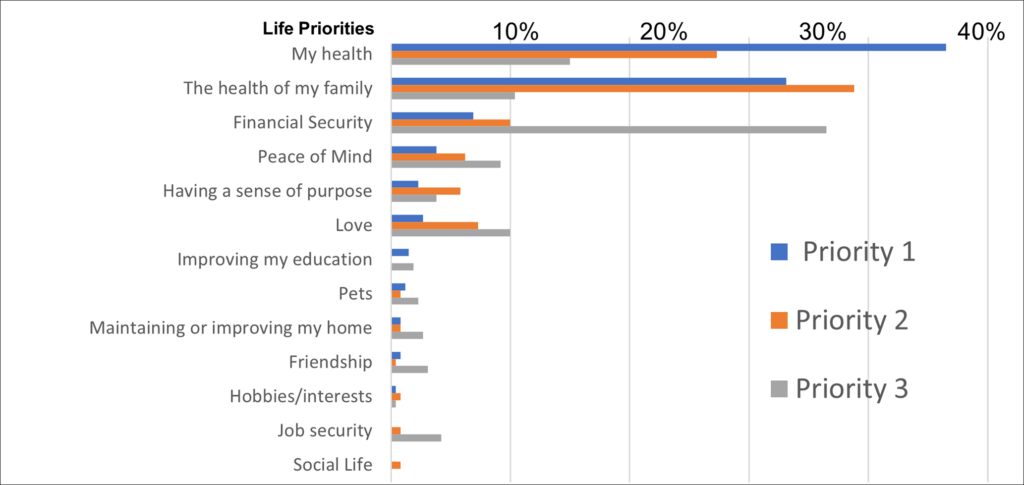
    Understanding where your staff need the most support is the best place to start. For our survey, we asked respondents to rank 13 important life factors in order of importance. The top three life priorities were ‘my health’, ‘the health of my family’, and ‘financial security’. This was also the case when we broke it down by income, age, or employment status.

    Life priorities results
    Life priorities results


    How do personal factors influence employee priorities?

    A variety of personal factors can affect employee needs. e.g., age, income, industry and location.

    Let’s focus on a couple of these:

    Life priorities by age:

    The Engage survey revealed that the top 3 priorities (health, health of family, financial security) remained the same across all age groups. The priorities following the top 3, however, saw slight differences between the older generation and younger. The older age group of employees were less likely to prioritise obtaining a sense of purpose, love, and friendships – focusing more on health.

    Meanwhile, the younger employees placed a higher emphasis on improving their education and boosting their careers, social life, and love.

    With such a wide range of priorities, businesses must work out how best to fulfil the needs of all.

    Life priorities by income:

    As with the different age groups, the top 3 priorities were consistent across income groups.

    An interesting finding that came out of this was how maintaining/improving the home, having a sense of purpose, and improving education, ranked higher amongst lower-income groups, compared to others. Perhaps this trend will encompass more people in the wake of rising living costs.

    There is a wide range of benefit options available to support these initiatives, so it’s important to consult with your teams and get a true understanding of what they most need.


    Current employee priorities: a surprise, or expected?

    With the current industry trends (such as remote/hybrid working), you would think there would be a move away from traditional priorities in employee benefits such as health – but no! Employee health and wellbeing still sit comfortably at the top of the list, reflecting how staff worries around how to best look after themselves has only been amplified by the pandemic.

    The pandemic has increased our awareness of mental wellbeing and how important it is to have a positive work-life balance. The pandemic, costs of living rising, world conflicts, remote/hybrid working, and the Great Resignation, have forced many to question the how, when, and where of workday expectations.

    Has a reset of priorities, perspectives, and work culture been on the cards for a while?

    Many workers are looking to employers to prioritise flexibility and skills development opportunities, allowing a sense of freedom and autonomy on flexible working options and a selection of benefits to suit their individual needs. And yet, despite the rising demand for these lifestyle perks, they still don’t trump the fundamental importance of health and wellbeing among people’s priorities.

    Looking for expert advice on how to establish the perfect employee benefits for your teams? Contact us at +44 (0)1273 974419 or click on the bottom right chatbox. We’re here to answer any queries, offering FREE no-obligation support.


    How the pandemic has influenced employee benefit demand

    More than two years on from the beginning of the pandemic and we are all still feeling its impact. This is particularly shown through the shift in life priorities and the added onus on looking after our health and wellbeing. The prominence of health remaining at the top of the list is likely a reflection of a growing sense of external threat.

    The strain on NHS services and concern over what support resources are available is another factor of likely concern – certainly one that points in the direction of private healthcare.

    Health is not the only issue. There are also concerns over personal finances. Earnings may have been hit during the pandemic, there are rising costs every which way you look and general increasing financial uncertainty. No surprise then that financial security sits firmly among the top three employee priorities.

    It’s worth noting that employees had these same needs pre-pandemic; their priorities have just been heightened over the past two years. Essentially, this raises the stakes for employers.


    Employee benefits which address staff needs

    If your teams are feeling listened to, appreciated, and supported, their output is inevitably only going to improve, and your business is going to be thriving.

    To target your employee’s top priorities (in particular health, family health, and financial security) you could offer:

    To help decide on which employee benefits your staff want, try consulting your team directly. This could be done through workplace surveys, setting up 1-2-1s, group meetings, or via email.

    Further reading: How to measure employee wellness in the workplace


    At Engage Health Group we help match employee benefits to the needs of your business and its employees – all within budgetary requirements. We offer FREE comprehensive advice, quotes and ongoing support to help alleviate the strain on HR teams.

    Contact us at Engage Health Group Ltd or call +44 (0)1273 974419 for FREE no-obligation advice and support.

  • FREE report: The employee’s perspective on workplace health and wellbeing

    FREE report: The employee’s perspective on workplace health and wellbeing

    We surveyed hundreds of UK employees spanning a wide range of sectors and industries from retail to professional services. The results tell us about employees’ priorities in the wake of the pandemic and how well companies are meeting demands.

    In our FREE 19-page report you will discover answers to the following questions:

    • What are employees’ priorities in the wake of the pandemic?
    • Do employees feel their workplace supports their wellbeing?
    • Is wellbeing considered a business priority?
    • How strong is the correlation between employee benefits and loyalty?
    • What employee benefits are being made available?
    • What are the most desired workplace benefits for employees today?


    Unsurprisingly, nine out of ten employees listed health as their number one life priority. But it’s interesting to learn what specific benefits are seen as the most important for supporting wellbeing.

    At Engage, we believe businesses should take a holistic approach to wellbeing in order to best support workers’ needs. Our survey explores this issue and much more.


    Click here to read the full report.


    Need help formulating an employee benefits scheme? Arrange a free chat with one of our expert advisors. Call 01273 974419 or use the chatbox and we’ll happy to answer your questions.

  • Looking for the right international insurance policy? Here are 9 to consider

    Looking for the right international insurance policy? Here are 9 to consider

    If you’re a company with employees spread across different countries, you might be wondering which international insurance policy or related benefits you should provide. Whether you have global offices, expat workers or a team of far-flung remote employees; it’s far easier to support them centrally rather than via separate policies and points of contact.

    The net benefit of implementing everything within one policy is less paperwork and reduced admin processes for HR teams – plus, a more cohesive offering for employees. Surveys show that over a third of businesses are increasing the number of international remote workers unaffiliated to a local office.

    In this context, offering attractive and easy-to-administer benefits will be key to winning the battle for talent.

    This blog post reveals:

    • The top 9 international insurance policies & related services
    • International Health Insurance trends and price ranges
    • 4 key benefits of investing in a single international scheme vs separate local schemes

    If you’d like one-to-one expert assistance call +44 (0)1273 974149 or use the chatbox on the right.


    9 international insurance policies and services to consider

    1. International Business Health Insurance:

    What does it do?

    Gives your employees access to private healthcare, wherever they are in the world. A specific short-term policy also exists for employees working abroad for between one and 12 months.

    Why provide it?

    Fulfils your duty of care to employees all over the world, gives them the medical support they need when they need it, reduces the chances of a failed expat assignment, and can also help diagnose problems before they occur thereby reducing absenteeism.

    Learn more about International Business Health Insurance

    2. International Group Life Insurance

    What does it do?

    Provides financial support to a team member’s loved-ones in the event of their death – wherever they are in the world.

    Why provide it?

    Reassures employees that their family is looked after should the worst happen. It’s also a relatively low-cost international insurance policy.

    Learn more about International Group Life Insurance

    3. International Group Income Protection

    What does it do?

    It provides financial support to an employee should they fall ill, wherever they are in the world. Essentially, it’s a form of sick pay.

    Why offer it?

    Rather than the business having to foot the bill for staff absence, the insurance policy covers it – avoiding a potential financial hit. For the staff member, it provides essential financial support. Income Protection is currently ranking as the most desired benefit in the post-pandemic era.

    Learn more about International Group Income Protection

    Looking for independent and impartial advice on international insurance policies and other benefits? Our team of expert advisors will be happy to answer all your questions. Call us on +44 (0)1273 974149 or use the chatbox on the right.

    4. International Group Critical Illness

    What does it do?

    Provides financial support to your international workforce in the event of a serious illness or, in some policies, if they suffer a disability.

    Why offer it?

    A serious debilitating illness is a major life event and many would struggle to support themselves or their families in the absence of a regular income. This international insurance policy comes to the rescue by providing support when it’s needed most.

    Learn more about International Group Critical Illness

    5. International Employee Assistance Programmes

    What does it do?

    While it’s not strictly an international insurance policy, it’s an important related service often included with a policy. An IEAP is a digital platform which provides practical health and wellbeing support to employees, either via a mobile or desktop app. Counselling services, financial advice, and stress support are among the services offered.

    Why offer it?

    Multi-lingual support means it’s easy to provide everyday wellbeing support to your global teams. In essence, it helps them help themselves, empowering them with the tools required to be happier, healthier and more at ease with whatever life and work throws at them. They are much vaunted for their ability to reduce staff sickness absence rates.

    Learn more about International Employee Assistance Programmes

    6. Group Travel Insurance

    What does it do?

    Provides insurance coverage for groups of employees travelling abroad, covering them for things such as: accidents, illnesses, lost possessions and travel cancellations.

    Why offer it?

    Particularly useful if you have teams travelling abroad for business trips. A comprehensive policy can massively reduce the burden on HR if employees’ get into difficulty, providing rapid support and guidance for all the issues covered within the policy. You might also be able to get travel insurance with Covid cover.

    Learn more Group Travel Insurance

    7. Pre-Assignment Screening

    What does it do?

    Provides a series of checks designed to assess an employee’s suitability for working overseas. Health screening, personal evaluation, pre-trip preparation and family support is often included.

    Why offer it?

    The failure rate of expat assignments can be quite high if not managed appropriately. Pre-assignment screening maximises the chances of a successful assignment by checking the psychological and physical wellbeing of the employee before they leave, and ensure that every potential challenge is considered or negated in advance.

    Learn more about Pre-Assignment Screening

    8. Kidnap & Ransom Insurance

    What does it do?

    It supports a business in the event of an employee’s kidnap or hostage. It covers consultancy costs (hostage negotiators, for example), care expenses (physical & mental), legal costs and/or employee replacement costs.

    Why offer it?

    If your business operates in a part of the world prone to such incidents, or you have high net worth individuals, then Kidnap & Ransom Insurance may be advisable. It helps protect both employee and business alike, both during and after the incident. This international insurance policy is often overlooked by businesses.

    Learn more about Kidnap & Ransom Insurance

    9. Cultural training

    What does it do?

    It’s a specific form of workplace training which essentially equips people (expats, multi-national workplaces and/or global leadership teams), with the knowledge and skills to communicate effectively across different countries and cultures, free of misunderstanding or cultural faux pas.

    Why offer it?

    Ultimately, improved communication leads to improved team dynamics – driving productivity and bolstering team morale.

    Learn more about Cultural Training


    International Health Insurance trends and price ranges

    Global health insurance provider, APRIL International, were happy to share with us some of the current trends they are witnessing. With over 30 years of experience and operations globally covering more than 150,000 insured members in 180 countries around the world, this is a market they know well.

        • Average International Business Health Insurance premiums: An employer can expect to pay on average £1,500 – £2,500 annual premium per employee but of course this can vary depending on the age, location and level of benefit required. For a basic Inpatient only policy with APRIL International we can expect an annual premium of around £1,200.
        • Average age range: The average age of an employee we typically see for an SME group is 35-40 years.
        • Percentage of ‘new to market’ business: 20-30% of group enquiries are businesses which have not purchased a policy previously. 70-80% are existing clients looking for an alternate offer to their renewal.
        • Mental health provisions are in demand: Over the last 5 years in general there has been a real emphasis on mental health awareness and therefore almost all brokers and customers query the cover in relation to this aspect.


    In a post Covid world, health insurance for global employees is likely to become ever more important. Global insurance providers such as APRIL International offer a route through the complexities of accommodating this risk.


    4 practical benefits of investing in single international insurance policies

    A single international employee benefits scheme provides several advantages over domestic, single country schemes:

    1. Consistency:

    International benefit schemes provide a consistent range of benefits and support for all staff across multiple countries creating simplicity and ease of administration.

    Even if an employee moves from one country to another, the scheme can be designed to move with them. This saves the trouble (and cost) of removing an employee from a pre-existing policy and enrolling them onto a new one.

    1. Generous terms

    When you have multiple employees under one policy, you can gain improved terms and conditions. This is the typical ‘bulk buy’ effect. For example, it’s possible to get Medical History Disregarded underwriting on an International Health Insurance plan – this means an individual’s previous medical conditions are overlooked in the pricing and/or terms of the policy. A single national policy is unlikely to offer such generous terms.

    1. Centralised and simplified

    Hundreds of HR hours can be saved by bringing together a range of insurance schemes and perks in one place. Different languages, renewal dates, currencies and points of contact can be brought into a centrally managed system.

    “Having one central point of contact to administer a group’s international healthcare cover across time zones and languages is costly, so if this burden can be borne by the insurer, the client will save valuable resource,” said Adam Vogt, Sales Director from APRIL International. “Equally, having clearly defined procedures and benefits centrally on a company intranet can ensure all have access and the rules and policy operation are made easier.”

    1. Superior quality

    Many international insurance policies will provide more extensive levels of cover than domestic policies. This is particularly true of global health insurance, where individuals may have access to extra services such as: maternity care, private GP visits, preventative health screening, dental, optical, wellbeing and medical evacuation.


    Would you like to outsource the workload?

    Many companies choose to utilise an insurance broker when seeking out an international insurance policy. A good broker can alleviate the strain on HR by doing all the legwork involved in sourcing and implemeting a scheme.

    Engage Health Group is a broker fully independent of any insurance provider. That means we can offer impartial advice free of charge and obligation.

    Tel: +44 (0)1273 974419 or use the chatbox on the right.

     

  • Global benefits, fixed! 6 common HR problems and how to solve them

    Global benefits, fixed! 6 common HR problems and how to solve them

    UK companies are increasingly drawing on international talent – whether that’s because they have offices around the globe, are utilising remote talent overseas or have expat employees.

    HR are entrusted with making sure each global employee is supported from a health and wellbeing perspective. And it’s no easy task. As an insurance broker with specialist expertise in the international employee benefits market, we see a lot of companies making the same mistakes.

    In this blog post we identify the six most common mistakes and how to fix them.

    1. Lopsided benefits > Balanced benefits

    Employee benefits can be divided into three broad categories:

    i. Insurance: health-related insurance policies such as Private Health Insurance, Life Insurance and Critical Illness Cover.

    ii. Everyday wellness: proactive approaches to wellbeing, such as gym discounts, Employee Assistance Programmes, BMI tracking, mental health toolkits and much more.

    iii. Rewards: perks to be enjoyed such as retail discounts, extra holiday days and bonus schemes.

    Achieving the right balance between these three is an important part of fulfilling the needs of your team. Yet, businesses often make the mistake of leaning too heavily on one category. For example, an insurance-heavy approach will neglect benefits which bolster staff wellbeing and those which provide positive motivation. On the other hand, too much emphasis on rewards could leave your staff’s health needs underserved.

    The solution is to take a blended approach which supports the health, wellbeing and happiness of your team. This increases a company’s allure to the global talent pool, while improving the health and productivity of their teams.

    Employee benefits – like wellbeing – should be considered a holistic pursuit.

    If you’d like FREE professional advice on how to best support your international teams, contact the industry experts at Engage Health Group +44 (0)1273 974419. We’re happy to answer all your queries and help guide you in the right direction.

    2. Location-blind schemes > Location-savvy schemes

    Employers with a global workforce need to be aware of the different standards and requirements each country has. For example, in the US a company is legally required to provide health insurance to their staff if they have over 50 employees, although it’s a very common benefit for teams of all sizes. The UAE, Saudi Arabia, The Netherlands, Switzerland, Singapore, Vietnam and Hong Kong all have specific requirements for company health insurance and navigating the rules can be tricky! It is also prudent to mention this list of countries is expanding due to the tightening of legislation within the healthcare market.

    Cultures also vary greatly which adds a layer of complexity to the goal of fulfilling the needs and expectations of staff wherever they are in the world. Consequently, it’s important to speak to your international team members and gain a clear understanding of which benefits are desired most.

    As an international insurance broker, we have a thorough understanding of the global market for employee benefits. We are on-hand to provide one-to-one advice to companies with a global footprint – or those who are looking to expand their company or talent search to different locations around the world.

    3. Unprepared expats > Primed and ready expats

    It’s worth considering the specific issue of expat employees – those employees or key personnel who are sent to work abroad on assignment. Expat failure rates are relatively high, anywhere between 10% and 50% according to research by INSEAD. The two most common reasons for failure, according to a study by Cornwell University, are:

    i.  Culture shock: an inability to adapt to the new location

    ii. Family issues: children or spouse may struggle to settle in to the new environment, thereby putting the family unit under strain.

    An investment in appropriate support (including employee benefits) will help increase the chances of the employee completing the expat assignment. Remember, the cost of investing in support needs to be weighed against cost of a failed assignment. Once more, different locations pose different challenges and present varying levels of failure risk.

    It might be worth undertaking ‘Pre-Assignment Screening’ to help gauge the risk associated with a sending a particular employee on a placement abroad.

    > Learn more about Pre-Assignment Screening

    4. Oblivious team members > Enlightened employees

    Once you’ve invested into a benefits scheme which supports business and employees alike, it’s easy to think: “job done”. But that’s not quite true.

    A key part of implementing a benefits scheme is the process of communicating it to your team. Your employees need to know it’s there, and how to use them.

    An insurance broker or consultant can assist with this. Engage Health Group is a specialist within this field and often holds presentations – in person and online – to educate company employees about the different benefits they have available. Engage also provides supporting documents to fully prepare both HR teams and employees.

    Without guidance and education, even the most carefully considered package of perks can go underused and unloved. Make sure the investment pays off!

    5. Separate national policies > One international policy

    The most common error made by businesses with an international footprint is that they provide employee benefits in separate polices for each country.

    There are usually two reasons:

    1. They are unaware that international benefits can be provided under one policy.
    2. Different insurance schemes are managed by different departments


    Let’s expand on the latter. Insurance mechanisms may be managed by different departments. For example, perhaps the finance department manages International Medical Insurance and Group Income Protection while the HR team manages Employee Assistance Programmes and other wellness perks.

    As you might imagine, a siloed approach to International Employee Benefits is more complex and admin-heavy, compared to an integrated one. By bringing together separate managed policies into one, Engage helps businesses harmonise and centralise their employee perks, as well as securing enhanced  underwriting terms, and an improvement on benefits.

    An international benefits broker can provide a single point of contact for multiple policies – centralising its management and simplifying the process. In essence, this means a business can still have policies with different providers (in order to negotiate the best deals across the whole market), but a broker like Engage presents them to the business under the same scheme. This provides the perfect balance between ease-of-use, cost efficiency and value for money.

    International benefits are best managed from one department (HR or finance – not both) and via a single service provider (in this case a specialist international benefits consultant).

    6. Assume success > Track success

    Once the benefit scheme has been put in place, it’s important to review it thereafter.

    • Is it providing value for money?
    • Are people using it?
    • Have regulations changed?
    • Are we paying too much?
    • Is it achieving our objective?
    • Are employee/business needs the same or have they changed?

    We recommend a yearly review which addresses the above questions. This ensures the benefits remain relevant to the team and continue to provide value for money to the business. All companies want to ensure optimal return on investment, an annual review achieves just that.

    Don’t forget to consider mental health support

    We recently gathered the views of Adam Vogt, Sales Director at APRIL International, providers of global health insurance policies. He was keen to stress the importance of protecting and strengthening the mental wellbeing of workers wherever they are in the world.

    “The number one trend for employee benefits programmes is the demand for mental health benefits. The aftermath of COVID-19 will impact upon international health insurance planning, in particular with the provision of mental health support facilities.

    “According to a study into working from home during the pandemic, carried out by FEnews in 2021, 52% stated that their mental health had been impacted by a combination of isolation at home and a sub-optimal working environment. If working from home becomes a growing trend, increased demand for mental health support could easily follow.

    “Our group health insurance offerings have the option to include Inpatient and Outpatient mental health benefits for their employees.”

    Are you ready to establish or review your global benefits?

    We’re certain these tips will help you better navigate the world of international employee benefits. But if you need one-to-one expert assistance free of charge, then contact our team at Engage. We can advise on all the issues surrounding global benefits schemes and bring the most competitive quotes right to you, and even help implement and manage the scheme.

    Here’s what one happy customer had to say:

    “Engage Health Group have been very helpful with our members, many of whom are based in third world countries. They have solved the problems raised regarding the COVID pandemic especially relating to evacuation if needed.”

    Eva Maguire, General Manager, Timber Trading

    Call us on +44 (0)1273 974419 or use the chatbox to the right.


  • How to keep employee benefits simple in the age of the global workforce

    How to keep employee benefits simple in the age of the global workforce

    Today’s HR teams face the challenge of handling increasingly disparate staff. While much attention is paid to the rise of remote working – and the challenges that poses – less is said of the increased international spread of workforces.

    In this blog post we examine the driving factors behind this trend, the impact it has on the delivery of employee benefits and how businesses can keep things simple.


    If you’d like FREE professional advice on how best to support your international teams, contact the experts at Engage Health Group +44 (0)1273 974419. We’re happy to answer all your queries and help guide you in the right direction.

    The rise of the global workforce

    According to CoderPad’s tech hiring survey, 40% of recruiters are hiring internationally for roles in other countries. While this brings many businesses perks, it also increases the logistical challenge of deploying employee benefits and maintaining a happy, healthy and motivated team. It also demands a keen awareness of cultural differences.

    There are five interconnected factors behind the increased internationalisation of the workforce, including:

    • The continued advance of online digital technology enabling more fluid communication and a wider variety of duties remotely performed.
    • The impact of the pandemic which has accelerated the above by forcing companies to adjust their business model toward remote work.
    • General trends around globalisation, such as ease-of-movement across borders (at least pre-Covid) and less anchorage to geographical locations.
    • The widening global talent tool, particularly in the digital sector.
    • Companies’ desire to source the best talent, regardless of where they are in the world.


    The pandemic has become a major driving factor over the last two years. The social restrictions it triggered forced many companies to reconsider how they employ talent. More than 80% of CFOs said it had fundamentally changed the way they think about hiring and workforce management. Those who have realised the benefits are unlikely to return to the way things were.

    According to the Future of Work survey by HSBC:

    More than one-third (36%) of businesses are increasing the number of international remote workers not affiliated with a local office.

    Over the next three years, 40% of companies are supporting increased flexibility over the office or country from which employees work.

    There are three main ways that companies develop an international workforce:

    1. Via expat workers: an employee working abroad for a defined period, either on assignment or independently.
    2. Via multinational company locations: the classic multinational company which has branches or divisions in different parts of the world.
    3. Via international remote employees: the most recent trend which sees employees working remotely from different parts of the world.


    As this trend continues, HR will be challenged to manage the health, wellbeing, and motivation levels of people in different countries. Part of this challenge is to account for different cultural perspectives, legal jurisdictions and personal needs. That’s no small undertaking for companies with a considerable international footprint.

    How to keep global employee benefits simple

    One of the problems usually encountered by businesses with global workforces is the complexity of delivering benefits across different locations. Whether it’s companies with satellite offices and/or globe-trotting expat workers, things can get complicated quickly.

    The simple solution is to keep everything in one place. Rather than let benefit schemes become a patchwork of different policies for each location, it’s easier – and more cost-effective – to have a single international scheme which covers everyone.

    Let’s consider two examples:

    Firstly, health insurance. If you have a separate business health insurance policy for each country, that means they must be purchased and managed separately. But if instead, you have a single International Health Insurance scheme you can cover all countries under one policy – a single purchase and everything managed in one place. The savings are considerable, and it significantly relieves the administrative burden on HR.

    Secondly, general wellbeing support. This can be difficult to provide consistently across different territories. One of the most popular solutions today is Employee Assistance Programmes (EAPs). EAPs are digital platforms which provide tools, advice and services designed to support employee wellbeing (such as one-to-one counselling support, healthy eating guidance, and much more).

    However, operating a separate EAP for each country would multiply the costs unnecessarily. Thankfully, there are International Employee Assistance Programmes which can be set up and managed from one location, once more reducing the burden of managing such schemes and controlling costs.


    Are you looking to build and implement a health and wellbeing plan that covers your whole international workforce? Get FREE expert advice from the specialists at Engage. Put your questions to us using the chat feature in the bottom right or call +44 (0)1273 974419.


    4 reasons why you should invest in a single international scheme

    A single international employee benefits scheme provides several advantages over domestic, single country schemes:

    Consistency

    International benefit schemes provide a consistent range of benefits and support for all staff across multiple countries.

    Even if an employee moves from one country to another, the scheme can be designed to move with them. This saves the trouble (and cost) of removing an employee from a pre-existing policy and enrolling them on a new one.

    Generous terms

    When you have multiple employees under one policy, you can gain improved terms and conditions. This is the typical ‘bulk buy’ effect. For example, it’s possible to get Medical History Disregarded underwriting on an International Health Insurance plan – this means an individual’s previous medical conditions are overlooked in the pricing and/or terms of the policy. A single national policy is unlikely to offer such generous terms.

    Centralised and simplified

    Hundreds of HR hours can be saved by bringing together a range of insurance schemes and perks in one place. Different languages, renewal dates, currencies and points of contact can be brought into a centrally managed system.

    “Having one central point of contact to administer a group’s international healthcare cover across time zones and languages is costly, so if this burden can be borne by the insurer, the client will save valuable resources,” said Adam Vogt from health insurance providers APRIL International. “Equally, having clearly defined procedures and benefits centrally on a company intranet can ensure all have access and the rules and policy operation are made easier.”

    Superior quality

    Many international policies will provide more extensive levels of cover than domestic policies. This is particularly true of global health insurance, where individuals may have access to extra services such as maternity care, private GP visits and medical evacuation.

    Ready for the road to simplicity?

    You should now have a fair understanding of how international insurance products can benefit HR teams and the employees they serve. Whether you’ve already gone down the tangled road of separate national policies and want some relief – or are now seeking ways to look after a newly expanded global workforce – we’d love to hear from you. For FREE no-strings advice call +44 (0)1273 974419 or use the chatbox.


    Related reading: The 3 Pillars of Corporate Wellbeing: What Do Employers Need to Offer?

  • Expert perspectives: Should you offer Cognitive Behavioural Therapy to your teams?

    Expert perspectives: Should you offer Cognitive Behavioural Therapy to your teams?

    CBT is learning to stop the cycle of negative thinking… it is the one tool that gets you out of the truly dark spots.” Mind

    Employee mental wellbeing has taken a massive hit over the last two years. Financial uncertainty from rising costs of living, the continued presence and impact of Covid-19, and people struggling with a return to the office are just a few of the factors which can affect people on a day-to-day basis.

    However, there’s a positive side to this – an increased awareness of mental health where more and more people are seeking help and guidance. One method that is becoming increasingly popular is Cognitive Behavioural Therapy (CBT), with employees developing strategies to help themselves. CBT can be accessed through:

    • NHS
    • Private sector
    • Charities
    • Education
    • Place of work


    Forward-thinking employers are providing staff with easy access to CBT. This enables employees to reach out for help and develop the tools for greater mental resilience.

    In this article, we talk with NHS accredited CBT therapist, Shay Rosenthal, to learn more about how CBT works, and how it can have a positive impact on employees in the workplace and beyond.


    Need professional help finding the best employee benefits to support your teams? Contact our friendly team of experts at Engage Health Group Ltd on +44 (0)1273 974419 or click on the bottom right chat-box.


    Cognitive Behavioural Therapy: What is it and how does it work?

    CBT is based on how our thoughts, feelings and behaviour are interconnected. Anyone can become trapped in a negative thought cycle, and CBT is designed to break this cycle. CBT can also help people avoid getting ensnared in the first place. This form of therapy looks for practical ways to improve a person’s daily state of mind, helping them break down overwhelming problems into more manageable positive steps.

    In CBT, people learn to recognise and identify patterns in thinking or behaviour which might be keeping their problems going,” says Shay Rosenthal, a CBT Therapist in the NHS.After therapy we would hope that a person can become adept in this skill to manage future problems, becoming their own therapist.”

    CBT can help people with:

    • Depression
    • Anxiety
    • Bipolar disorder
    • Borderline personality disorder
    • Eating disorders
    • Obsessive-compulsive disorder
    • Panic disorder
    • Phobias
    • Post-traumatic stress disorder
    • Psychosis
    • Schizophrenia
    • Insomnia
    • Substance abuse
    • Stress
    • Long-term health conditions e.g., irritable bowel syndrome, chronic fatigue syndrome – cannot cure physically, but can help to cope with symptoms


    CBT is often spread across 12 sessions or more for those in serious need, but a brief course of treatment can be helpful for anyone seeking greater mental clarity and resilience. In these sessions, a person breaks down problems in how they think and behave. The idea is for them to learn these strategies and apply them to their everyday lives.

    However, we wanted to break this down even further to get more depth on how CBT is applied in therapy and the theories behind it.


    Diving deeper into CBT with Shay Rosenthal

    Shay outlined two main concepts that are associated with CBT, revealing how and what the sessions focus on.


    Cognitive approach (thoughts)

    How you think influences how you feel and how you behave.

    If you are thinking in a certain way, that can influence how you behave and also impact how you are feeling. Those experiences can subsequently reinforce your way of thinking, creating a cycle that can become difficult to get out of.

    Shay imagines what this might be like for an employee:

    If I think in such a way like ‘Im terrible at my job, everyone will eventually find out that I have no idea what Im doing, this could lead me to call in sick (behaviour), procrastinate with assignments (behaviour), and increase anxiety, low mood, or hopelessness. These behaviours and feelings will reinforce my initial thoughts about being terrible at my job, making my conviction of these beliefs even stronger.”

    Working with people’s cognitive processes allows someone to break down these patterns of thinking, allowing them to restructure and experiment with new ways of approaching situations. This will help them to move away from being stuck in a negative perception of themselves/the world.


    Behavioural approach

    Behaviour can explain the maintenance of a problem.

    Another approach taken in CBT is placing our focus on how our behaviour specifically might be keeping our problems going.

    Again, Shay outlines a potential employee perspective:

    If Im scared of public speaking, I might naturally then avoid presentations. This is obviously a very effective short-term solution to avoid feeling anxious. However, this avoidance does not allow us to grow in confidence, and crucially learn more about our fears. This will typically lead to anxiety increasing over time.”

    Similarly to the cognitive approach of CBT, a behavioural approach focuses on setting goals that the person wants to achieve through therapy and developing a step by step approach to facing one’s fears. This will build a sense of tolerance or the ability to handle these triggers. Shay explained this in a simple analogy:

    If you think about the first time you went to a new job, you would likely have been very anxious on day 1. If you had run away or avoided doing things / talking to people, that anxiety about your new job would get worse and worse over time. However, when we face things that make us anxious what happens naturally is that as day 1 progresses the anxiety will gradually reduce over time. Come day 2, the anxiety, whilst maybe high at the start of the day will in most cases be slightly less than on day 1. Again if the person perseveres this will gradually reduce again and after enough time that person will no longer be experiencing that same anxiety the had on day 1. We call this process habituation, which is a CBT way of saying “we get used to it”. The key is we learn enough about our fears to make accurate predictions rather than assuming the worst will happen.”


    Can CBT help employees and businesses alike?

    CBT can be a useful tool in supporting the mental wellbeing of staff so it’s worth considering as part of an employee benefits package. It can also benefit your business by improving team members’ ability to handle challenging situations. Here’s how:

    • Identifying the cause of disruptive thoughts helps employees discover alternative perspectives – will help staff in accepting different opinions, leading to better performance and improved work relationships.
    • Fear and anxiety can cause lower esteem, productivity, and retention levels. Understanding what causes fear and how to tackle it allows staff to overcome situations that cause anxiety.
    • CBT promotes mindfulness. Practising mindfulness improves concentration, reduces stress and anxiety, and reduces presenteeism. Employee engagement will be boosted in a positive work culture.
    • Freed from anxiety and unhelpful thoughts, the employee can improve their problem-solving skills
    • An improved ability to overcome challenges boosts confidence
    • By better managing emotional responses, an employee can improve social and communication skills
    • Cultivating a more positive mindset can:
      • Improve focus/productivity
      • Reduce absenteeism
      • Promote a healthier/happier work environment
      • Improve decision making
      • Reduce stress, depression, and anxiety
      • Boost employee performance, innovation, confidence, and creativity
    • Successful CBT programmes can lead to fewer mental health-related absences

    These are just a handful of things that employees can develop from undergoing CBT if they need help, making it a win-win for both staff and business.


    We help businesses navigate the world of employee benefits and health insurance. Contact our team of AMII accredited employee benefits brokers for FREE expert advice and support. Click on the bottom right chat box or call Engage Health Group Ltd at +44 (0)1273 974419.


    How else can you support employee mental wellbeing?

    CBT is one of several employee benefits which are designed to aid mental health. Sometimes they are included in an Employee Assistance Programme or Corporate Wellness Programme – so it’s well worth checking if it’s available as an add-on. Below are a few other examples of employee benefits that target the mental wellbeing of your staff:


    Over half of all working days are lost each year to high levels of stress or mental health issues. So, it’s certainly an issue that all companies should address. The most important thing is for businesses to encourage a positive, open, and supportive work environment, whether that’s augmented by CBT or other measures outlined above.

    Further reading: The 3 Pillars of Corporate Wellbeing: What do employers need to offer?


    At Engage, we take the time to carefully consider financial, mental, and physical wellbeing when helping businesses and HR teams design an employee benefits scheme.

    Contact us at Engage Health Group Ltd or call +44 (0)1273 974419 for FREE no-obligation advice and support.

  • Fitness February: Engage takes on Hooray in office step-count challenge!

    Fitness February: Engage takes on Hooray in office step-count challenge!

    It’s been a couple of weeks since the beginning of our Fitness February competition in the Engage office and we can confidently say that it’s been well received by our teams.

    The YuLife step-count challenge was first introduced by Hooray Health & Protection Director Charlie Cousins. Charlie set the scene for the competition, introducing his ‘winning’ team (maybe a tad prematurely!) and laid down the ground rules of what we were all doing for the next few weeks.

    But this month has indeed been a busy one. So, let’s have a recap of what Fitness February is all about and how Engage got involved.


    What does Fitness February mean in the Engage office?

    We split our office into three teams – Hooray, Engage UK and Engage International – all competing for the greatest number of average step-counts. Teaming up with YuLife, we have been keeping a leader board, recording our steps over the course of February.

    YuLife is a life insurance company that focuses on inspiring employees to lead healthy and fulfilled lives by making simple lifestyle changes. This is supported by the YuLife App which rewards staff for their efforts with vouchers, discounts, gifted experiences, and more.

    To further incentivise the teams, the directors at both Hooray and Engage have promised an extra reward for the winning group. To up the competition further, they have also offered a special prize for the individual employee with the most steps overall! Who doesn’t love a bit of healthy competition?

    At Engage, we have been using the YuLife App, amongst other YuLife benefits, since autumn 2021, meaning our teams were already fully acquainted with the app ahead of the competition. This made us confident in our bid to outstep the team Hooray. We had already begun the process of incorporating small everyday changes into our personal and work lives, ranging from mindfulness practices, such as meditation, to challenging each other to walks.

    All in all, we were more than ready to get stuck into the Fitness February challenge!


    Who are the Engage teams?

    We already know about the Hooray team and their desire to win (you can check the details out here!). But what about the rest of us in the office? Both Engage UK and Engage International have four members on each team, giving the groups equal footing.

    Engage UK

    This team consists of Nick, Boxy, Molly, and me! How are we levelling up so far? What have we been doing to make a difference towards winning?

    We have been shaping up into a strong team! Nick has been playing football more, even strapping his phone to himself whilst playing to build up those steps. I have been walking to and from work on the three days I’m in the office (this being a 50-minute walk there and back), really boosting the team’s overall step count.

    Boxy and Molly have also proven to be strong contenders, committing to steadily increasing their steps every day of this month.

    Engage International

    On the International team, we have Ian, Judit, Jo, and Dave. Also proving to be a formidable force, these guys are really starting to go all out!

    Dave has taken the competition by storm, quickly rising up the leader board by making frequent visits to the gym after work and spending his lunches on hour-long walks around the area.

    For all their talk, the Hooray lot really do need to be watching their backs! Thinking you can take a day off hunkering down in your living room provides the perfect opportunity for the Engage teams to stride into that top spot.


    The Engage values: what we’re bringing to the competition

    As a health insurance broker, the issue of wellbeing holds great importance – both within our teams and for our clients. This has been brought to the fore during this step-count challenge. Light-hearted joking and friendly competition have been combined with support and encouragement – even for the smallest contributions!

    Fitness February has brought our team even closer together and boosted each other’s morale and productivity. But we have also taken improvement seriously.

    Improving our physical and mental health by getting outside and moving about has been a huge motivation for a lot of our team members, who are each enjoying seeing changes in themselves.

    Here’s what we have been doing:

    • 1-hour walks at lunch
    • Walking to and from work
    • 1-2-1’s either walking to the pub for a lunch or taking a stroll around the local area
    • Playing football
    • Going to the gym
    • Doing exercise classes
    • Moving around the office when taking calls
    • Walking to the shops, post office etc instead of driving
    • Getting out and about at the weekends – e.g., exploring new parts of the East Sussex coastline (taking tips from each other about where to go/which walks are great in this area). This not only boosts our step-counts but also improves our relationships with one another, as we learn about interests and personal lives.


    Pushing ourselves and one another to take those small steps in our everyday lives can often seem easier said than done. Having a focus on team building has demonstrated how each of us can provide that extra bit of support to help someone make a change.


    How is the competition shaping up so far?

    As outlined in Charlie’s introduction earlier this month, all teams were establishing strategies to ensure our steps would be increasing over February.

    We were all pleasantly surprised at how well these strategies were received by almost everyone in the office. Yes, that is almost everyone. Where most of the office has been making the change, there are a few staff that are still falling behind! Alfie has shockingly let the side down so far – but luckily, his steps go towards the Hooray team, working in our favour.

    Getting out at lunch is helping everyone massively, and, with the days getting longer, walking home from work is becoming more appealing for a lot of people in the office.

    However, before revealing who is currently leading the way at the top of the competition, we thought it was important to mention some difficulties that we’ve encountered so far.

    Events this month have often felt out of our control, meaning a lot of us in the office struggled with maintaining a high step count every day and haven’t been able to stay active as much as we would have liked. These circumstances include:

    • The continuing presence of Covid, and having to isolate to protect others in the office
    • General illnesses e.g., colds, doctor appointments, sometimes even the odd hangover (although we can fairly say that the last one is self-inflicted)
    • Storm Eunice hitting last weekend


    Just two months into 2022 and it is already testing everyone’s physical and mental wellbeing. Being a part of Fitness February has meant we have been able to focus on something different, teaching us that it’s okay to ease up from time to time.

    We are not machines! It is important to understand when to take a step back, when to look after yourself in different ways, and be able to recognise exactly what it is you need at that certain moment.


    The current state of the leader board:

    But let’s get into what you want to know – who is currently winning?

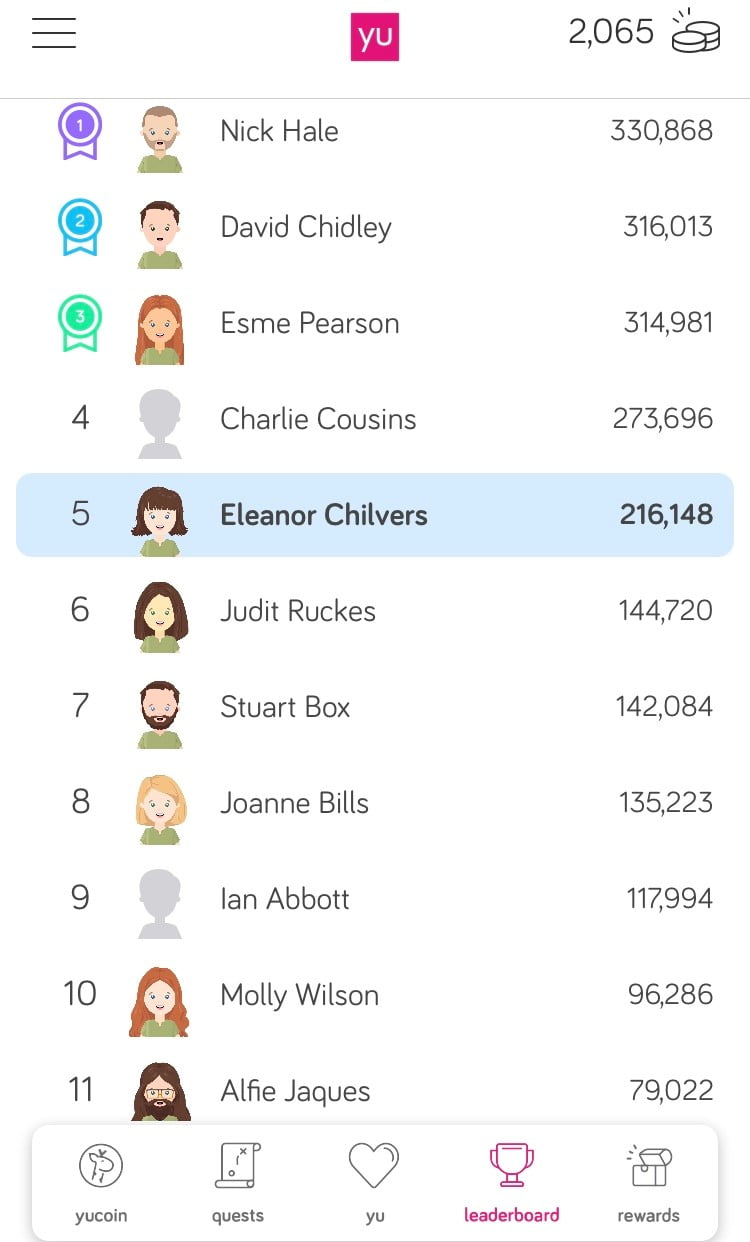
    Hooray were originally soaring ahead with Esme and Charlie sitting comfortably for most of the competition. However, there has been a surprising turn of events.

    YuLife Leader Board
    YuLife Leader Board

    Nick has quietly taken the lead, closely followed by Esme, and then with Dave – meaning the Engage UK team are strong contenders to lead this competition across the finish line! However, everything is still to play for – we have a feeling this week is going to be filled with lots of surprises.

    Although Charlie began with a confident effort, things appear to have taken a turn for the worse for the Hooray Director. Could Engage UK be taking home the winnings?


    What else to expect from February

    Alfie aside, we have all been impressed at how much everyone has really gotten into this Fitness February challenge and how much of a positive impact it has had on our team building here in the office. The fact each team member has improved over the course of the month just goes to show how these healthy fitness trends can lead to positive and optimistic attitudes.

    For the final week of February, I’m sure there will still be many more challenges that we as an office will have to face – this is 2022 after all, and the world does seem to continue to throw challenge after challenge at all of us.

    That is why taking part in these team building activities and events can be so important to the overall wellbeing of employees. The workplace is a great place for people to come together, feel connected, and have a sense of community. We believe the step challenge will provide benefits way beyond February!

    Let us know what you and your teams are doing for Fitness February, and any ideas for more competitions that we could take part in for the rest of the year.


    Contact us at Engage Health Group Ltd for FREE no-obligation advice and support, or call our team of experts on +44 (0)1273 974419.